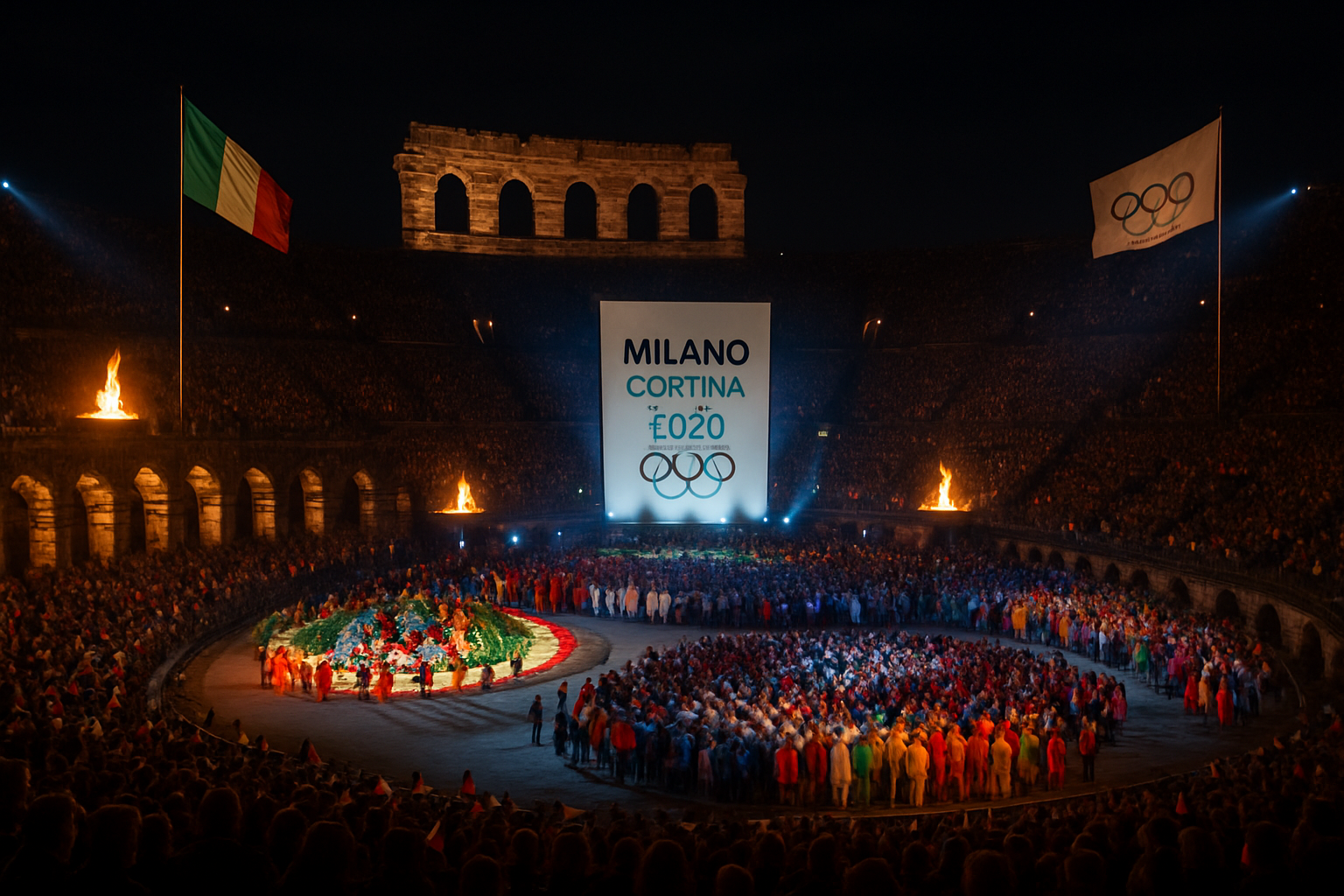
The 2026 Milano-Cortina Winter Olympics concluded on February 22 with an unprecedented closing ceremony held at the 2,000-year-old Arena di Verona, marking the end of the most geographically dispersed Winter Games in Olympic history with a spectacular celebration of Italian culture and global athletic achievement.
The historic "Beauty in Action" ceremony drew 1,500 athletes from 92 nations to the ancient Roman amphitheater, creating a stunning juxtaposition between Olympic modernity and classical architecture. For the first time in Winter Olympic history, a closing ceremony was held outside the host cities, with Verona's UNESCO World Heritage site providing a dramatic backdrop for the Games' conclusion.
Star-Studded Italian Showcase
The ceremony featured world-renowned Italian performers celebrating the nation's rich cultural heritage. Ballet legend Roberto Bolle delivered a mesmerizing aerial dance performance suspended above the arena floor, while jazz trumpeter Paolo Fresu provided a stirring musical accompaniment. Pop sensation Achille Lauro brought contemporary Italian music to the ancient venue, demonstrating the country's artistic evolution across centuries.
Italian Prime Minister Giorgia Meloni attended the ceremony alongside IOC President Kirsty Coventry, who declared: "Grazie per aver condiviso il vostro meglio" (Thank you for sharing your best) in tribute to the hosts' exceptional organization despite initial challenges.
"These Games have shown that the Olympic spirit transcends geographical boundaries and traditional hosting models. Milano-Cortina has written a new chapter in Olympic history."
— Kirsty Coventry, IOC President
Record-Breaking Norwegian Dominance
The ceremony celebrated Norway's historic achievement of setting new Winter Olympic records with 18 gold medals and 41 total medals, surpassing all previous benchmarks. Johannes Høsflot Klæbo emerged as the Games' greatest star, winning six gold medals in cross-country skiing at a single Olympics and becoming the most decorated Winter Olympian ever with 11 career golds.
Italy delivered exceptional results as hosts, securing nine gold medals and 26 total medals, including Lisa Vittozzi's historic first individual women's biathlon Olympic gold for the country. The performances demonstrated how the revolutionary dual-city hosting model successfully maintained competitive excellence while showcasing sustainable Olympic practices.
Revolutionary Hosting Success
Milano-Cortina 2026 proved that Olympic excellence could coexist with environmental responsibility and geographic innovation. The Games spanned over 400 kilometers across northern Italy, utilizing seven venues from Milan to Cortina d'Ampezzo, establishing a new paradigm for sustainable Olympic hosting.
The Games featured groundbreaking technological integration, including the first Olympic deployment of Alibaba's Qwen AI language model for broadcasting services and OMEGA's AI-powered figure skating analysis. These innovations enhanced the spectator experience while maintaining the authentic Olympic atmosphere.
Global Winter Sports Revolution
The ceremony celebrated unprecedented global participation, with breakthrough performances from six continents challenging traditional winter sports hierarchies. Australia achieved its most successful Winter Olympics ever, Brazil won its first winter gold through Lucas Pinheiro Braathen, and Kazakhstan's Mikhail Shaidorov delivered a stunning figure skating upset.
Historic debuts included Saudi Arabia's first Winter Olympic participation with alpine skier Fayik Abdi and cross-country skier Rakan Aliriza, while Caribbean nations Jamaica and Trinidad & Tobago competed in bobsleigh for the first time. These participations exemplified the Games' theme of democratizing winter sports beyond traditional geographical boundaries.
Olympic Flame Handover to France 2030
The ceremony's climax featured the symbolic handover of the Olympic flag to France, which will host the 2030 Winter Olympics in the French Alps. The dual Olympic flames that had burned throughout the Games in both Milan and Cortina were simultaneously extinguished, symbolically ending the most geographically dispersed Olympics while passing the torch to the next generation.
French representatives accepted the flag in a moment that highlighted the continuity of Olympic values and international cooperation, themes that defined Milano-Cortina 2026 despite global geopolitical tensions.
Cultural and Environmental Legacy
The Games successfully integrated authentic Italian culture with Olympic traditions, featuring bilingual place names in Alto Adige/South Tyrol to honor the German-speaking population, sustainable Olympic villages with greenhouse spaces, and the popular "Gen Z" mascots Milo and Tina that resonated with younger audiences worldwide.
Despite infrastructure challenges including incomplete cable cars and power outages, the Games demonstrated that sustainable hosting could maintain world-class competition standards. Europe's harshest winter in decades provided ideal natural snow conditions, reducing reliance on artificial snow production.
Overcoming Adversity
The closing ceremony also acknowledged the Games' resilience in face of challenges, from pro-Russian cyberattacks successfully countered by Italian security services to transportation difficulties across the vast venue network. The controversial exclusion of Ukrainian skeleton racer Vladyslav Heraskevych for wearing a memorial helmet honoring war victims sparked international debates about Olympic neutrality versus remembrance.
Protests in Verona hours before the ceremony, organized by groups opposing the Games' environmental and social impact, were managed without disrupting the celebration, demonstrating Italy's commitment to both Olympic values and democratic expression.
A New Olympic Paradigm
As the Arena di Verona's ancient stones witnessed Olympic history, Milano-Cortina 2026 established new precedents for future Games. The successful dual-city model proved that geographic distribution could enhance rather than hinder Olympic excellence, while environmental sustainability became integral rather than auxiliary to Olympic planning.
The Games featured 3,000 athletes competing in 116 medal events across 16 sports, including the Olympic debut of ski mountaineering. The competition demonstrated that winter sports excellence could transcend traditional geographic and cultural boundaries, with nations from all inhabited continents achieving podium success.
Looking Forward
The ceremony concluded with performers and athletes celebrating under the starlit Italian sky, their cheers echoing off the ancient amphitheater walls. This historic venue choice symbolized the Games' broader message: that Olympic values are timeless, capable of adapting to contemporary challenges while honoring both sporting tradition and cultural heritage.
As France prepares for 2030, Milano-Cortina 2026 leaves a legacy of innovation, sustainability, and global inclusivity. The Games proved that the Olympic movement could evolve to meet 21st-century realities while preserving the fundamental spirit of international competition and cooperation that has defined the Olympic ideal for over a century.
The extinguishing of the Olympic flames at Arena di Verona marked not just the end of 16 days of competition, but the beginning of a new chapter in Olympic history—one where environmental responsibility, technological innovation, and global accessibility define the path forward for the world's greatest sporting celebration.