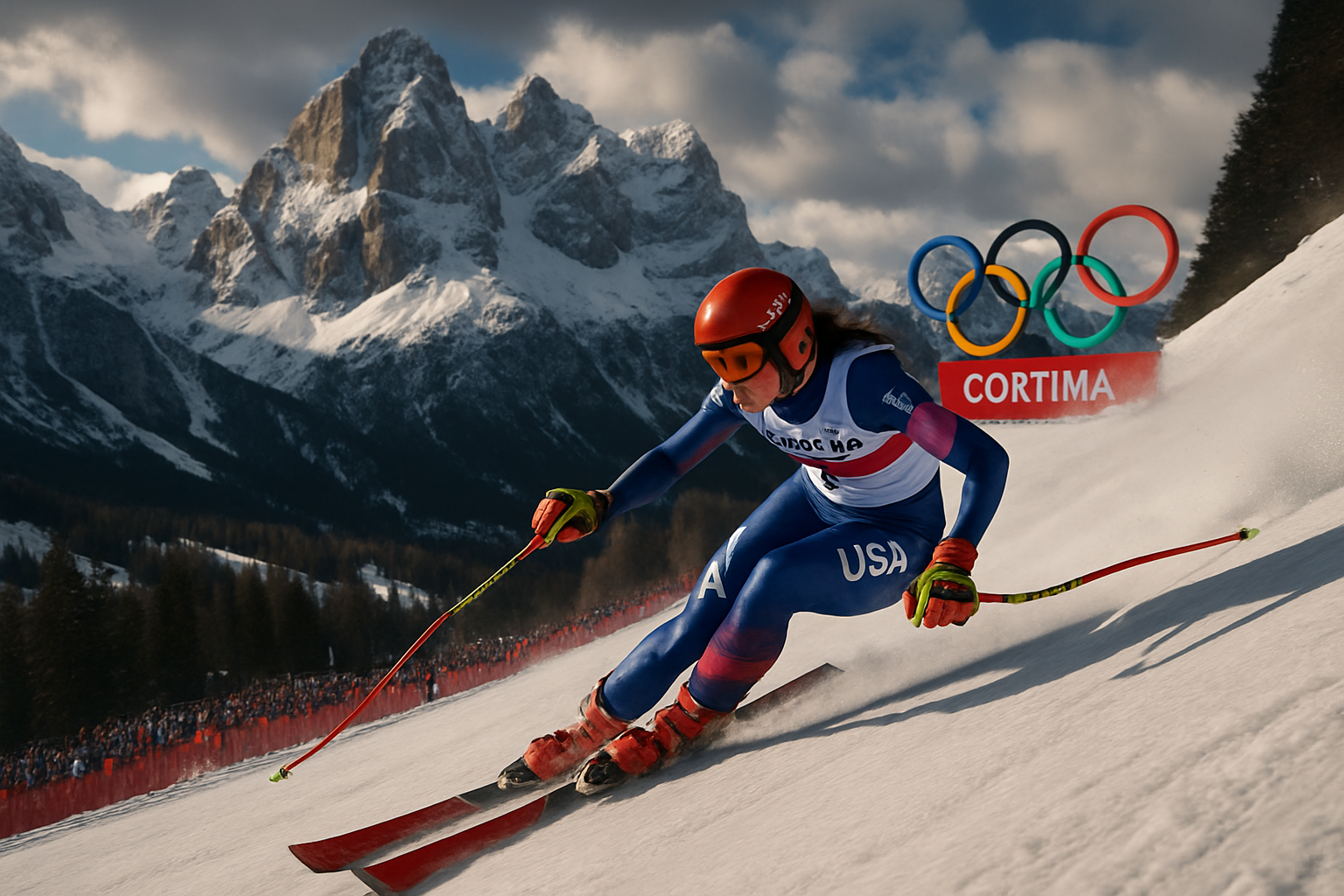
The second day of the Milano-Cortina 2026 Winter Olympics delivered high-stakes competition and emotional storylines as the women's downhill skiing event took center stage, with American legend Lindsey Vonn's unprecedented comeback attempt capturing global attention alongside fierce international competition across multiple disciplines.
Day two of the XXV Winter Games brought thrilling action across the geographically dispersed venues, with the women's alpine downhill serving as the marquee event. The competition showcased the remarkable depth of international winter sports talent while highlighting the ongoing challenges faced by the most dispersed Olympic Games in history.
Vonn's Extraordinary Comeback Dominates Headlines
The most compelling story of the day centered on 41-year-old Lindsey Vonn, who attempted to compete in the women's downhill just over a week after suffering a complete ACL rupture in her left knee during a crash at Crans-Montana, Switzerland on January 30. The American skiing legend's decision to race with such a severe injury on the dangerous Tofana course in Cortina represented one of the most extraordinary comeback attempts in Winter Olympics history.
Vonn, who already had a partial prosthesis in her right knee from previous injuries, declared at a February 3 press conference in Cortina d'Ampezzo that she would compete regardless of the risk, stating "I have already won, whatever happens on Sunday." Her remarkable determination to race after seven years of retirement, having achieved seven podium finishes in the World Cup this season before her injury, embodied the Olympic spirit of transcending physical limitations.
International Competition Intensifies
While Vonn's story captured headlines, fierce competition emerged from athletes representing nations across the globe. German skiers Emma Aicher and her teammate positioned themselves as strong medal contenders, racing "in the shadow of Lindsey Vonn" but demonstrating their own championship-caliber performances on the challenging alpine course.
The women's downhill event highlighted the technical mastery required to navigate the steep Cortina slopes, with athletes reaching speeds exceeding 100 kilometers per hour while maintaining precision through demanding technical sections. The race showcased the evolution of women's alpine skiing, where the performance gap between nations has narrowed significantly.
Broader Olympic Competition
Beyond alpine skiing, day two featured compelling action across multiple disciplines. Cross-country skiing events, including the skiathlon discipline, saw athletes like Bulgaria's Daniel Peshkov and Mario Matikanov making their Olympic debuts. The 15-kilometer race combining classical and freestyle techniques demonstrated the endurance and versatility required in Nordic skiing.
Biathlon competition continued with the mixed relay event, while snowboard athletes competed in parallel giant slalom qualifications. Bulgarian snowboarders including Radoslav Yankov, Tervel Zamfirov, Aleksandar Krashnyak, and Malena Zamfirova participated in the morning qualifications, with the top 16 advancing to elimination finals scheduled for later in the day.
The evening brought attention to luge competition, where athletes prepared for medal events on one of the sport's most technically demanding tracks. These events collectively demonstrated the breadth and diversity of winter sports excellence on display at Milano-Cortina 2026.
Venue Challenges and Triumphs
The competition unfolded against the backdrop of the Games' unprecedented geographic dispersion across seven venues spanning over 400 kilometers from Milan to Cortina d'Ampezzo. While this distribution initially posed logistical challenges, organizers successfully coordinated transportation and timing to enable seamless competition flow.
Infrastructure concerns that had plagued earlier preparations, including the incomplete Apollonio-Socrepes cable car system, were managed through alternative transport solutions. The venues themselves provided spectacular backdrops, with the Dolomites offering dramatic mountain vistas that enhanced the visual appeal of alpine events for global television audiences.
Technology and Innovation
Day two showcased several technological innovations pioneered at these Games. The integration of Alibaba Cloud's Qwen AI system continued to provide enhanced broadcasting capabilities and spectator experiences, marking the first use of Olympic-specific LLM technology. OMEGA's AI-powered analysis systems offered viewers unprecedented insights into athlete performance and technique.
These technological advances complemented traditional Olympic coverage while creating new ways for global audiences to engage with winter sports competition. The innovations represented a significant step forward in Olympic broadcasting and fan engagement.
Cultural and Environmental Context
The competitions took place during Europe's harshest winter in decades, with temperatures reaching minus-30 degrees Celsius. These extreme conditions, while challenging for athletes and spectators, provided ideal natural snow conditions that reduced reliance on artificial snow production—a key environmental concern addressed throughout the Games.
The cultural innovations of Milano-Cortina 2026, including bilingual place names in the German-speaking Alto Adige/South Tyrol region and the "Gen Z" mascots Milo and Tina, continued to resonate with diverse audiences. These elements reinforced the Games' commitment to cultural inclusion and modern Olympic values.
Looking Ahead
As competition progresses through the remaining days of Milano-Cortina 2026, day two established several key narratives that will define these Olympics. Lindsey Vonn's courage in the face of injury exemplified the determination that makes Olympic competition extraordinary. The strong performances from athletes representing nations across six continents demonstrated the global growth of winter sports.
The successful management of logistical challenges across the dispersed venues proved the viability of the sustainability-focused hosting model. Most importantly, the day showcased the pure athletic excellence and international cooperation that remain at the heart of the Olympic movement, even amid the various challenges that have marked these Games.
With 13 days of competition remaining, Milano-Cortina 2026 continues to deliver compelling storylines, remarkable athletic achievements, and demonstrations of human resilience that will resonate long after the Olympic flame is extinguished. Day two set the stage for what promises to be an unforgettable celebration of winter sports excellence and international unity.