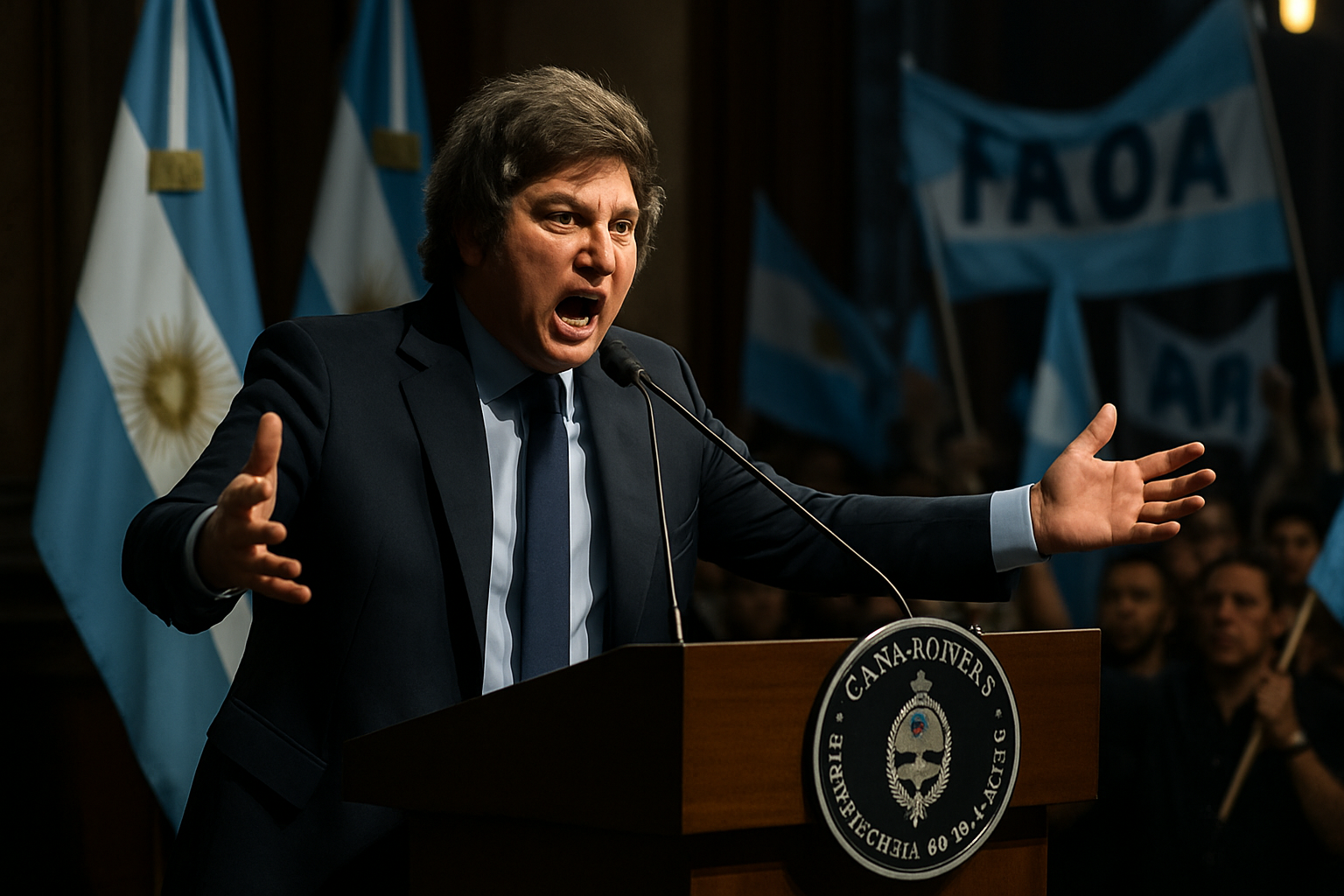
President Javier Milei finds himself at the most critical juncture of his presidency as he prepares to embark on a nationwide "Tour de la Gratitud" (Tour of Gratitude), facing unprecedented political opposition while pushing through controversial economic reforms that have fundamentally reshaped Argentina's political landscape.
The libertarian president is scheduled to visit Tucumán province on March 19, following his official trip to New York, in what his administration describes as an effort to thank voters and lawmakers who supported his historic labor reform legislation. However, the tour comes amid escalating tensions with opposition forces and internal party disputes that threaten to undermine his reform agenda.
Congressional Warfare and Legislative Drama
The political atmosphere in Buenos Aires has reached a fever pitch following a series of dramatic parliamentary confrontations. La Libertad Avanza (LLA) deputies have filed a legislative project demanding criminal charges against Unión por la Patria legislator Florencia Carignano, who created one of the most controversial moments in recent congressional history by unplugging microphones during a heated session.
The incident, which the libertarian bloc characterized as "illegal acts of sabotage," exemplifies the increasingly confrontational tone of Argentine politics under Milei's administration. The move to potentially expel Carignano and pursue criminal charges represents an escalation in parliamentary warfare that has characterized the president's relationship with traditional opposition forces.
"The actions we witnessed represent an unprecedented attack on democratic institutions and the legislative process," declared a spokesperson for La Libertad Avanza.
— LLA Parliamentary Bloc
The Greatest Battle of Milei's Presidency
Political analysts are describing the current moment as "the mother of all battles" for the Milei administration. The president faces what experts characterize as the most significant challenge of his tenure - managing the complex aftermath of his aggressive economic restructuring while maintaining political viability for potential reelection.
The consequences of Milei's "strong reformatting of the productive scheme" are beginning to manifest through growing social conflicts, particularly following dramatic price reductions in traditionally protected industrial products. This has created a paradoxical situation where the administration's anti-inflation policies have succeeded in certain sectors while simultaneously triggering industrial disruption and unemployment.
The closure of the iconic Fate tire manufacturing plant, eliminating 920 jobs, has become symbolic of the broader industrial crisis. The company cited "commercial liberalization and Chinese import competition" as primary factors, highlighting the real-world consequences of Milei's trade opening policies.
Economic Indicators Paint Complex Picture
Argentina's economic data reveals the complexity of Milei's transformation strategy. While economists project annual inflation of 22.4% for 2026 - more than double the government's optimistic 10.1% forecast - other indicators show mixed results. The country has lost 21,938 companies under Milei's administration, affecting 290,602 workers, according to data from the Superintendency of Labor Risks.
However, the administration has achieved notable successes, including currency stability with the official dollar maintaining relatively steady levels and successful negotiations with the International Monetary Fund, which has prepared a $1 billion disbursement despite Argentina's failure to accumulate reserves in 2025.
Labor Reform Victory Comes at High Cost
Milei's historic labor reform legislation, which introduced the controversial "bank of hours" overtime system and modified severance structures, passed through both chambers of Congress after intense political maneuvering by Interior Minister Patricia Bullrich. The minister successfully modified over 30 articles to secure support from the Radical Civic Union (UCR) and dialoguist opposition blocs.
The legislative victory, however, came at an extraordinary political and social cost. The General Confederation of Labor (CGT) organized four general strikes, including the most violent protests in recent Argentine history, featuring Molotov cocktails thrown at federal police outside the National Congress, resulting in over 50 arrests and 270 million pesos in property damage.
The most recent strike achieved complete nationwide paralysis, with transportation systems, banking services, and essential sectors joining the 24-hour work stoppage. Economic analysts calculated the strike's cost at $489 million, equivalent to 0.8% of February's GDP.
Opposition Consolidation and 2027 Positioning
Buenos Aires Governor Axel Kicillof has emerged as the de facto leader of the Peronist opposition, successfully consolidating control over the Buenos Aires Peronist party while positioning himself for a potential 2027 presidential campaign. Kicillof's strategy includes personally joining labor protests and coordinating resistance with six provincial governors who oppose Milei's reforms.
The governor's consolidation represents a significant challenge for Milei's reelection prospects, as Buenos Aires province controls Argentina's largest electoral machinery and symbolizes the heart of Peronist political organization.
International Partnerships and Strategic Positioning
Despite domestic turmoil, Milei has successfully positioned Argentina as a key strategic partner of the Trump administration through the historic US-Argentina trade agreement. The bilateral deal eliminates over 1,600 US tariffs on Argentine goods and 220 Argentine levies on US products, with potential agricultural export benefits estimated at $800 million annually.
The agreement includes strategic cooperation on lithium extraction, Port of Rosario expansion, and critical minerals partnership - positioning Argentina as an alternative to Chinese dominance in global supply chains.
Professional Sector Backlash
The Tucumán Bar Association has issued a strong repudiation of President Milei's comments about the "lawsuit industry," defending the constitutional role of legal professionals in democratic society. This represents growing professional sector resistance to the president's confrontational rhetoric toward traditional institutions.
The legal profession's response illustrates how Milei's aggressive communication style has created new political enemies beyond traditional union and opposition party structures.
The Path Forward: Reelection or Reversal?
Political commentator Marcelo Longobardi has declared that Milei has "reelection almost assured" for 2027, citing a weakened opposition and favorable global climate of popular anger. However, this assessment may prove premature given the mounting social tensions and economic disruptions.
The success of Milei's "Tour of Gratitude" will serve as a crucial barometer for measuring his political resilience. The tour represents an attempt to rebuild direct connection with supporters while bypassing traditional media and political intermediaries that have proven hostile to his agenda.
"Although today he may not have strong competitors, it will not be easy for Milei to achieve reelection if he fails to demonstrate that a productive country emerges from the rubble of traditional industry that is collapsing."
— Political Analysis, La Nación
Democratic Institutions Under Pressure
The current political crisis represents a fundamental test of Argentina's democratic institutions. The combination of violent street protests, parliamentary confrontations, and industrial disruption creates unprecedented challenges for maintaining institutional legitimacy while implementing comprehensive economic transformation.
International observers are closely monitoring Argentina's experience as a potential template for democratic management of structural reforms. The outcome will influence similar efforts throughout Latin America, where governments face comparable challenges balancing economic modernization with social stability.
As Milei prepares for his gratitude tour, he confronts the paradox of his presidency: achieving significant legislative victories while facing the most sustained social opposition since Argentina's return to democracy. The coming months will determine whether his radical economic experiment can survive the political turbulence it has unleashed, or whether the forces of traditional Argentine politics will ultimately prevail in reversing his transformative agenda.