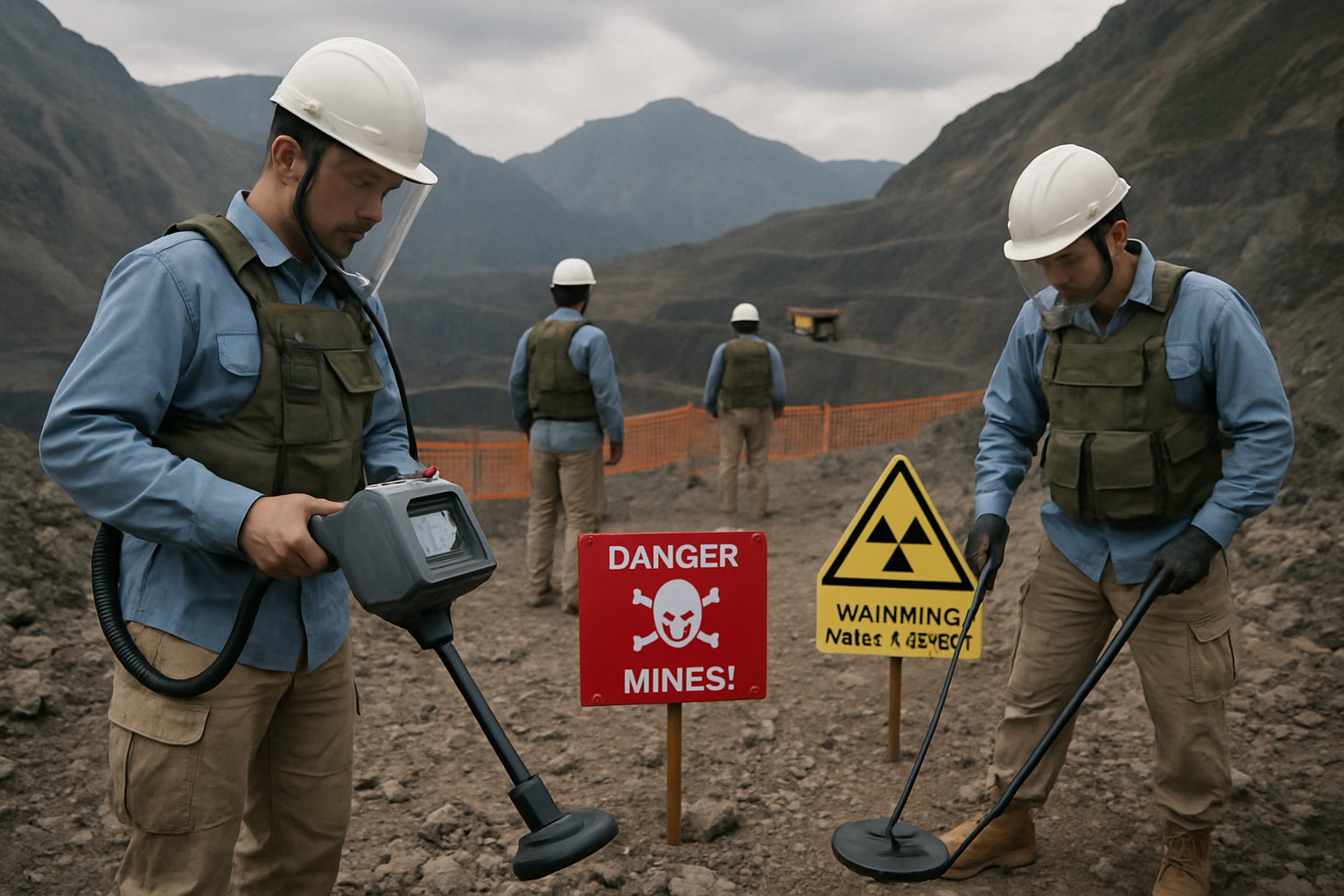
Two critical safety developments in the global mining and resource sector have emerged this week, highlighting the urgent need for enhanced safety protocols and international cooperation. Afghanistan's UN Special Rapporteur has called for increased mine clearance funding, while the Democratic Republic of Congo has issued a health alert over radiation risks at a major copper mining facility.
Afghanistan: Urgent Call for Mine Clearance Funding
UN Special Rapporteur on human rights in Afghanistan Richard Bennett has issued an urgent appeal for increased international funding for mine clearance and unexploded ordnance removal, warning that Afghanistan remains one of the world's most heavily contaminated countries. The appeal coincides with April 4, International Day for Mine Awareness and Assistance in Mine Action, underscoring the critical humanitarian nature of the situation.
Bennett's warning comes at a particularly challenging time for Afghanistan, as the country faces what UN describes as the worst humanitarian crisis in 25 years. With 88% of female-headed households unable to meet minimum living requirements under current Taliban restrictions, the presence of mines and unexploded ordnance further compounds the challenges facing vulnerable communities.
"Afghanistan remains one of the world's most heavily contaminated countries with landmines and unexploded ordnance."
— Richard Bennett, UN Special Rapporteur
The mine contamination issue severely affects rural communities, limiting agricultural productivity and freedom of movement at a time when basic survival is already at stake. This creates a cascading effect on the economy, as Afghanistan's agricultural sector remains crucial for food security and economic stability.
Congo Radiation Alert at Kamoto Copper Company
In a separate but equally concerning development, the Congolese government launched an urgent health alert during the Council of Ministers meeting on March 27, warning of radioactive contamination risks at the Kamoto Copper Company (KCC) mining site in Kolwezi, Lualaba Province. The T17 backfill zone has been placed under enhanced surveillance to prevent mass contamination.
The alert represents a significant escalation in safety concerns at one of the Democratic Republic of Congo's major copper production facilities. KCC operates in the heart of the DRC's copper belt, a region critical to global supply chains for electric vehicle batteries and renewable energy infrastructure.
This radiation warning follows a pattern of safety challenges across the DRC's mining sector. Earlier in 2026, the tragic Rubaya coltan mine disasters claimed over 500 lives across multiple incidents, highlighting systemic safety failures in the country's artisanal and industrial mining operations.
Global Mining Safety Context
These safety alerts emerge against the backdrop of Africa's unprecedented mining investment boom, with the African Finance Corporation reporting $29.5 trillion in mineral reserves (20% of the global total), of which $8.6 trillion remains untapped. Recent major investments include Ivory Coast's $1.2 billion gold projects and South Africa's R325 million Zandkopsdrift rare earth commitment.
The safety challenges come as seven African countries—Angola, DRC, Guinea, Kenya, Morocco, Sierra Leone, and Zambia—participate in the US-EU-Japan Critical Minerals Partnership, aimed at challenging China's dominance in mineral production and refining. This geopolitical shift toward supply chain diversification makes safety standards increasingly crucial for international investment decisions.
Environmental and Regulatory Enforcement Evolution
The mining industry is experiencing a transformation in environmental governance standards. Earlier this year, Congo's Environment Minister Marie Nyange ordered the immediate suspension of Congo Dongfang Mining operations in Lubumbashi following catastrophic acid water overflow that contaminated local water systems.
Modern mining projects increasingly incorporate Environmental, Social, and Governance (ESG) compliance as prerequisites for international investment. This includes advanced waste management systems, digital monitoring capabilities, renewable energy integration, and comprehensive community engagement protocols.
International Cooperation and Security Challenges
The Afghanistan mine clearance funding appeal highlights the complex intersection of humanitarian needs and security challenges. Despite political tensions surrounding Taliban governance, humanitarian organizations continue to advocate for mine clearance as a basic human safety requirement that transcends political considerations.
Meanwhile, the Congo radiation alert demonstrates how safety challenges can affect global supply chains. The Kolwezi region's copper production is essential for the global transition to renewable energy, making safety protocols not just a local concern but a matter of international economic security.
Technology and Safety Innovation
The mining industry is increasingly adopting advanced technologies to address safety challenges. These include automated monitoring systems for radiation detection, smart sensors for early warning systems, and AI-powered risk assessment tools. However, implementation often lags in regions with limited infrastructure or resources.
In Afghanistan's case, mine clearance operations require sophisticated detection equipment and extensive training programs. The international community's response to Bennett's funding appeal will determine whether these life-saving technologies can be deployed effectively in contaminated areas.
Economic and Humanitarian Impact
The economic implications of these safety challenges extend beyond immediate operational concerns. In Afghanistan, mine contamination prevents agricultural development and limits access to natural resources that could support economic recovery. For Congo, radiation risks at major mining facilities could affect the country's position in global copper markets and its participation in the Critical Minerals Partnership.
Both situations demonstrate how safety failures create cascading effects that impact not only worker welfare but also community development, international trade relationships, and global supply chain stability.
Regional Security and Stability
The mining safety crisis also has broader implications for regional security. In Afghanistan, mine contamination contributes to displacement and limits livelihood opportunities, potentially exacerbating humanitarian challenges. In Congo, industrial safety failures at major facilities can undermine confidence in the country's regulatory framework and affect long-term investment planning.
These developments occur as the broader African mining sector seeks to balance rapid development with enhanced safety standards. The success of this balance will likely influence mining development patterns across the continent for decades to come.
Future Implications and International Response
The convergence of these safety challenges in April 2026 represents a critical test for international cooperation mechanisms in addressing mining-related humanitarian and environmental risks. The response to Richard Bennett's funding appeal for Afghanistan mine clearance will signal the international community's commitment to humanitarian mine action despite political complexities.
Similarly, how the international mining community responds to Congo's radiation alert will establish precedents for safety oversight in strategic mineral extraction operations. These responses will likely influence safety standards and international cooperation frameworks throughout the global mining sector.
As the world increasingly depends on critical minerals for renewable energy infrastructure and technology manufacturing, ensuring the safety of extraction operations becomes not just a humanitarian imperative but a strategic necessity for global economic stability and environmental sustainability.