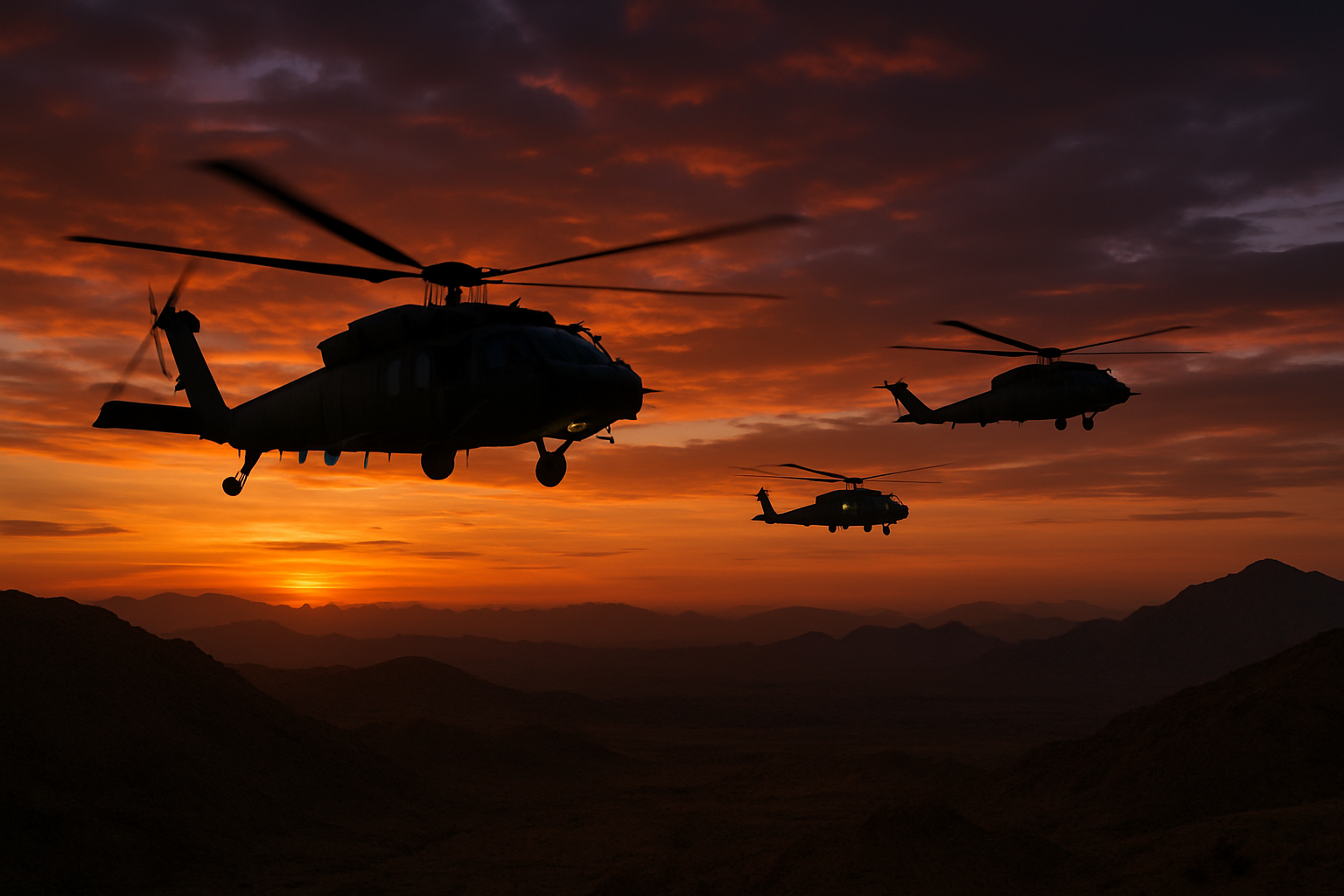
As time passes, the prospect of reaching the second airman from the US F-15 fighter jet shot down on Friday before the Iranians grows slimmer and slimmer, creating a high-stakes race between elite American rescue units and Iran's Revolutionary Guard forces across hostile terrain.
The dramatic search for the missing US pilot represents the human dimension of what has become the most dangerous international crisis since the Cold War's end. With Iranian forces conducting "comprehensive field operations" and offering substantial rewards for the airman's capture, American special operations forces are operating deep in contested territory in what sources describe as an increasingly desperate mission.
Critical 48-Hour Window
The F-15E Strike Eagle was shot down Friday during Operation Epic Fury, the largest US-Israeli military campaign since 2003. While one crew member was successfully rescued by a US Air Force Black Hawk helicopter, the second pilot - reportedly the weapons systems officer - remains missing in southwestern Iran, according to multiple international sources.
Swedish military analysts report that pilots are trained in survival techniques, but note that the United States has conducted few rescue operations of this type in recent decades. The challenging terrain and hostile environment significantly complicate extraction efforts, with Iranian Revolutionary Guards and local armed nomadic groups actively searching the same area.
"This represents a very large trophy for Iran from both strategic intelligence and propaganda value perspectives,"
— Laurel Rapp, Defense Analyst
Iranian media has broadcast offers of substantial rewards - reportedly up to 57,000 euros according to some sources - for information leading to the pilot's capture, while simultaneously conducting systematic ground searches with military units.
Broader Context of the Crisis
The missing pilot crisis unfolds against the backdrop of an escalating conflict that began with the collapse of promising nuclear negotiations in Geneva. Despite achieving what Iranian Foreign Minister Abbas Araghchi called "broad agreement on guiding principles" - the most significant diplomatic progress since the JCPOA collapse in 2018 - fundamental disagreements over scope proved insurmountable.
Iran had excluded ballistic missiles and regional proxies as "red lines" from nuclear-only talks, while the US insisted on comprehensive agreements including missiles, armed groups, and human rights issues. This structural deadlock, unchanged for over a decade, ultimately led to the military confrontation now endangering American personnel.
The current crisis reached a critical juncture following the death of Iran's Supreme Leader Ali Khamenei on March 1, 2026. His son Mojtaba Khamenei assumed power in the first hereditary succession in the Islamic Republic's 47-year history, consolidating Revolutionary Guards control during active warfare - an unprecedented shift from traditional clerical governance.
Operation Epic Fury Escalation
The F-15E shootdown marks the first confirmed US aircraft loss to Iranian forces during the six-week conflict, representing a major symbolic and tactical victory for Iran against American air superiority. The incident occurred during operations that have cost over $11.3 billion in the first week alone, with Pentagon planning extending through September - far beyond the initially projected 4-6 week timeline.
Iran's "Operation True Promise 4" retaliation campaign has systematically targeted US and allied assets across the region, declaring that "no red lines remain." The conflict has expanded beyond traditional Middle Eastern boundaries, with Iranian drones striking RAF Akrotiri in Cyprus - marking the first European territory attack since World War II.
This unprecedented escalation prompted the largest European military mobilization in the Eastern Mediterranean since 1974, with France, Greece, Britain, Italy, Spain, and the Netherlands deploying naval assets in a coordinated response.
Global Implications
The search for the missing American pilot occurs amid a broader global crisis that has cancelled over 18,000 flights worldwide - the most severe disruption since COVID-19. Oil prices have surged past $100 per barrel, heading toward $200, as Iran has effectively closed the Strait of Hormuz through naval mining, affecting 40% of global oil transit.
The International Energy Agency has authorized the largest strategic petroleum reserve release in 50-year history - 400 million barrels from 32 countries - in an attempt to stabilize energy markets. Natural gas prices have increased 24% in Europe and 78% in the United States, creating worldwide economic disruption.
Congressional pressure is mounting, with Senator Blumenthal expressing being "more concerned than ever" about potential ground troop deployment. The conflict maintains historically low 25% public support, with bipartisan lawmakers demanding answers about strategy and costs.
Nuclear Governance Crisis
The military confrontation emerged from the complete breakdown of nuclear diplomacy, despite the February 2026 Geneva framework breakthrough. Iran continues 60% uranium enrichment with over 400 kilograms of weapons-grade material - sufficient for multiple weapons if weaponized - approaching the 90% threshold.
The crisis unfolds amid broader nuclear governance breakdown, with the New START treaty having expired on February 5, 2026 - marking the first time in over 50 years without US-Russia nuclear constraints. UN Secretary-General António Guterres has warned that nuclear risks are at their "highest in decades."
Search Operations Under Fire
Multiple sources report that US helicopters conducting search operations have come under fire from Iranian forces, with at least one Black Hawk helicopter sustaining damage and crew members wounded during rescue attempts. The hostile environment has forced American forces to operate with extreme caution while racing against time.
Iranian Revolutionary Guards are reportedly using the search operations as an opportunity to gather intelligence on US special operations capabilities and tactics. European intelligence sources suggest Iran has deliberately released ejection seat footage to disrupt American rescue coordination.
The challenging terrain includes mountainous regions, desert areas, and territories controlled by various armed groups, some of whom have historical grievances against American forces. The pilot's survival depends not only on evading capture but also on navigating an environment where multiple hostile actors are actively hunting for the same target.
Template-Setting Moment
UN Secretary-General Guterres has characterized the current crisis as the "greatest test of multilateral cooperation in the modern era." The outcome of both the search operations and the broader conflict will establish precedents for 21st-century international relations, determining whether diplomatic solutions can prevail over military confrontation in an increasingly multipolar world.
The stakes extend far beyond the immediate rescue mission. Success in containing the escalation could provide a framework for future nuclear crisis resolution, while failure may accelerate military solutions for decades to come, encouraging proliferation globally and undermining diplomatic credibility worldwide.
As elite American forces continue their dangerous mission to locate and extract the missing pilot, the world watches a crisis that represents not just a race against time in hostile territory, but a defining moment for international order in the 21st century. The pilot's fate has become symbolic of broader questions about whether diplomacy or military force will shape global governance for generations to come.