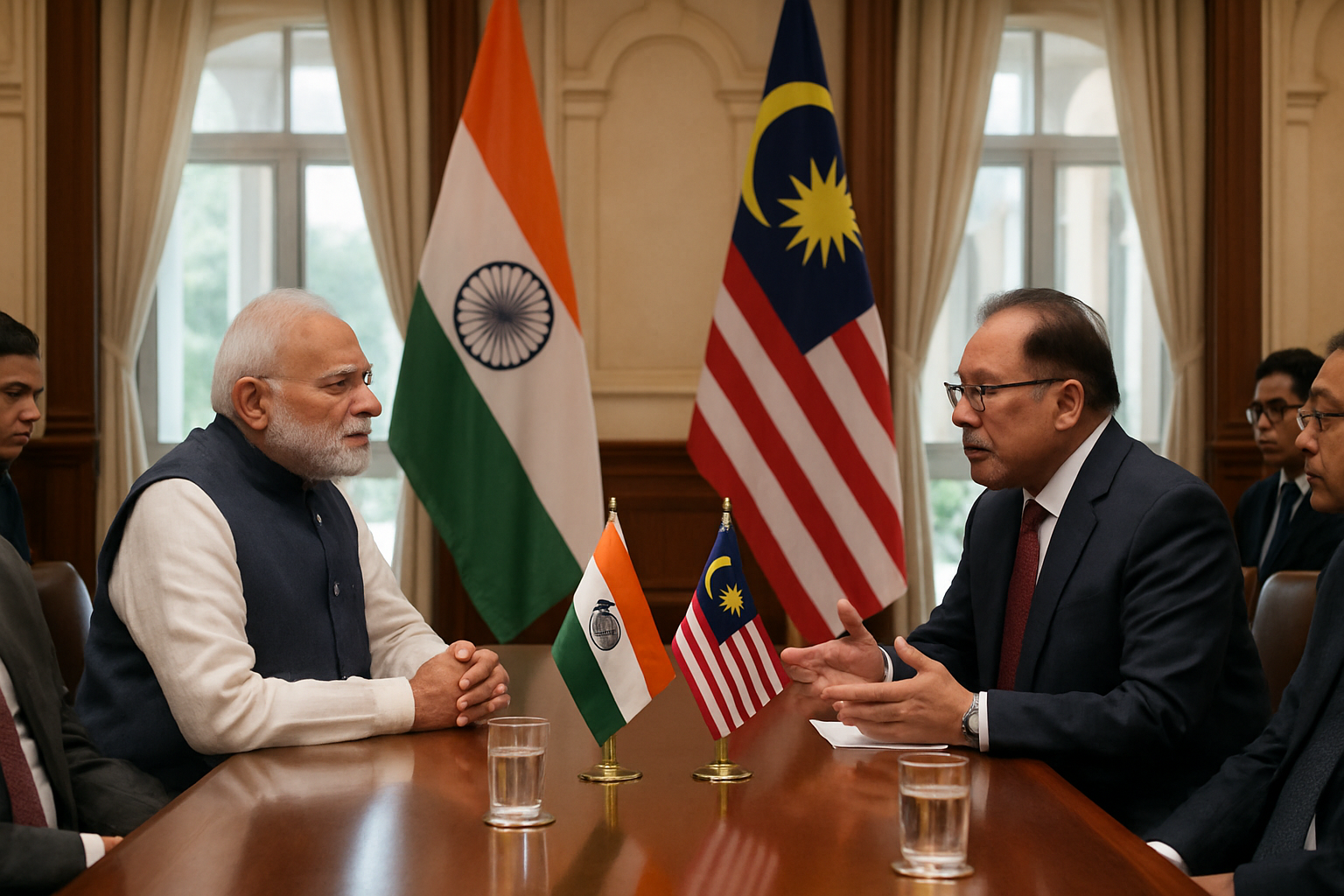
Indian Prime Minister Narendra Modi concluded a significant two-day official visit to Malaysia on February 8, 2026, strengthening the comprehensive strategic partnership between the two nations with Prime Minister Anwar Ibrahim, marking a historic milestone in India-Malaysia relations that both leaders declared had reached "new heights."
Speaking at a joint press conference in Putrajaya, Modi described Malaysia as a "trusted partner" and emphasized that bilateral relations are "scaling new heights each year." The visit, which reciprocated Anwar Ibrahim's official visit to India in August 2024, resulted in multiple agreements spanning trade facilitation, security cooperation, and financial innovation.
Major Economic Breakthrough in Currency Cooperation
The most significant economic development emerged from Malaysia and India's agreement to expedite the use of the Malaysian ringgit and Indian rupee in bilateral trade and investment. Anwar Ibrahim announced that Bank Negara Malaysia and India's central bank will work closely to promote local currency settlement, aimed at facilitating more efficient and cost-effective transactions.
"Similarly, (the use of local currency) in the digital connectivity, energy and semiconductor," Anwar stated during the joint press conference, indicating the broad scope of the currency cooperation initiative that could reshape bilateral trade dynamics.
The move represents a strategic shift away from dollar-dependent transactions, potentially saving both nations significant foreign exchange costs while strengthening economic sovereignty. Financial experts view this as part of a broader trend toward regional currency arrangements that could influence Southeast Asian economic integration.
Security and Intelligence Cooperation Enhanced
Modi announced that India and Malaysia have agreed to strengthen cooperation in counter-terrorism, intelligence sharing, and maritime security. This enhancement comes amid growing regional security challenges and represents a deepening of the strategic dimensions of bilateral relations.
"We will strengthen cooperation in counter-terrorism, intelligence sharing and maritime security," Modi declared, highlighting the importance of collaborative security frameworks in addressing contemporary threats in the Indo-Pacific region.
The security cooperation agreements build upon existing frameworks while expanding the scope of intelligence sharing and joint operational capabilities, particularly relevant given both nations' strategic positions in crucial maritime corridors.
Ceremonial Welcome and Diplomatic Protocol
Modi received a ceremonial welcome and Guard of Honour at Perdana Putra in Malaysia, underlining the significance both nations place on the bilateral relationship. The formal reception included traditional Malaysian cultural performances and represented the highest level of diplomatic protocol.
Following the ceremonial welcome, both leaders proceeded to hold wide-ranging bilateral discussions at the Seri Perdana Complex, where they were joined by senior ministers from both governments including Malaysia's Transport Minister Anthony Loke, Foreign Minister Mohamad Hasan, Digital Minister Gobind Singh Deo, and Economy Minister Akmal Nasrullah Mohd Nasir.
Comprehensive Strategic Partnership Advancement
Anwar Ibrahim described India as "a great and friendly nation" during delegation meetings, emphasizing the close cultural ties and growing geopolitical importance of the bilateral relationship. The Malaysian Prime Minister expressed hope for greater collaboration across all sectors.
"We have discussed privately some of the issues of concern, which I think need to be elaborated by our team. But the principle is important, that we consider India as a great, friendly nation of ours, close to Malaysia, culturally and, of course, now geopolitically," Anwar stated.
The discussions covered multiple cooperation agreements in healthcare, national security, and labor, with both sides witnessing the signing of several memorandums of understanding that will form the foundation for expanded collaboration in coming years.
Regional and International Context
The visit occurs within the broader context of evolving Indo-Pacific dynamics and India's expanding engagement with Southeast Asian partners. Malaysia's strategic position in ASEAN and India's growing influence in regional affairs create opportunities for enhanced cooperation on multilateral initiatives.
Both nations emphasized their commitment to maintaining regional stability and promoting inclusive growth through enhanced trade and investment flows. The agreements signed during Modi's visit are expected to contribute significantly to the bilateral trade target of expanding commercial relationships across traditional and emerging sectors.
Historical Significance and Future Prospects
The February 2026 visit represents a continuation of the momentum built during Anwar Ibrahim's August 2024 India visit, demonstrating sustained high-level political commitment to the bilateral relationship. Historical context shows India-Malaysia relations have consistently strengthened over recent years, with both nations recognizing their complementary economic strengths and shared strategic interests.
Anwar described the visit as holding "significant personal importance" and anticipated greater cooperation with India following the productive discussions. The Malaysian Prime Minister's emphasis on both cultural and geopolitical dimensions reflects the multi-layered nature of contemporary India-Malaysia relations.
The agreements reached during Modi's visit are expected to be implemented through regular consultation mechanisms and monitoring frameworks, ensuring sustained progress on the ambitious agenda set forth by both leaders. The success of these initiatives could serve as a model for enhanced India-ASEAN cooperation and broader regional integration efforts.
As both nations face evolving global challenges, from economic uncertainties to security threats, the strengthened partnership provides a foundation for addressing shared concerns while maximizing opportunities for mutual benefit through expanded cooperation across all sectors of engagement.