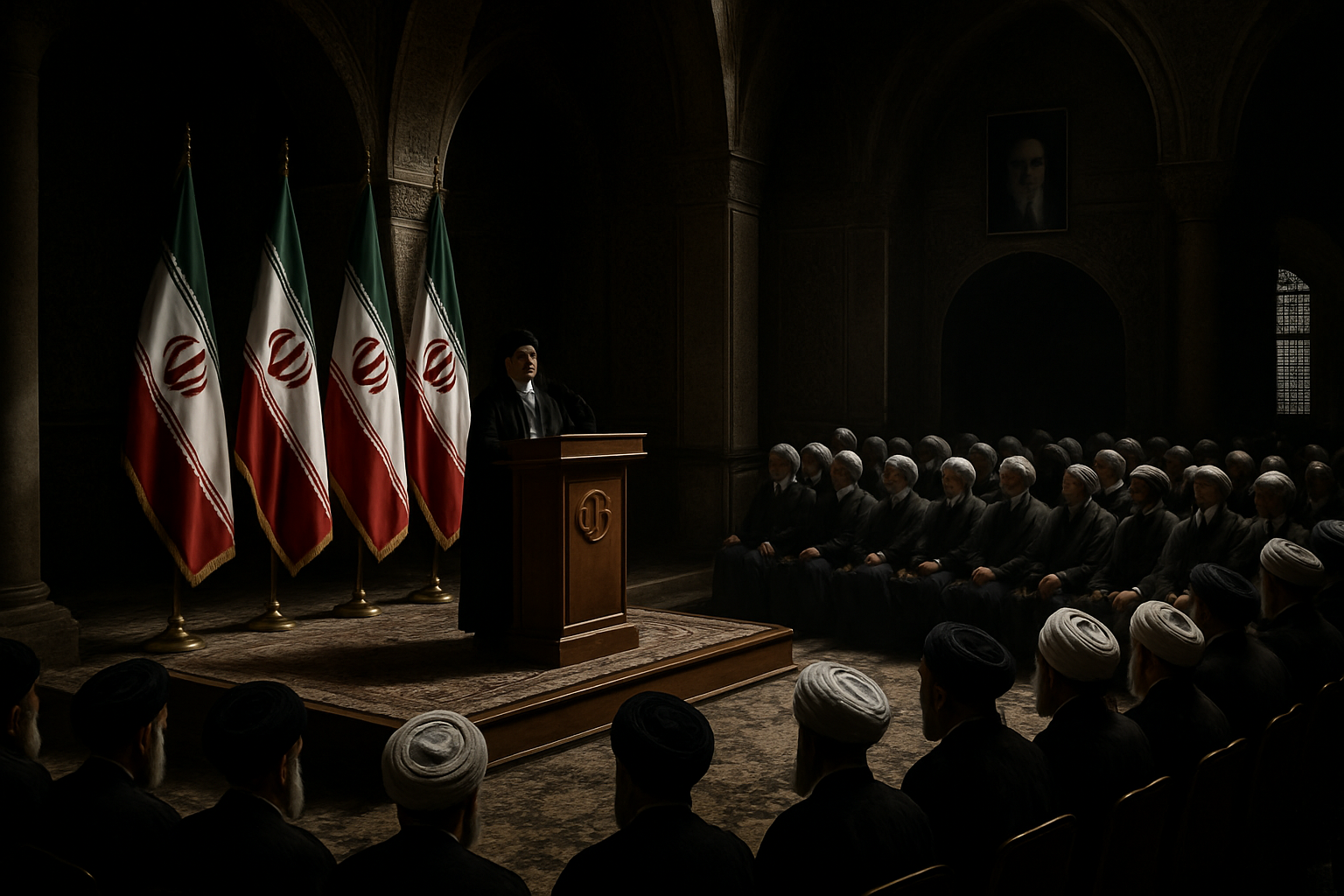
Mojtaba Khamenei, the 56-year-old son of Iran's late Supreme Leader Ali Khamenei, has reportedly emerged as the leading candidate to assume the Islamic Republic's highest office following his father's confirmed death in US-Israeli Operation Epic Fury strikes on March 1, 2026.
Multiple international sources, including The New York Times and Persian television channels, cite anonymous officials indicating that the Assembly of Experts has moved toward selecting Mojtaba Khamenei as Iran's new Supreme Leader. The selection comes during the most dangerous Middle East crisis since the Cold War, as Iran grapples with succession while managing massive retaliation operations against US and Israeli targets.
Historic Leadership Transition
The selection of Mojtaba Khamenei would mark an unprecedented dynastic succession within the Islamic Republic's theocratic system. Unlike his father's rise through clerical ranks following Ayatollah Khomeini's death in 1989, the younger Khamenei has built his career primarily through military and security apparatus connections, earning him the nickname "the invisible soldier."
According to CIA assessments referenced in previous intelligence reports, a Revolutionary Guards member was considered likely to succeed the elder Khamenei. Mojtaba's extensive IRGC background and role in helping his father control Iran's military apparatus since the mid-2000s positions him as the embodiment of this hardline military influence.
The Man Behind the Succession
Mojtaba Khamenei has deliberately operated in the shadows throughout his political career, avoiding public appearances while wielding significant influence behind the scenes. Intelligence sources suggest he played a crucial role in managing Iran's proxy network across the Middle East and overseeing the regime's response to domestic protests since 2022.
His selection signals continuity with his father's hardline policies and increased military influence in Iran's governance structure. Unlike potential civilian alternatives, Mojtaba's background suggests no softening of Iran's confrontational stance toward the West or its nuclear ambitions.
"The choice of Mojtaba represents the institutionalization of military control over Iran's theocratic system."
— Senior Western Intelligence Official
Constitutional Crisis and Wartime Selection
The succession process occurs under extraordinary circumstances, with Iran's three-member transitional council—consisting of President Masoud Pezeshkian, judiciary head Gholamhossein Mohseni Ejei, and Guardian Council jurist Ayatollah Alireza Arafi—managing the country during ongoing military operations.
The Assembly of Experts, comprising 88 senior clerics traditionally responsible for selecting the Supreme Leader, faces the unprecedented challenge of conducting this process while Iran executes "Operation True Promise 4"—its massive retaliation campaign following the elder Khamenei's death.
Intelligence reports suggest the Assembly of Experts building in Qom was struck during US-Israeli operations, complicating but not preventing the selection process. The wartime conditions have likely accelerated decision-making and strengthened support for continuity through Mojtaba's candidacy.
Regional and Global Implications
Mojtaba Khamenei's emergence as Supreme Leader would occur amid the most serious Middle East crisis since the Cold War. Iran's massive retaliation has already caused civilian casualties across UAE, Kuwait, Qatar, and Bahrain, while global aviation faces unprecedented disruption with over 18,000 flights cancelled worldwide.
Energy markets have responded dramatically, with oil prices surging 10% to over $80 per barrel as Iran declared the Strait of Hormuz—through which 40% of global oil transit flows—"unsafe" for shipping. Major carriers including Maersk and MSC have suspended operations, stranding over 150 tankers in the Persian Gulf.
The succession also unfolds against the backdrop of complete nuclear diplomacy collapse. Despite achieving "broad agreement on guiding principles" in Geneva talks—the most progress since the JCPOA's 2018 collapse—fundamental scope disagreements proved insurmountable when Iran excluded ballistic missiles and regional proxies from discussions while the US demanded comprehensive agreements.
International Response and Recognition
The international community faces the complex challenge of engaging with a new Iranian leader whose rise coincides with the largest regional military confrontation in decades. UN Security Council emergency sessions continue as Secretary-General António Guterres warns of "serious threats to international peace and security."
China has issued its strongest condemnation in years, calling recent events a "serious violation of Iran's sovereignty," while Russia has warned against regime change attempts. European nations have activated unprecedented evacuation protocols, with Cyprus implementing its ESTIA plan for the first time.
The regional coalition of Saudi Arabia, UAE, Qatar, and Egypt that had supported diplomatic engagement now faces severe strain as Iranian retaliation targets member territories. Egyptian President Abdel Fattah al-Sisi condemned attacks on "sisterly Arab countries," warning of "comprehensive chaos."
The Nuclear Question
Perhaps most critically, Mojtaba Khamenei's leadership will determine Iran's nuclear trajectory. The country currently enriches uranium at 60% purity with over 400 kilograms of material—approaching weapons-grade levels that could enable multiple nuclear weapons if weaponized, according to nuclear experts.
This succession occurs during a broader nuclear governance crisis, with the New START treaty having expired on February 5, 2026—the first time in over 50 years without US-Russia nuclear constraints. Combined with China's nuclear expansion, experts warn that nuclear risks have reached their "highest levels in decades."
Domestic Challenges Ahead
The new Supreme Leader will inherit a country facing unprecedented domestic challenges. Over 42,000 protesters have been arrested since the 2022 uprising, while economic sanctions continue devastating Iran's economy. Recent spontaneous celebrations in Tehran following his father's death—with residents chanting "the tyrant is no more"—indicate significant internal opposition to the system.
However, the Revolutionary Guards have maintained control, ordering citizens to evacuate Tehran and demonstrating the security apparatus's continued loyalty to the system that Mojtaba Khamenei is positioned to lead.
Historical Watershed Moment
The emergence of Mojtaba Khamenei as Iran's likely new Supreme Leader represents what analysts describe as the most dangerous moment since the Cold War's end. The combination of leadership transition, regional warfare, energy crisis, and nuclear tensions creates a template-setting moment for 21st-century international relations.
Success in containing the current escalation could provide a framework for future nuclear crisis resolution, while failure may accelerate military solutions and reshape Middle Eastern geopolitics for decades. The stakes include regional war prevention, global energy security, nuclear governance credibility, and international law enforcement mechanisms.
"March 2026 marks a watershed moment in Middle East geopolitics with global implications extending decades beyond current events."
— International Crisis Management Expert
As the Assembly of Experts finalizes its selection, the international community watches closely whether Mojtaba Khamenei's leadership will continue his father's confrontational path or adapt to unprecedented regional and global pressures. The decision will reverberate through international relations, affecting conflict resolution approaches, energy architecture evolution, and nuclear proliferation prevention mechanisms worldwide.
The coming days will determine whether this historic succession occurs amid contained regional confrontation or broader Middle Eastern warfare with implications extending far beyond Iran's borders, fundamentally reshaping global security architecture for the 21st century.