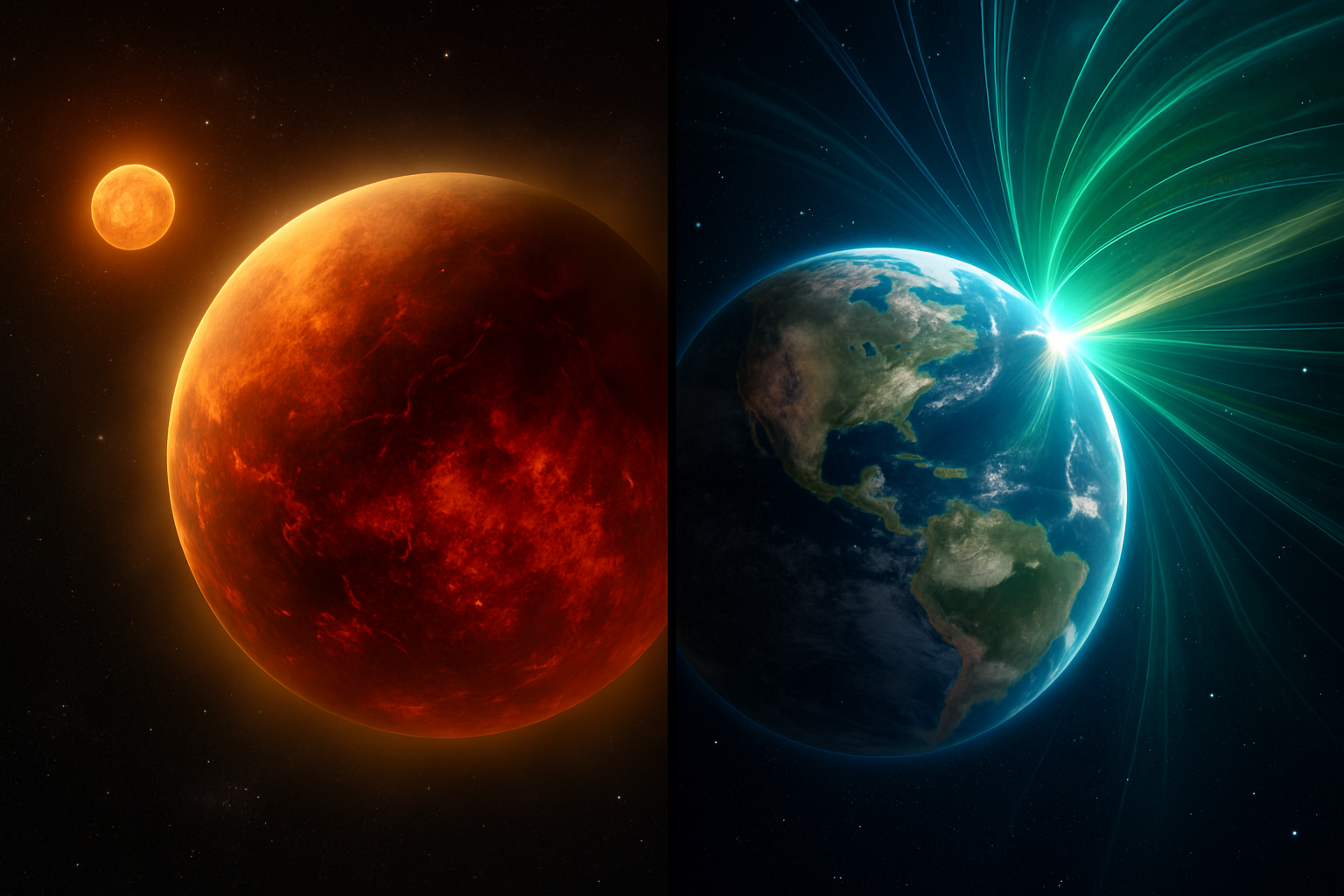
In a remarkable convergence of cosmic discoveries, astronomers have identified an alien world presenting a unique hellscape of perpetual magma oceans while Earth simultaneously experiences its strongest magnetic storm in two months, underscoring both the diversity of planetary environments and the ongoing threats from space weather.
The molten exoplanet, located approximately 34 light-years from Earth in the constellation Volans, represents one of the most extreme planetary environments ever documented. According to research published Monday in Nature Astronomy, the world is enveloped by a noxious, sulfur-rich atmosphere and covered entirely by a perpetual ocean of magma.
A World of Endless Fire
"The planet lacks distinct structure within its magma ocean, so there is no crust, upper mantle and lower mantle. The magma ocean is a single deep, mushy layer," explained Harrison Nicholls, a postdoctoral researcher at the University of Cambridge Institute of Astronomy and lead author of the study.
The hellish world's diameter exceeds Earth's by more than 60 percent, though its density measures only about 40 percent that of our planet. This unusual combination creates a world where the familiar geological layers of rocky planets simply cannot exist due to the intense heat and constant molten state of the surface.
The planet orbits a star smaller and dimmer than our Sun, yet receives such intense radiation that its surface remains in a perpetual state of molten rock. The sulfur-choked atmosphere adds another layer of hostility to this cosmic inferno, creating conditions that would instantly vaporize any known spacecraft or probe.
Earth Under Cosmic Assault
While astronomers studied this distant hellscape, Earth itself came under assault from space weather. Russian scientists confirmed that a magnetic storm that began yesterday has become the strongest geomagnetic disturbance our planet has experienced in the past two months.
The geomagnetic event, triggered by enhanced solar wind activity, demonstrates the ongoing vulnerability of Earth's technological infrastructure to space weather phenomena. According to Russian space weather experts, the magnetic situation is expected to fully normalize by March 24, providing a timeline for the gradual recovery of affected systems.
This magnetic storm represents the latest in a series of increasingly powerful space weather events that have characterized 2026 as an exceptional year for solar-terrestrial interactions. The timing coincides with NASA's DAGGER AI system recently achieving breakthrough 30-minute geomagnetic storm prediction capabilities, providing unprecedented advance warning for infrastructure protection.
Technological Implications and Infrastructure Threats
The current magnetic storm affects critical systems including GPS navigation, satellite communications, and power grid operations across multiple continents. Airlines operating polar routes have implemented precautionary measures, while satellite operators have activated protective protocols to safeguard orbital assets worth billions of dollars.
These space weather events have gained particular significance during the current "space economy golden age," with thousands of satellites in orbit supporting everything from internet communications to financial transactions. The economic implications of severe geomagnetic storms can reach into the billions, as demonstrated by historical events like the 1989 Quebec blackout that left millions without power.
The contrast between the hellish exoplanet discovery and Earth's magnetic storm illustrates the delicate balance that makes our planet habitable. While the distant world exists in a state of permanent geological chaos, Earth's magnetic field—currently under stress from solar activity—provides crucial protection that enables life to thrive.
Scientific Context and Discovery Methods
The molten exoplanet discovery emerged from advanced telescopic observations that can analyze atmospheric composition across interstellar distances. The detection of sulfur compounds and the characterization of the magma ocean represent significant achievements in exoplanetary science, demonstrating how modern instruments can reveal detailed information about worlds dozens of light-years away.
This discovery adds to a growing catalog of extreme exoplanets that challenge our understanding of planetary formation and evolution. The perpetual magma ocean suggests the planet formed under conditions vastly different from those that shaped the rocky worlds in our solar system, or that it experiences ongoing heating mechanisms that prevent the formation of a solid crust.
Meanwhile, the magnetic storm monitoring demonstrates the sophisticated space weather infrastructure developed by international space agencies. Ground-based magnetometers, satellite sensors, and AI-powered prediction systems work together to track and forecast geomagnetic disturbances, providing early warning systems that protect modern technological civilization.
Broader Astronomical Context
These discoveries occur during what space scientists are calling a "golden age of astronomical observation," characterized by unprecedented international cooperation and advanced technology deployment. Recent months have witnessed extraordinary cosmic events including six-planet alignments, total lunar eclipses, and breakthrough discoveries about stellar formation processes.
The molten exoplanet joins a growing list of "impossible" worlds that have forced astronomers to revise fundamental theories about planetary system formation. Similar recent discoveries include planetary systems 116 light-years away that violate conventional gravitational models, demonstrating that the universe contains far more diversity than previously imagined.
The research occurs alongside major advances in space exploration, including ongoing preparations for NASA's Artemis II lunar mission and the expansion of international space cooperation through programs like the Chinese Tiangong station and European space initiatives.
Future Research and Space Weather Preparedness
Scientists plan continued observations of the molten exoplanet to better understand its atmospheric dynamics and the mechanisms maintaining its perpetual magma state. The world serves as a natural laboratory for studying extreme geological processes that may have occurred on early Earth or other rocky planets during their formation phases.
Space weather research continues advancing through AI-powered prediction systems and enhanced satellite monitoring networks. The current magnetic storm provides valuable data for improving future forecasting capabilities and developing more effective protection protocols for space-based and terrestrial infrastructure.
As humanity expands its presence in space through lunar exploration programs and expanding satellite constellations, understanding both extreme exoplanetary environments and space weather threats becomes increasingly critical for long-term space exploration success.
Implications for Planetary Science
The discovery of this sulfur-choked hellscape provides crucial insights into the limits of planetary habitability and the diverse evolutionary paths that worlds can follow. By studying such extreme environments, scientists gain better understanding of the conditions necessary for life and the factors that determine whether a planet becomes Earth-like or develops into a molten wasteland.
The research contributes to humanity's expanding knowledge of cosmic environments during a period when space exploration is transitioning from purely scientific endeavors to essential infrastructure supporting modern civilization. Understanding the full spectrum of planetary possibilities helps inform the search for potentially habitable worlds and guides future exploration priorities.
As Earth continues to experience the effects of this significant magnetic storm while astronomers study distant worlds of unimaginable hostility, the discoveries underscore both the remarkable diversity of cosmic environments and the precious rarity of conditions that support life as we know it.