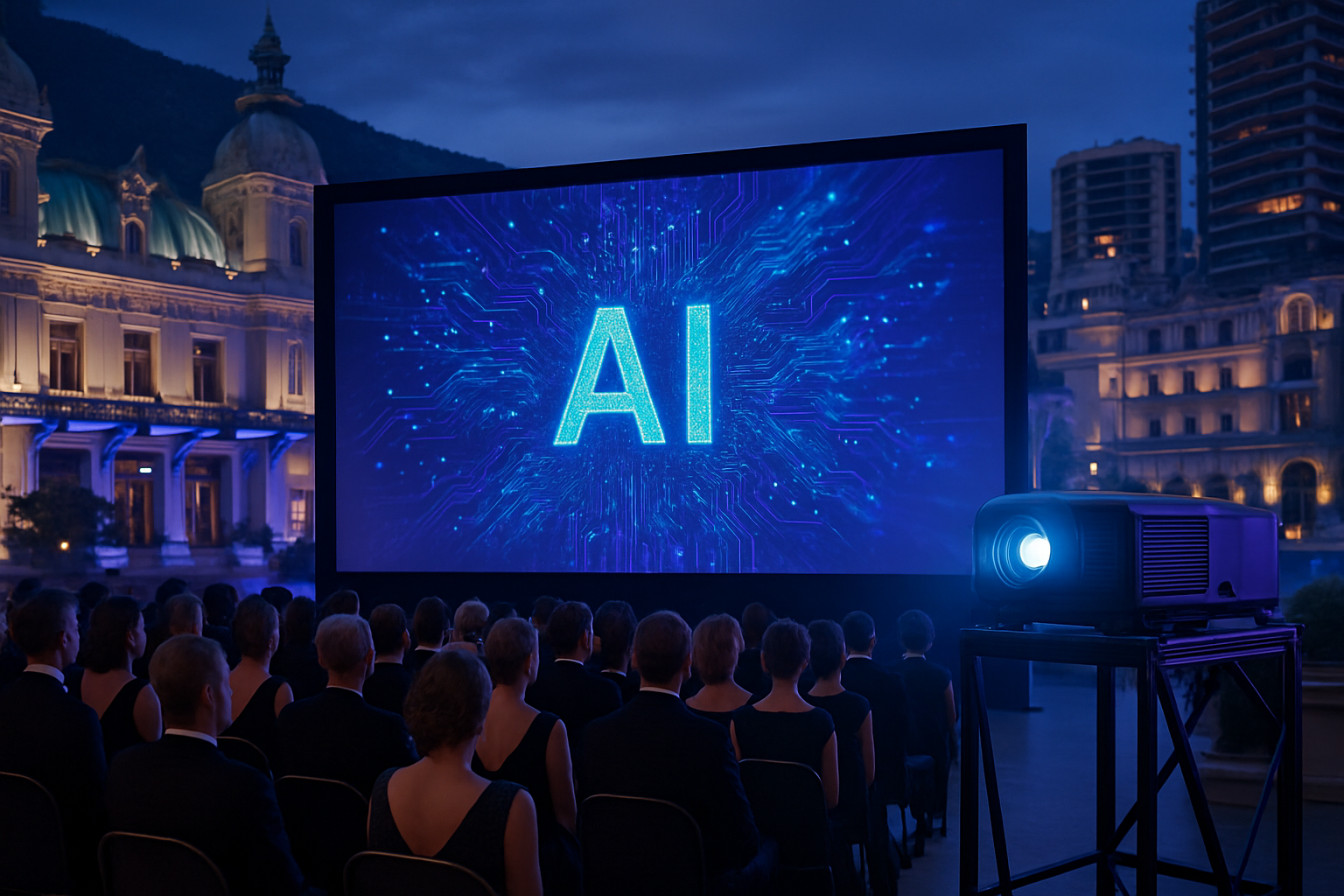
Monaco will host its first artificial intelligence film festival on June 9th and 10th at One Monte-Carlo, immediately following the Formula 1 Grand Prix, bringing together filmmakers, AI developers, digital artists, academics and technology industry representatives for two days of screenings, discussions and live creative challenges.
The AI Film Festival Monaco 2026, organized by WAIB Summit, represents the first festival of its kind in the Principality and arrives at a critical moment in cinema history when artificial intelligence is fundamentally transforming how films are conceived, produced, and distributed. The event will draw participants from the worlds of cinema, generative AI and creative technology, alongside representatives of the Monaco government, European policymakers and leaders from the broader creative and technology sectors.
Major technology companies including Alibaba Cloud, Microsoft, the Yacht Club de Monaco and AS Monaco FC are among those confirmed to participate, signaling the high-profile nature of this unprecedented convergence of entertainment and artificial intelligence.
The 24-Hour AI Film Hackathon: Cinema's Creative Frontier
The festival's centerpiece is an ambitious 24-hour AI film hackathon, where filmmakers, producers, AI developers and creative technologists will collaborate in real-time to produce original works that push the boundaries of AI-assisted storytelling. This intensive creative challenge reflects the industry's rapid transition from experimental AI tools to essential filmmaking infrastructure.
The hackathon format acknowledges a fundamental shift occurring across the global entertainment landscape. According to comprehensive industry analysis documented in February 2026, artificial intelligence has moved from a curiosity to a critical component of modern film production, with applications ranging from script analysis and visual effects to automated editing and sound design.
This transformation has not been without controversy. Over 4,000 French actors and filmmakers condemned what they termed "systematic plundering" by AI tools that reproduce voices and images, highlighting widespread creative industry anxiety about AI-generated content sophistication threatening traditional livelihoods and artistic integrity.
Global Context: The 2026 AI Revolution in Cinema
Monaco's festival launches amid what industry experts have characterized as the "2026 AI Revolution in Cinema," a watershed moment when artificial intelligence applications in entertainment reached unprecedented sophistication. The Academy Awards made history in 2026 by allowing AI-assisted films in competition for the first time, marking mainstream acceptance of the technology in prestigious filmmaking circles.
Recent developments have demonstrated both the promise and peril of AI in entertainment. ByteDance's Seedance 2.0 creates cinema-quality videos from text prompts, with viral demonstrations including realistic celebrity content that prompted copyright warnings from Disney and Paramount. Meanwhile, the introduction of "Tilly Norwood," the first AI-generated actress to release a debut single, exposed significant technological limitations despite achieving historic milestones in synthetic media.
The industry has experienced dramatic upheaval as traditional production methods face disruption from AI-generated content reaching unprecedented authenticity levels. Prague designer Vašek Krejčí's "Postapo Praha" project created hyper-realistic apocalyptic videos that viewers mistook for actual documentary footage, demonstrating the authenticity crisis facing modern media consumption.
European Leadership in AI Governance and Creative Rights
Monaco's festival occurs within a broader European framework of AI regulation and creative protection. Spain implemented the world's first criminal executive liability framework for technology platforms, while France conducted AI company cybercrime raids, reflecting the most sophisticated global technology governance efforts since internet commercialization.
The festival's manifesto states that "art may no longer belong exclusively to humankind, but instead become a shared language between humans and intelligence," encapsulating the philosophical questions at the heart of this technological transformation. This perspective aligns with successful human-AI collaboration models documented globally, including Canadian universities' AI teaching assistants that maintain critical thinking standards and Malaysia's world-first AI-integrated Islamic school that combines advanced technology with traditional learning.
Infrastructure Challenges and Creative Solutions
The timing of Monaco's festival is particularly significant given current global infrastructure constraints. The worldwide memory semiconductor crisis has driven chip prices up sixfold, affecting Samsung, SK Hynix, and Micron operations, with shortages expected to persist until 2027 when new fabrication facilities come online.
Paradoxically, these constraints have spurred innovation toward memory-efficient algorithms and creative deployment strategies that maximize AI capabilities while minimizing hardware requirements. This has democratized access to advanced AI filmmaking tools, potentially leveling the playing field between major studios and independent creators.
The "SaaSpocalypse" phenomenon has eliminated hundreds of billions in traditional software market capitalization as AI systems replace conventional solutions, fundamentally altering the business ecosystem supporting film production. Despite these challenges, massive investments continue, with Alphabet committing $185 billion to AI infrastructure in 2026 and Amazon announcing over $1 trillion in development plans.
Human-AI Collaboration: The Path Forward
Industry analysis suggests that the most successful AI implementations in filmmaking emphasize enhancement rather than replacement of human capabilities. Curious Refuge, an AI film academy launched in 2023, has become essential for Hollywood workers adapting to technological change. Visual effects veteran Michael Eng represents thousands of professionals acquiring machine learning skills to remain competitive in the evolving landscape.
The Monaco festival's approach appears aligned with these collaborative models. Rather than positioning AI as a replacement for human creativity, the event framework suggests artificial intelligence as sophisticated amplification tools that preserve uniquely human elements like imagination, cultural understanding, emotional depth, and authentic expression while leveraging computational advantages.
Economic and Cultural Implications
The festival represents Monaco's positioning within what has been documented as the "February 2026 Cultural Renaissance," a period of unprecedented international cultural coordination emphasizing authentic expression over homogenized content. This aligns with broader evidence that audiences prefer genuine cultural experiences that transcend geographic and linguistic boundaries.
From an economic perspective, the event contributes to cultural tourism revenue, creative industry employment, and enhanced international recognition for the Principality. Cultural investments of this nature create lasting infrastructure benefits supporting future artistic development, soft power projection, and sustainable economic opportunities.
The presence of organizations like Alibaba Cloud and Microsoft alongside traditional entertainment entities reflects the fundamental convergence occurring between technology and creative industries. This collaboration model suggests that successful navigation of the AI transformation requires unprecedented coordination between technology companies, entertainment institutions, and regulatory bodies.
Looking Ahead: A Template for Global Innovation
As the entertainment industry grapples with questions about AI's role in creative work—whether it fundamentally alters the nature of artistic professions or enhances human capabilities—Monaco's festival may provide crucial insights into sustainable integration approaches.
The event occurs at what experts have identified as a "civilizational choice point" in March 2026, where decisions about AI implementation will determine trajectories for the remainder of the decade. Success depends on developing sophisticated human-AI collaboration models that amplify creative capabilities while preserving the creativity, cultural understanding, and ethical reasoning that define human potential.
The festival's June timing, immediately following the Monaco Grand Prix, ensures maximum global attention for these critical conversations about the future of cinema and artificial intelligence. As the industry transitions from experimental applications to essential infrastructure, Monaco's inaugural AI Film Festival may well establish templates for how creativity and technology can coexist in service of storytelling's highest aspirations.
The challenge ahead involves ensuring that technological advancement serves human flourishing while maintaining the authentic expression, emotional resonance, and cultural significance that make cinema an irreplaceable form of human communication and artistic achievement.