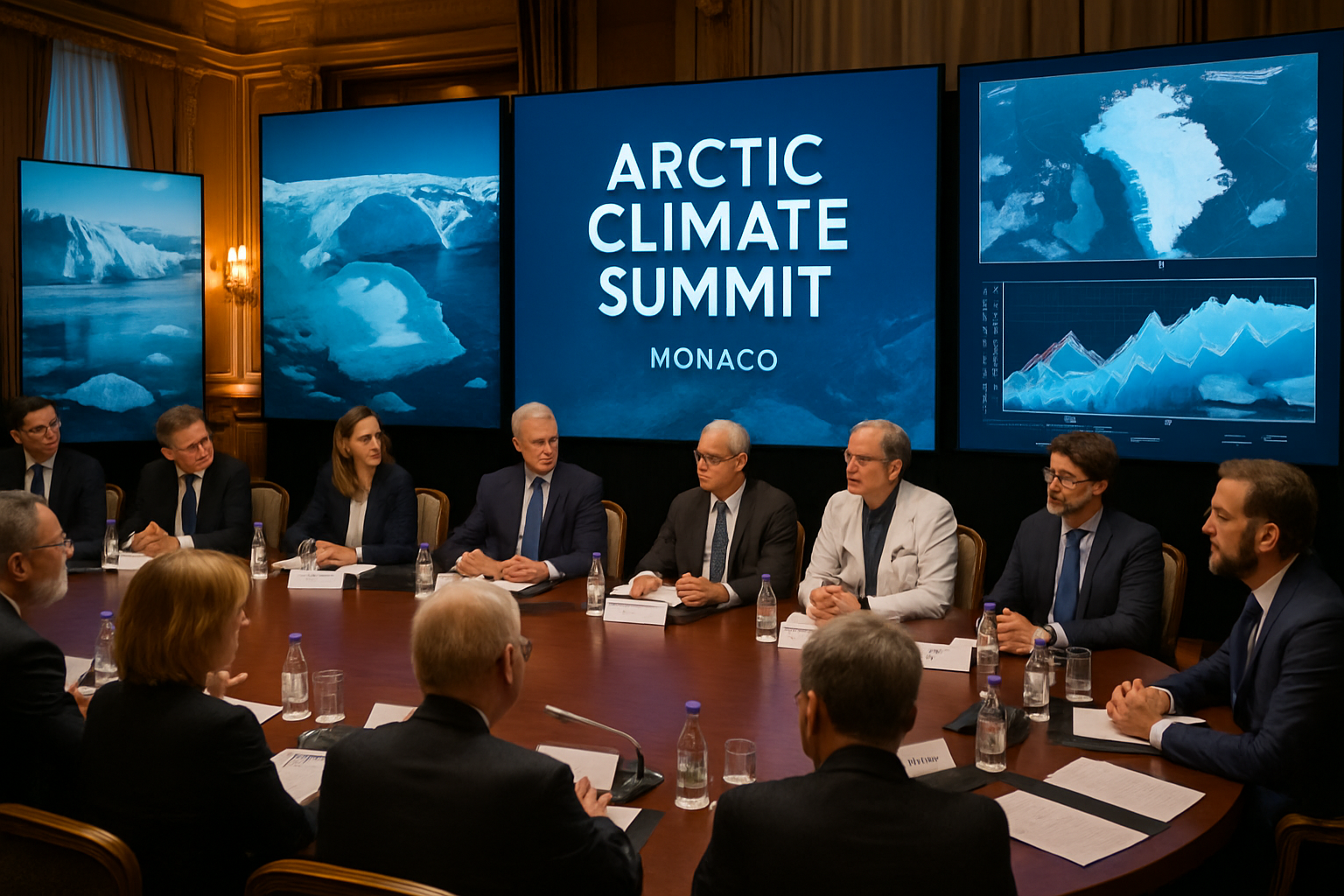
Monaco has once again positioned itself at the forefront of global climate diplomacy as the Prince Albert II of Monaco Foundation hosts the third edition of the Polar Symposium: From the Arctic to the Antarctic this week, addressing the accelerating crisis facing Earth's polar regions during an unprecedented period of global warming.
The international gathering brings together scientists, policymakers, and environmental experts from around the world as the planet experiences its 18th consecutive month of temperatures exceeding 1.5°C above pre-industrial levels, with January 2026 confirmed as the hottest month ever recorded.
Scientific Evidence of Accelerating Change
The timing of this summit reflects the urgent reality facing polar regions. Recent scientific evidence reveals that climate tipping points are approaching faster than previously anticipated, with potential "hot house" scenarios where extreme greenhouse conditions could accelerate beyond human control. Arctic temperatures have increased faster than global averages, with profound implications for ice sheet stability, sea level rise, and global ocean circulation.
Argentine Antarctic research, spanning over a century of continuous scientific observation, has documented these changes through sophisticated monitoring systems. Since 1904, Argentina's meteorological operations in Antarctica have created an invaluable climate dataset providing irreplaceable insights into climate change patterns and natural variability. This historical perspective demonstrates how dramatically conditions have altered in recent decades.
International Cooperation Under Pressure
The Monaco symposium occurs as international Arctic cooperation faces unprecedented challenges. NATO's Arctic Sentry mission, launched in February 2026, represents the alliance's most comprehensive Arctic security response, with European nations taking leadership roles as climate change opens new shipping routes and resource extraction opportunities.
"The Arctic is becoming a domain of great power competition precisely because climate change is making previously inaccessible resources and routes available."
— European Defense Official
The Netherlands has successfully installed advanced climate monitoring equipment across Antarctic research stations, creating the most sophisticated polar climate monitoring network ever deployed. This technology, designed to withstand extreme conditions including temperatures as low as -70°C and winds exceeding 200 km/h, provides real-time data transmission capabilities essential for understanding rapidly changing polar systems.
Arctic Marine Ecosystem Under Threat
Recent marine discoveries underscore the complexity of polar ecosystem changes. Scientists have documented the first-ever Antarctic sleeper shark, a massive 3-4 meter specimen found cruising in deep Antarctic waters previously thought too frigid for such predators. This discovery challenges decades of scientific assumptions about marine life limits in polar environments and suggests that Arctic Ocean ecosystems may be more complex and vulnerable than previously understood.
Research published in Nature Ecology & Evolution reveals that every 0.1°C of ocean warming per decade reduces fish populations by 7.2%, with seabed warming directly correlating to marine life population decline. This evidence compounds concerns about Arctic marine ecosystems already under stress from temperature increases, ice loss, and changing ocean chemistry.
Infrastructure and Economic Implications
The symposium addresses critical infrastructure challenges as permafrost thaw affects Arctic construction and transportation networks. Canada's Arctic highway infrastructure faces unprecedented climate pressures, with the Inuvik-Tuktoyaktuk highway experiencing extended closures due to changing ground conditions. Traditional construction methods designed for stable permafrost must evolve toward adaptive systems capable of functioning in changing climate conditions.
Economic implications extend far beyond the Arctic itself. Global supply chains depend on predictable Arctic shipping routes, while the region contains significant reserves of critical minerals essential for renewable energy infrastructure. Chinese control of 60% of global production and 90% of refining capacity for lithium, cobalt, and rare earth elements creates strategic dependencies that Arctic developments could help address.
Conservation Success Stories Amid Crisis
Despite mounting challenges, the summit highlights remarkable conservation achievements. The Yangtze River's ten-year fishing ban has delivered dramatic results, with marine biomass surging and the critically endangered Yangtze finless porpoise showing population stabilization for the first time in decades. This success demonstrates that large-scale conservation interventions can work even in heavily industrialized environments.
International cooperation has enabled sophisticated conservation approaches combining cutting-edge technology with traditional ecological knowledge. Environmental DNA sampling, satellite monitoring, and AI-powered analysis provide unprecedented capabilities for tracking species and ecosystem health across vast polar territories.
Renewable Energy Arctic Connection
The symposium addresses the paradox that Arctic climate change, largely driven by fossil fuel emissions, may become essential for renewable energy infrastructure. Finland's launch of Europe's first major lithium mining operation represents a strategic breakthrough for EU battery manufacturing and reduced dependence on Chinese-dominated supply chains.
This €800 million investment demonstrates how Arctic resource development, conducted responsibly, could support the global transition to renewable energy while providing sustainable employment and regional economic development.
Health and Human Dimensions
Climate change in polar regions creates cascading health impacts globally. The symposium examines how Arctic warming affects weather patterns worldwide, contributing to extreme events that strain healthcare systems and emergency services. Recent research reveals concerning patterns of viral misidentification in disease surveillance, highlighting how climate-driven changes in human-wildlife interactions require enhanced global health preparedness.
Ancient bacterial strains preserved in Arctic permafrost present both medical opportunities and threats. Romanian scientists' discovery of 5,000-year-old bacteria from ice cores reveals microorganisms with complete antibiotic resistance, warning of potential pandemic risks as permafrost thaws accelerate.
Technology and Traditional Knowledge Integration
Successful Arctic climate adaptation requires sophisticated integration of advanced technology with indigenous knowledge systems. Inuit communities possess millennia of experience with polar conditions, providing essential insights for contemporary climate adaptation strategies. Recent diplomatic initiatives, including the France-Canada consulate openings in Nuuk, Greenland, demonstrate respect for indigenous sovereignty while strengthening international cooperation.
Modern monitoring systems combine AI-powered analysis, satellite communication, and renewable energy systems for autonomous operation in extreme conditions. This technological infrastructure provides real-time data essential for climate modeling, sea level prediction, and adaptation planning.
Economic Development vs Environmental Protection
The Monaco symposium addresses fundamental tensions between economic development pressures and environmental protection requirements. Portugal's insurance industry facing €750 million in climate-related claims demonstrates how environmental protection functions as economic development strategy rather than regulatory burden. Countries implementing comprehensive environmental protection show greater economic resilience and attract sustainable investment.
Preventive environmental strategies demonstrate substantial cost reductions through decreased crisis interventions while achieving superior environmental outcomes. The choice between reactive crisis management and proactive ecosystem service management becomes increasingly urgent as climate action windows narrow.
Future Implications and Strategic Responses
The symposium occurs at a critical juncture for global environmental protection. Tools, knowledge, and cooperation frameworks exist for comprehensive polar region protection, but success depends on rapid scaling through enhanced international cooperation, sustained financial commitments, and recognition that environmental protection constitutes essential infrastructure for human prosperity and planetary sustainability.
February 2026 represents potentially decisive momentum for Arctic climate action. The convergence of technological innovation, international cooperation models, and prevention-focused strategies provides foundation for resilient systems capable of addressing 21st-century challenges.
"We are at a critical moment where the choices made in 2026 will determine whether we can maintain Arctic stability for future generations."
— Climate Research Scientist
Call for Coordinated Action
The Prince Albert II Foundation's symposium emphasizes that Arctic climate challenges require unprecedented global coordination. Success depends on sustained political commitment across electoral cycles, comprehensive professional training, continued international cooperation, and resource allocation adequate to match the scale of the challenge.
As the symposium concludes, participants face the reality that the window for effective Arctic climate action is narrowing rapidly. The 18th consecutive month of record-breaking global temperatures demonstrates that human-induced climate change has fundamentally altered atmospheric systems beyond natural recovery mechanisms.
The gathered experts agree that coordinated action remains possible, but requires immediate implementation at unprecedented scale and speed. Monaco's leadership in convening this critical dialogue demonstrates how smaller nations can drive global environmental diplomacy precisely when such leadership is most urgently needed.