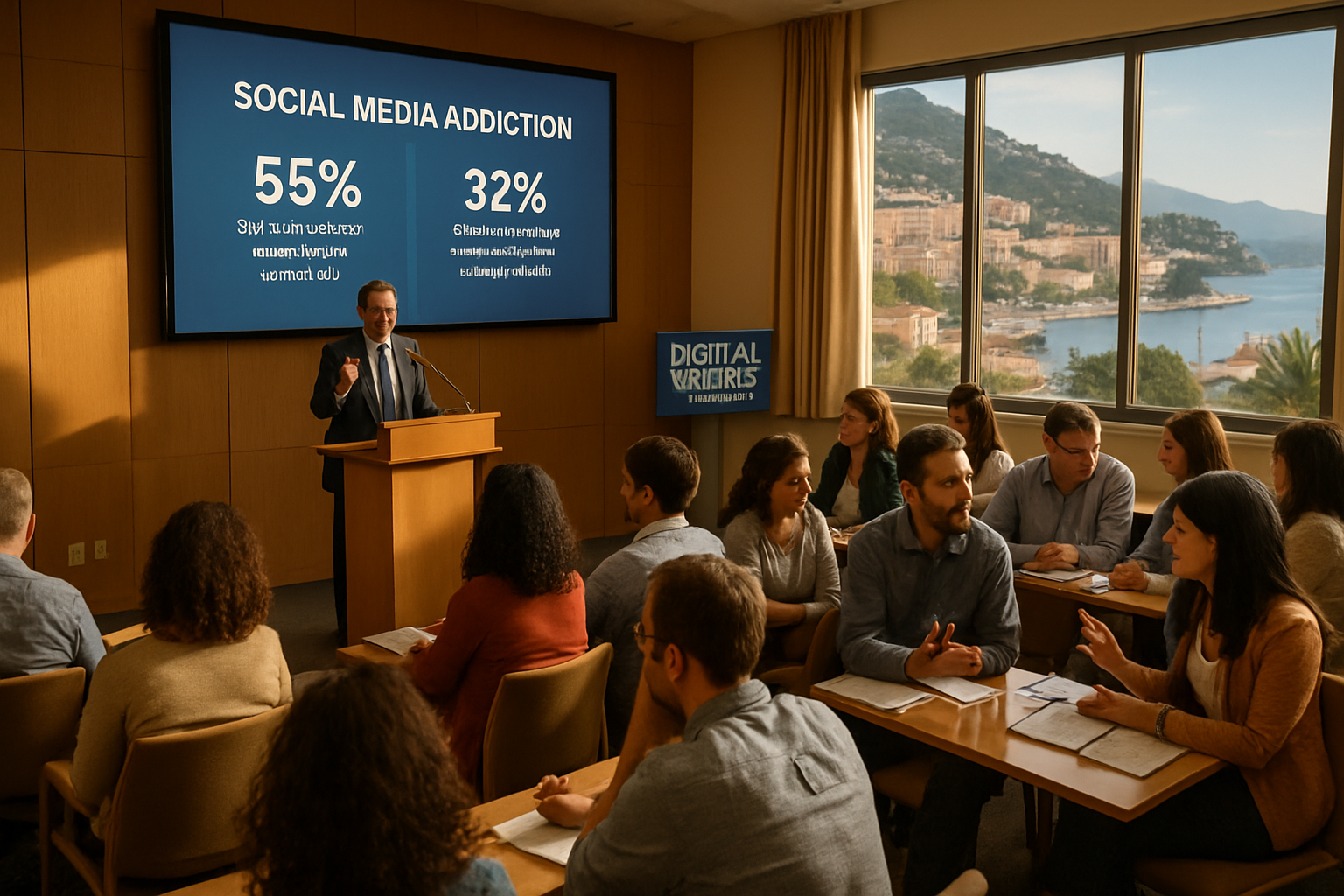
Monaco is taking a proactive stance against social media addiction with its first-ever public lecture on digital wellness, scheduled for March 26 at 6:30 PM, as part of a new initiative to address the growing mental health crisis among young people worldwide.
The groundbreaking event, organized by Monaco's Interministerial Delegation for Digital Transition (DITN), comes at a critical time when the average person spends more than three hours daily on their phone, raising serious concerns about the impact on mental health, relationships, and cognitive focus.
The lecture, titled "Social Media and Digital Addiction: What We Can Do About It," will bring together mental health experts to explore why social media platforms are so difficult to put down, how they shape human attention and behavior, and what practical steps individuals and communities can take to find a healthier digital balance.
A Global Crisis Demands Local Action
Monaco's initiative arrives amid unprecedented global awareness of digital wellness challenges. Recent research from Dr. Ran Barzilay at the University of Pennsylvania demonstrates that early smartphone exposure before age 5 causes persistent sleep disorders, cognitive decline, and weight problems that extend into adulthood. The statistics are alarming: 96% of children aged 10-15 use social media, with 70% experiencing harmful content exposure and over 50% encountering cyberbullying.
The principality's approach reflects what mental health professionals worldwide are calling the "Therapeutic Revolution of 2026" – a fundamental shift from crisis-response healthcare to prevention-first strategies. This movement recognizes that addressing digital wellness requires comprehensive community engagement rather than individual solutions alone.
"The average person now spends more than three hours a day on their phone. This figure has prompted growing concern about the effects on mental health, relationships and focus."
— Monaco's DITN Initiative
International Regulatory Revolution
Monaco's educational approach comes as governments worldwide implement increasingly strict regulations on social media platforms. Australia's under-16 ban eliminated 4.7 million teen accounts in December 2025, proving such restrictions are technically feasible. Spain has introduced the world's first criminal executive liability framework, creating imprisonment risks for tech executives whose platforms harm children.
European coordination is expanding rapidly, with Greece implementing "Kids Wallet" under-15 restrictions, while France, Denmark, and Austria conduct formal consultations. The UK government under Prime Minister Keir Starmer has announced fast-track implementation of Australia-style restrictions, with Technology Minister Liz Kendall confirming legislative changes to enable rapid deployment.
The European Commission has found TikTok in violation of the Digital Services Act for "addictive design" features including unlimited scrolling, autoplay, and personalized recommendations that prioritize engagement over user wellbeing, facing potential penalties of 6% of global revenue – billions of dollars for a platform of TikTok's scale.
Scientific Evidence Drives Policy
The urgency behind Monaco's initiative is supported by mounting scientific evidence. Large-scale US studies reveal that children spending four or more hours daily on screens face a 61% increased risk of depression through sleep disruption and decreased physical activity. University of Macau research proves that short-form video consumption negatively impacts cognitive development, causing social anxiety and academic disengagement.
Mental health professionals have identified what they term the "wellness paradox" – where constant self-improvement pursuits create psychological exhaustion rather than genuine healing. This insight is driving the shift toward prevention-first approaches that emphasize authentic community connections over performance-based metrics.
Monaco's Comprehensive Approach
The March 26 event will run until 8 PM and be followed by a drinks reception, providing attendees with opportunities to continue conversations informally. The lecture will be conducted in French, with online participation available for those who cannot attend in person.
Monaco's approach represents a middle path between heavy-handed regulatory enforcement and complete laissez-faire attitudes toward digital wellness. While countries like Malaysia emphasize parental responsibility through digital safety campaigns, and Oman implements "Smart tech, safe choices" education focusing on conscious awareness, Monaco is combining public education with expert guidance.
The initiative recognizes that successful digital wellness interventions require cultural adaptation. Evidence-based practices must be integrated with local values and community structures to yield better outcomes than standardized approaches. Monaco's unique position as a wealthy, internationally connected principality allows it to serve as a testing ground for innovative approaches that could be adapted elsewhere.
Economic and Social Stakes
The economic implications of digital wellness extend far beyond immediate healthcare costs. Countries implementing prevention-focused strategies report substantial cost reductions through decreased crisis interventions, while achieving superior population health outcomes. These benefits include improved educational performance, enhanced workplace productivity, and stronger community resilience.
Monaco's investment in prevention-first digital wellness education could position the principality as a leader in addressing 21st-century mental health challenges. The approach acknowledges that mental wellness should be treated as fundamental community infrastructure rather than optional individual services.
Technology Industry Resistance
The timing of Monaco's initiative coincides with escalating resistance from technology companies. Elon Musk has characterized regulatory measures as "fascist totalitarian," while Pavel Durov has warned of "surveillance state" implications. The so-called "SaaSpocalypse" of February 2026 eliminated hundreds of billions in tech market capitalization amid regulatory uncertainty.
However, some platforms are beginning to adapt. Instagram recently announced parental notification systems alerting parents when teens repeatedly search for suicide or self-harm content, while X Platform has introduced new safety rules barring under-13 accounts and prohibiting advertisers from targeting users under 16.
Implementation Challenges
Monaco's educational approach sidesteps some of the technical challenges facing regulatory solutions. Real age verification requires biometric authentication, raising surveillance concerns that privacy advocates worry could enable broader government monitoring. Cross-border enforcement of platform restrictions requires unprecedented international cooperation.
The global semiconductor shortage, with memory chip prices increasing sixfold, is constraining age verification infrastructure until 2027 when new fabrication facilities come online. These technical limitations make educational approaches like Monaco's initiative particularly valuable as immediate interventions.
Looking Toward the Future
Monaco's digital wellness lecture represents more than a single event – it signals the principality's recognition that digital wellness challenges require sustained, community-based responses. The initiative could serve as a model for other small nations and city-states seeking to address digital wellness without the regulatory complexity faced by larger jurisdictions.
The success of Monaco's approach will likely depend on sustained political commitment, adequate resource allocation, and comprehensive professional training for those delivering digital wellness education. Most importantly, it will require continued international cooperation and knowledge sharing as communities worldwide grapple with similar challenges.
As the global community faces fundamental questions about childhood development, human agency, and democratic governance in the digital age, Monaco's initiative offers hope that coordinated educational action can achieve meaningful improvements in digital wellness while respecting individual rights and community values.
The March 26 lecture may be Monaco's first digital wellness initiative, but given the urgency of the challenges it addresses, it is unlikely to be the last.