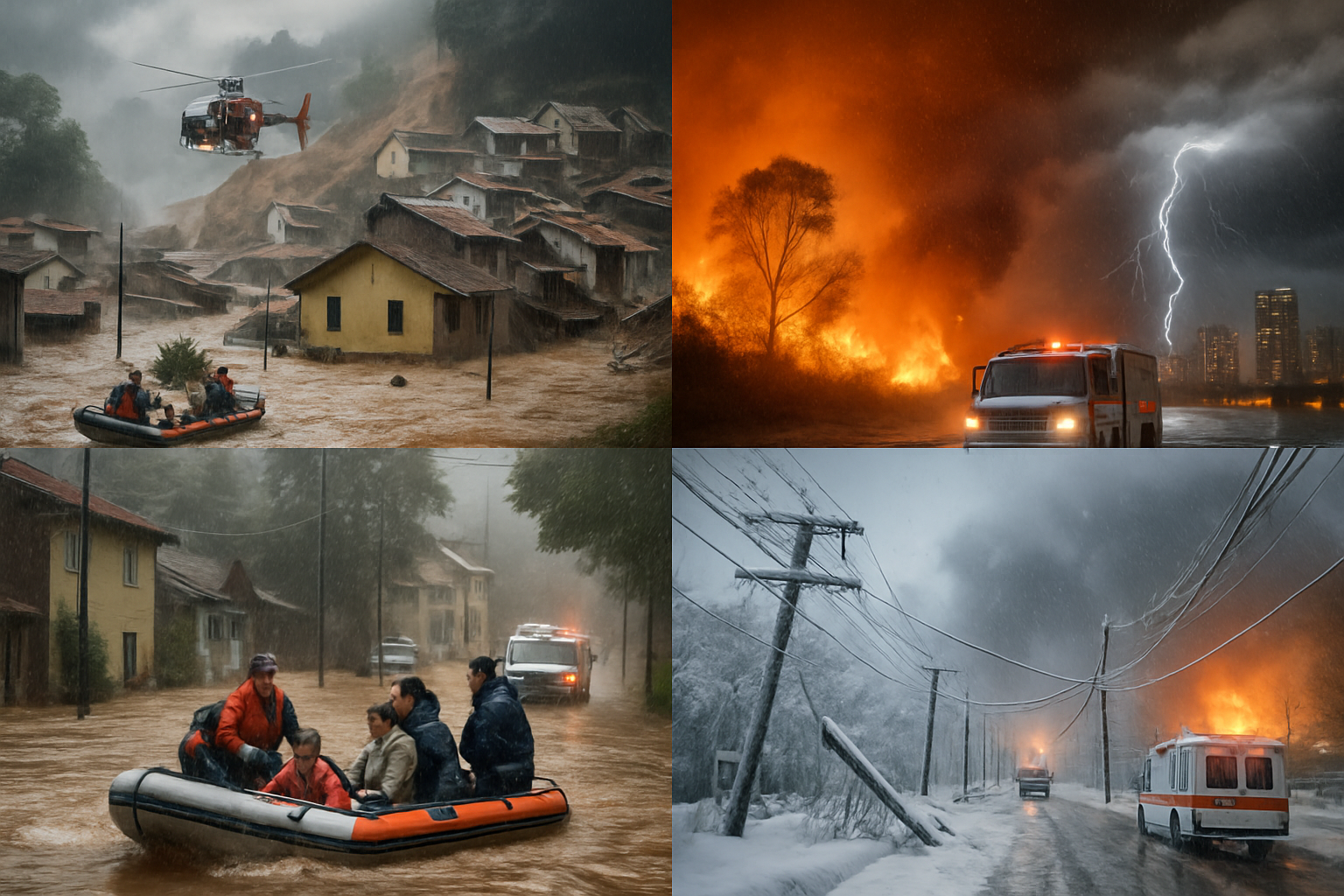
A catastrophic convergence of extreme weather disasters across multiple continents has claimed over 100 lives in the past 48 hours, with emergency services from Brazil to Canada struggling to respond to an unprecedented scale of simultaneous natural disasters that experts warn represents a preview of the climate volatility era.
Brazil Devastated by Record-Breaking Rainfall
Brazil's southeastern state of Minas Gerais bears the heaviest toll, with at least 23 people confirmed dead and dozens still missing after torrential rains triggered catastrophic flooding and landslides. The municipalities of Juiz de Fora and Ubá have been declared disaster zones, with 16 deaths recorded in Juiz de Fora alone and 7 in Ubá.
Mayor Margarida Salomão of Juiz de Fora declared a state of emergency, describing the situation as "extreme" as the city of over 500,000 people experiences its wettest February on record. The unprecedented rainfall caused rivers to overflow their banks, triggered at least 20 landslides, and led to spectacular building collapses captured on video by residents.
"Civil Defense estimates that 440 people have had to leave their homes and are receiving support from the mayor's office for temporary shelter and accommodation," Salomão's office announced on social media.
The Minas Gerais fire department continues searching for "dozens" of missing persons, according to official statements, while some residents attempt to rescue family members on their own. The disaster has isolated several neighborhoods and left thousands without basic services.
Peru Faces Catastrophic Multi-Regional Crisis
In Peru, extreme weather events have claimed more than 50 lives across multiple regions, with the Arequipa area particularly hard-hit by torrential rains that generated deadly lahars on the Misti volcano. The volcanic mudflows have inundated streets, destroyed crops, and severed essential services across affected communities.
The scale of destruction has prompted authorities to consider declaring a national emergency, as the disaster affects transportation networks and basic infrastructure across several provinces. Agricultural areas have been devastated, with entire crop fields washed away by the unprecedented rainfall.
Argentina Faces Infrastructure Collapse
Buenos Aires' Jorge Newbery Aeroparque was struck by a dramatic infrastructure failure when a drainage system collapsed during the early morning hours, creating a waterfall effect inside one of the airport's restaurants. The incident occurred in the international departures section, though airport concessionaire Aeropuertos Argentina confirmed "no structural damage" to the roof itself.
The collapse highlights the vulnerability of critical infrastructure to extreme weather events, as Argentina grapples with the broader impacts of the regional weather system affecting South America's Atlantic coast.
Australia Battles Widespread Flooding Threats
Australia faces a double threat as an unusually slow-moving weather system delivers intense rainfall across central regions while summer storms pummel southern states. The Bureau of Meteorology has issued widespread flood warnings as the sluggish weather pattern continues to dump heavy rain on already saturated ground.
Melbourne and surrounding areas in Victoria have been particularly affected, with thousands of residents losing power as intense storms sweep across the region. The storms have created flash flooding risks throughout urban areas, forcing authorities to issue emergency warnings for multiple suburbs.
"There are widespread warnings for intense rain and potential flooding, as summer storms hit southern states and an unusually slow-moving system soaks central Australia," meteorologists reported.
Canada Endures Punishing Winter Storm
Atlantic Canada remains in the grip of a severe winter storm that has paralyzed the region with heavy snow and dangerous ice conditions. Public schools across Nova Scotia, Prince Edward Island, and St. John's have been closed as crews work to clear snow-blocked roads and restore services.
The storm has created hazardous travel conditions throughout the Maritime provinces, with authorities advising residents to avoid unnecessary travel. Deep snow covers cars and buildings in St. John's neighborhoods, where residents face the challenging task of digging out from the latest in a series of powerful winter storms.
Global Context: Climate Volatility Era Arrives
These simultaneous disasters occur against the backdrop of January 2026 being confirmed as the hottest month in recorded history—the 18th consecutive month to exceed 1.5°C above pre-industrial levels. This unprecedented warming trend is creating a climate volatility paradox where global heat records coincide with devastating regional extremes.
Climate scientists point to this pattern as evidence that human-induced warming is overriding natural climate cycles, including La Niña cooling patterns. The result is an increasingly unstable global weather system that can produce simultaneous heat waves, floods, droughts, and severe storms across different regions.
Emergency Response Systems Under Strain
The scale and simultaneity of these disasters have exposed critical vulnerabilities in global emergency response capabilities. Traditional mutual aid mechanisms, which typically rely on unaffected regions providing support to disaster areas, are being overwhelmed as multiple continents face crises simultaneously.
Infrastructure systems designed for historical climate patterns are operating beyond their intended parameters. Transportation networks, power grids, and communication systems across affected regions are struggling to maintain operations under conditions more severe than their design specifications anticipated.
Emergency services in each affected country report operating at or beyond capacity limits, highlighting the urgent need for enhanced preparedness and climate-adaptive infrastructure.
Economic and Social Impacts
The economic toll continues to mount across multiple sectors. Agricultural regions in Brazil and Peru face devastating crop losses during critical growing seasons. Australia's tourism and transportation sectors confront disruptions at the height of summer travel. Canada's energy infrastructure strains under extreme cold conditions.
Beyond immediate economic impacts, these disasters are affecting millions of people's daily lives. Families are losing generational homes, businesses face potential closure, and vulnerable populations require extended emergency support services.
Mental health services across affected regions report increased demand as communities grapple with repeated exposure to extreme weather events, creating long-term recovery challenges that extend far beyond physical reconstruction.
International Cooperation Challenges
The simultaneous nature of these disasters is testing international cooperation frameworks that traditionally assume regional disasters with neighboring countries available to provide assistance. When multiple continents face emergencies simultaneously, these mutual aid mechanisms become strained beyond their intended capacity.
International organizations emphasize the need for fundamental transformation toward proactive global coordination capable of managing multi-continental crises. Current response systems, while functional, are stretched thin when disasters occur simultaneously across vast geographic areas.
Infrastructure Adaptation Imperatives
Recovery efforts across all affected regions are emphasizing "build back better" approaches that incorporate climate resilience from the design phase. Infrastructure rebuilt using historical climate data is likely to face similar failures as extreme weather events become more frequent and intense.
Transportation networks, power grids, drainage systems, and emergency response capabilities require fundamental upgrades to handle the increased volatility of the climate system. The choice between reactive crisis management and transformative infrastructure adaptation becomes increasingly urgent as extreme weather events occur with greater frequency.
Looking Forward: Permanent Climate Volatility Era
Scientists warn that current conditions represent a preview of routine circumstances expected in the 2030s without significant climate adaptation investments. The February 2026 multi-continental crisis demonstrates the urgent need for comprehensive adaptation strategies that protect lives and maintain essential services in an era of increasing weather volatility.
The window for effective climate action continues to narrow while the costs of reactive emergency response escalate. The simultaneous disasters across eight countries provide a stark illustration of the global coordination and infrastructure transformation required to build resilience for the climate challenges ahead.
As recovery efforts continue across affected regions, the focus shifts toward learning from this watershed moment to develop more robust systems capable of protecting communities from the increasingly volatile climate conditions that experts predict will define the coming decade.