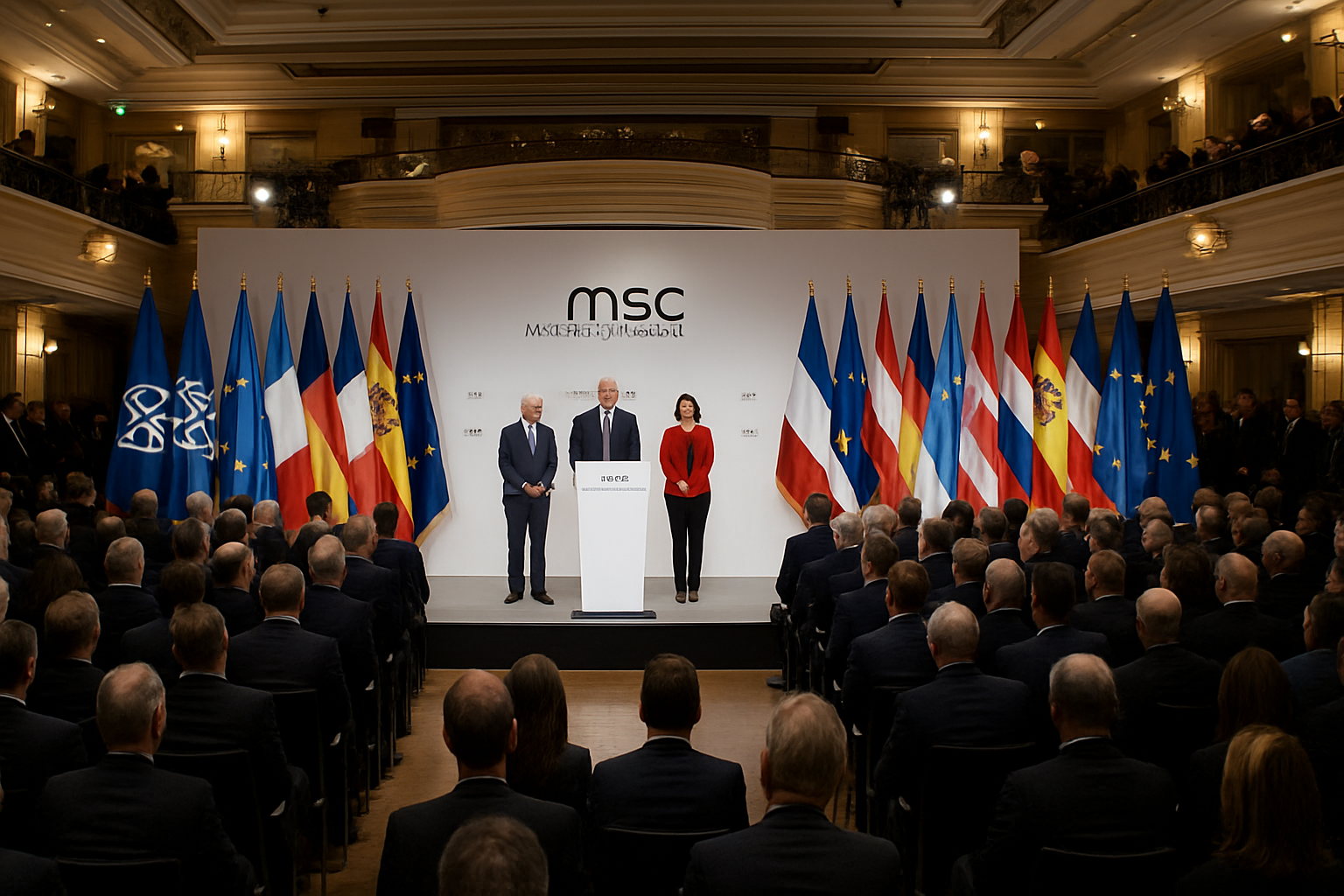
The 62nd Munich Security Conference concluded on Sunday with European leaders delivering their strongest call yet for strategic autonomy, marking what many observers consider a watershed moment in transatlantic relations and post-Cold War security architecture.
MSC Chairman Wolfgang Ischinger declared in his closing remarks that the three-day gathering had demonstrated a "greater spirit of European determination" to defend common values, as more than 1,000 guests, hundreds of discussion rounds, speeches, and bilateral meetings came to an end at the Hotel Bayerischer Hof.
European Strategic Autonomy Takes Center Stage
The conference's central theme, "Era of Disruptive Politics: Challenges to International Order," reflected what organizers called the most sobering assessment in the event's 62-year history. German Chancellor Friedrich Merz opened proceedings by declaring that the "post-war order no longer exists," setting the tone for unprecedented discussions about Europe's future security architecture.
French President Emmanuel Macron, delivering the conference's closing address, emphasized that Europe must become a "geopolitical power providing its own security." His remarks culminated three days of intensive discussions about European strategic autonomy that reached levels not seen since the Cold War's end.
Most significantly, European leaders engaged in their first serious discussions about expanding France's nuclear deterrent beyond national scope. Sources confirmed that German Chancellor Merz held direct talks with Macron about nuclear cooperation, with Germany, Poland, and Finland participating in preliminary conversations about extended deterrence arrangements.
Transatlantic Relations Under Strain
US Secretary of State Marco Rubio's appearance represented a diplomatic reset attempt exactly one year after Vice President JD Vance's controversial 2025 remarks that severely damaged transatlantic relations. Despite declaring America and Europe "made to be together" and receiving a standing ovation, Rubio's absence from a critical Ukraine supporters meeting with German, French, and Polish leaders was interpreted by European officials as declining US interest in European-led initiatives.
"The transatlantic alliance remains important, but Europe must be able to defend itself,"
— Wolfgang Ischinger, MSC Chairman
The conference highlighted the deepest strain in US-European relations since the Cold War, with European leaders choosing strategic autonomy over traditional American deference while attempting to maintain alliance relationships.
Ukraine Context Drives European Unity
The conference occurred against the backdrop of ongoing Ukraine peace efforts, with recent diplomatic breakthroughs including a 314-prisoner exchange and the restoration of US-Russia military communications after a four-year suspension. These developments provided hope amid continued military escalation, with Russia capturing 481 square kilometers in January compared to 260 square kilometers in December 2025.
The European Union's approval of a historic €90 billion loan package for Ukraine—the largest ever for a single nation—demonstrated unprecedented European commitment. However, Slovakia, Czech Republic, and Hungary's refusal to participate highlighted persistent divisions within the bloc.
Romania's Foreign Minister Oana Ţoiu participated in the "Odesa Triangle" trilateral meeting with Ukraine and Moldova counterparts, emphasizing regional efforts to strengthen international positioning. The meeting represented broader Eastern European coordination in response to security challenges.
Nuclear Governance Crisis
The conference took place just days after the New START treaty's expiration on February 5, marking the first time in over 50 years without US-Russia nuclear constraints. UN Secretary-General António Guterres warned of a "grave turning point" with nuclear risks at their "highest level in decades."
This nuclear governance vacuum provided additional impetus for European nuclear deterrence discussions, as traditional arms control frameworks collapsed. The restored US-Russia military communications represents the only remaining major diplomatic channel between the nuclear superpowers.
Arctic Security and Alliance Adaptation
NATO's formal launch of the Arctic Sentry mission during the conference demonstrated European leadership in regional security. The UK announced plans to double its troop presence in Norway to 2,000 over three years, while Sweden committed to deploying Gripen jets for Greenland exercises and Finland contributed operational planning expertise.
The mission addresses Russian Cold War-era base reopening and systematic Arctic military infrastructure restoration, while climate change opens new shipping routes and resource extraction opportunities, creating a new domain for great power competition.
Global Participation and Broader Implications
The Nizami Ganjavi International Center's high-level event brought together political leaders, diplomats, and strategic thinkers amid growing geopolitical fragmentation, demonstrating the conference's global reach beyond traditional Atlantic partners.
The conference's theme reflected the most sobering assessment in its history, with leaders grappling with challenges ranging from authoritarian resistance to technological disruption and climate security intersection. The success or failure of European strategic autonomy development will determine whether the Western alliance adapts through innovation or faces continued fragmentation.
Looking Ahead: June 2026 Deadline
With the Trump administration's June 2026 peace deadline for Ukraine approaching and potential Washington-venue talks suggesting presidential-level involvement, the coming months will test whether European strategic autonomy can develop within existing alliance frameworks or requires fundamental transatlantic relationship restructuring.
The Munich Security Conference 2026 will be remembered as a turning point where European leaders chose to assert greater independence while maintaining alliance commitments—a delicate balance that will shape the international order for decades to come.
"This conference has shown that Europeans are ready to take greater responsibility for their own security while remaining committed to our transatlantic partnership,"
— European Official, speaking on condition of anonymity
As delegates departed Munich, the question remained whether this unprecedented call for European strategic autonomy would lead to renewed Western unity through adaptation or mark the beginning of a fundamental realignment in global power structures. The stakes extend far beyond Europe, potentially reshaping international security architecture for 21st-century challenges including democratic resilience, territorial sovereignty, and conflict resolution mechanisms.