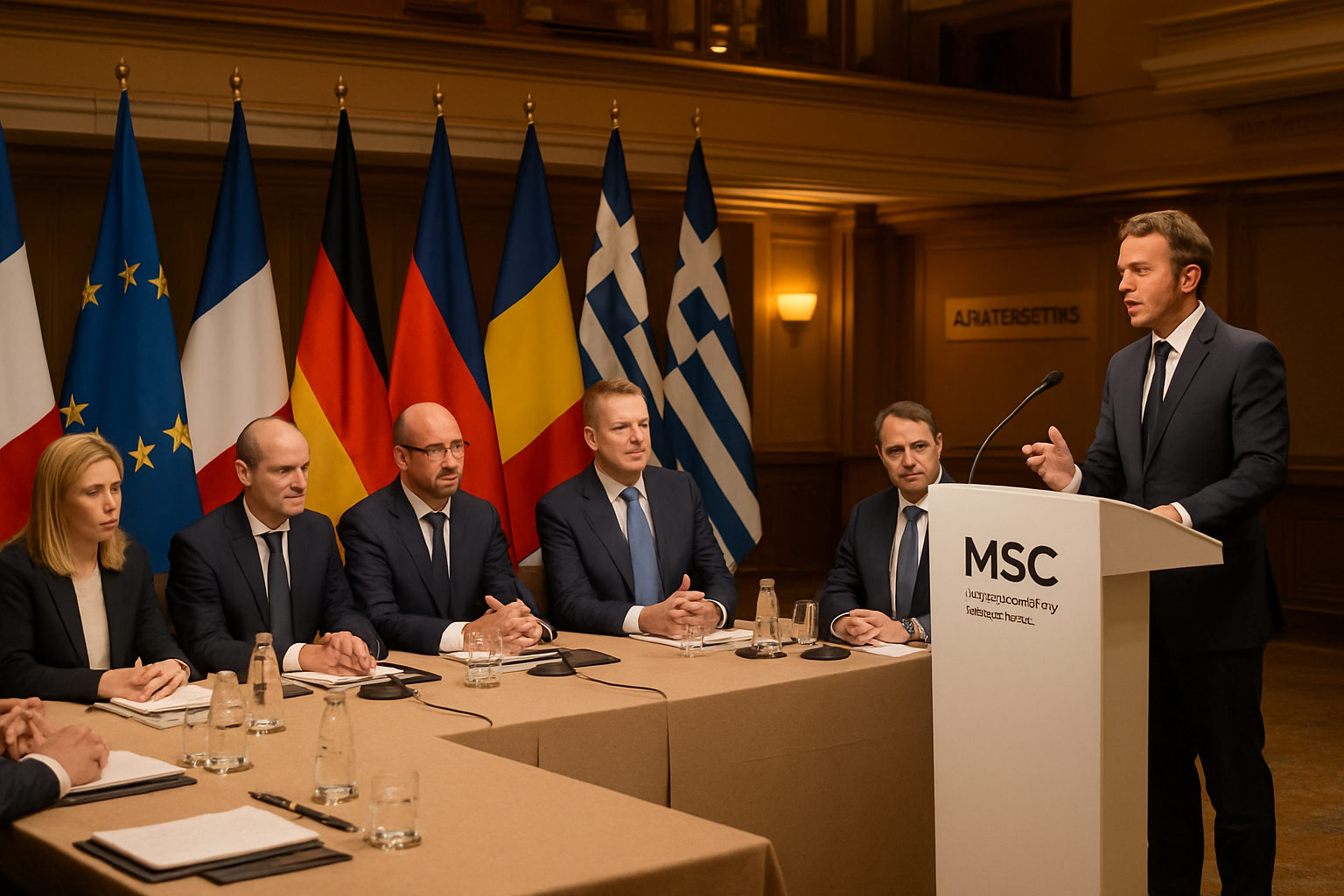
French President Emmanuel Macron delivered a defiant speech at the 62nd Munich Security Conference on Friday, declaring that Europe must become "a geopolitical power that can provide its own security" while criticizing the characterization of the continent as "timid" on the global stage.
Speaking to European leaders gathered in Munich, Macron rejected what he called the "vilification" and "caricaturing" of Europe, asserting that "everyone should take their cue from us." The French president's remarks came amid deepening transatlantic tensions and notable absences from the American delegation.
US Absence Highlights Transatlantic Strain
The conference was marked by the conspicuous absence of US Secretary of State Marco Rubio from a critical meeting of Ukraine supporters. According to German media reports, Rubio was scheduled to join discussions with leaders from Germany, France, Poland, and European Commission representatives but canceled at the last moment citing "scheduling conflicts."
European officials privately characterized Rubio's absence as signaling declining American interest in involving European allies in Ukraine conflict resolution efforts. The no-show occurred just days before scheduled direct talks between Russia and Ukraine, mediated by the United States but excluding European participation.
"The Trump administration is pressuring both sides according to this timeline. When certain leaders urge Ukraine to accept defeat, they overestimate Russia - this is a huge strategic error,"
— Emmanuel Macron, French President
European Nuclear Deterrent Discussions
Against this backdrop of American disengagement, European capitals are quietly exploring nuclear deterrent capabilities for the first time since the Cold War's end. According to Bloomberg sources familiar with the discussions, high-level talks between military officials and government representatives are examining how Europe might develop its own nuclear umbrella.
Lithuanian reports suggest these deliberations are awaiting signals from Macron, who has previously advocated for France's nuclear deterrent to serve broader European interests. The discussions reflect growing concerns about America's commitment to NATO's Article 5 guarantees under the Trump administration.
Context of Crisis
The Munich Security Conference takes place amid multiple cascading crises that have strained the Western alliance. The recent expiration of the New START treaty between the US and Russia on February 5 eliminated nuclear arms control constraints for the first time in over 50 years. UN Secretary-General António Guterres warned that nuclear risks are now "higher than at any time in decades."
Meanwhile, the Ukraine conflict continues to escalate despite ongoing peace negotiations. Russian forces captured 481 square kilometers in January 2026, compared to 260 square kilometers in December, demonstrating an acceleration in territorial gains. Recent energy infrastructure attacks left over 1,170 Kyiv buildings without heating during minus-30°C temperatures.
European Unity and Divisions
The EU has responded with unprecedented financial support, approving a historic €90 billion loan package for Ukraine - the largest assistance package in EU history. However, the decision revealed ongoing European divisions, with Slovakia, Czech Republic, and Hungary refusing to participate in financing.
Sweden and Denmark announced an additional €246 million air defense package, including advanced Tridon Mk2 systems, demonstrating Nordic commitment to collective security. These commitments contrast sharply with American unpredictability under the Trump administration.
German Leadership Perspective
German Chancellor Friedrich Merz echoed calls for European strength, emphasizing that Europe must actively advance its own interests while maintaining alliance relationships. German media highlighted Macron's criticism of US policy and his demand for more European "courage" in geopolitical affairs.
The German perspective reflects broader European frustration with what Spanish and Swedish sources described as America acting as a "wrecking ball" against international systems. This sentiment has been building since Vice President JD Vance's controversial 2025 remarks that created lasting strain in transatlantic relations.
Hungary's Perspective on Russian Vulnerabilities
Hungarian Prime Minister Viktor Orbán's delegation offered a different analysis of the geopolitical situation. Hungarian sources report that French officials described Russia as "completely dependent on China" while facing demographic problems and potential military setbacks.
This assessment supports Macron's broader argument that Western leaders are making a "huge strategic error" by overestimating Russian strength and urging Ukraine to accept territorial concessions. The French president emphasized that Russia's apparent strength masks fundamental vulnerabilities.
Peace Negotiations and European Exclusion
The conference occurs as Ukraine-Russia peace talks evolve toward potential direct negotiations in Washington, with a June 2026 deadline established by the Trump administration. Recent Abu Dhabi breakthrough achieved a 314-prisoner exchange and restored US-Russia military communications after a four-year suspension.
However, European leaders express concern about being marginalized from peace negotiations that will fundamentally affect European security. Macron insisted that "without Europeans, there will be no peace," emphasizing that lasting stability requires European involvement in any conflict resolution.
Strategic Autonomy Imperative
Macron's Munich speech represents the culmination of years of advocacy for European strategic autonomy. The French president argued that Europe must establish "rules of coexistence" with Russia while developing independent capabilities to defend continental interests.
This vision extends beyond military capabilities to encompass technological sovereignty, economic independence, and diplomatic leadership. European officials see the current crisis as a watershed moment that could either drive greater integration or expose terminal weaknesses in European cohesion.
Looking Toward June Deadline
As diplomatic efforts intensify toward the June peace deadline, European leaders face fundamental questions about the continent's role in global governance. The Munich Security Conference highlighted both European determination to assert independence and the practical challenges of achieving strategic autonomy.
The success or failure of European efforts to develop independent capabilities while maintaining transatlantic ties will likely determine the future of Western security architecture. With nuclear risks at historic highs and traditional alliance structures under strain, Europe's response to these challenges may define international relations for decades to come.
The 62nd Munich Security Conference will be remembered as a pivotal moment when European leaders chose defiance over deference, setting the stage for either renewed Western unity or fundamental realignment in global power structures.