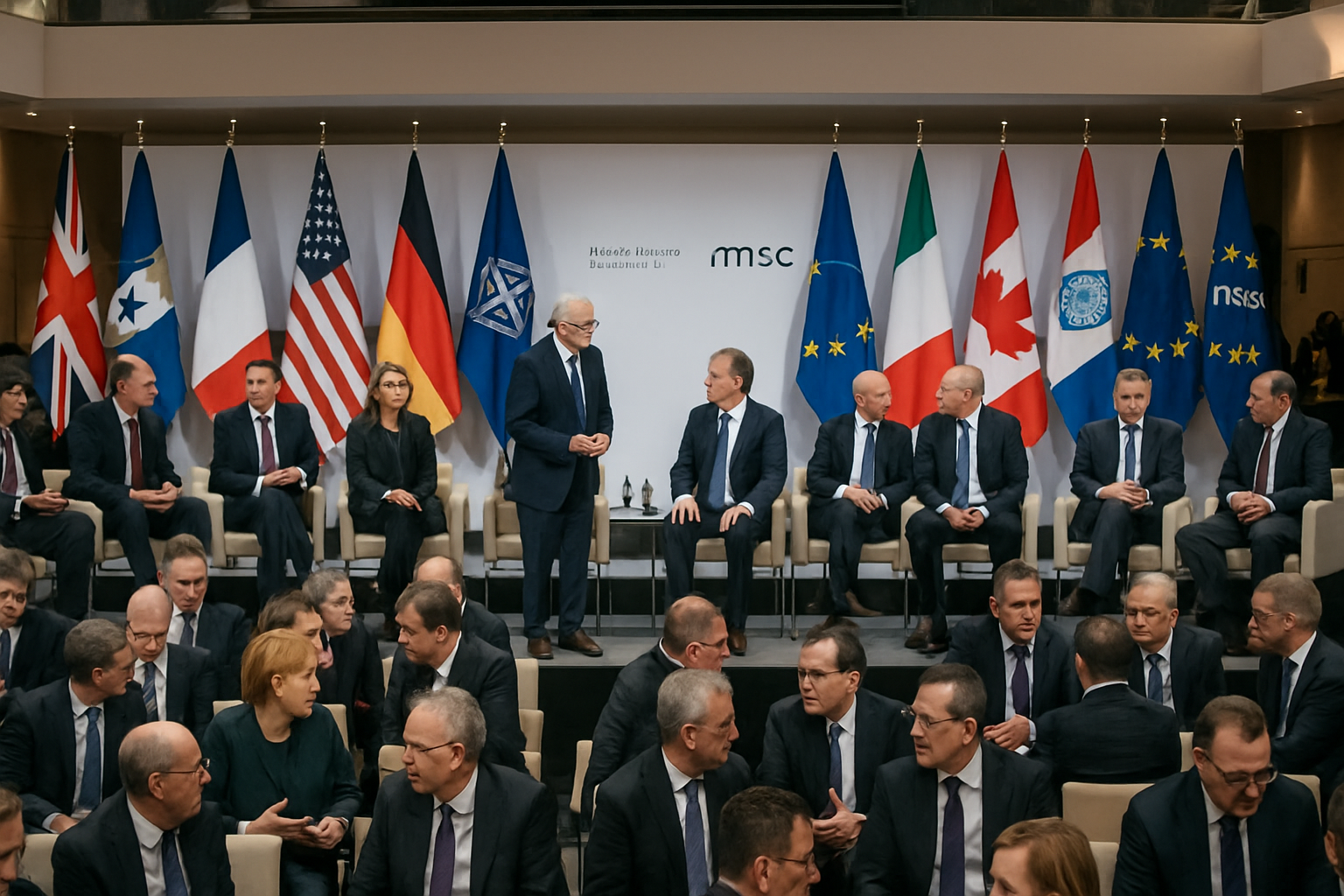
The 62nd Munich Security Conference concluded as a watershed moment for international relations, with US Secretary of State Marco Rubio attempting a diplomatic reset after a year of strained transatlantic ties while European leaders engaged in unprecedented discussions about strategic autonomy and nuclear deterrence alternatives.
Meeting under the sobering theme "Era of Disruptive Politics: Challenges to International Order," the conference brought together over 60 heads of state and government at the Hotel Bayerischer Hof in Munich from February 13-15, 2026. The gathering addressed critical global challenges including the ongoing Ukraine war, nuclear governance crises, and the deepest transatlantic strain since the Cold War.
Rubio's Diplomatic Reset Attempt
Secretary Rubio's keynote address declaring America and Europe "made to be together" represented a calculated attempt to repair relationships damaged by Vice President JD Vance's controversial 2025 remarks. The speech, which received a standing ovation from European leaders, cast America as a "child of Europe" while acknowledging the need for stronger transatlantic cooperation.
However, diplomatic sources noted that Rubio's absence from a critical Ukraine supporters meeting with German, French, and Polish leaders was interpreted as declining US interest in European-led initiatives. This absence highlighted ongoing tensions despite the softer rhetorical approach.
"We have restored the dialogue that was broken, but trust must still be rebuilt through actions, not just words."
— Senior European diplomat, speaking on condition of anonymity
European Strategic Autonomy Takes Center Stage
Perhaps the most significant development was the emergence of serious discussions about European strategic autonomy, including nuclear deterrence alternatives. For the first time since the Cold War's end, European capitals quietly explored nuclear umbrella capabilities beyond traditional US guarantees.
German Chancellor Friedrich Merz confirmed direct negotiations with French President Emmanuel Macron about nuclear cooperation, while Poland and Finland participated in preliminary conversations about extended deterrence arrangements. These discussions reflected deep concerns about the reliability of US security commitments under changing political circumstances.
European Commission President Ursula von der Leyen declared that Europe must "take on its responsibilities," while Macron emphasized in his closing remarks that Europe must become a "geopolitical power providing its own security."
Ukraine: Diplomatic Progress Amid Military Escalation
The conference occurred against the backdrop of significant diplomatic momentum in Ukraine peace efforts. The Abu Dhabi breakthrough in early February achieved a historic 314-prisoner exchange and restored US-Russia military communications after a four-year suspension.
President Zelensky met extensively with Rubio and other US officials, building toward potential Geneva peace talks scheduled for February 17-18. Despite this diplomatic progress, military escalation continued, with Russian forces accelerating territorial gains to 481 square kilometers in January versus 260 square kilometers in December 2025.
The systematic targeting of civilian infrastructure persisted, with energy attacks leaving over 1,170 Kyiv buildings without heating during minus-30°C temperatures. Zelensky disclosed that 55,000 Ukrainian soldiers had been officially killed, with a "large number" missing.

Nuclear Governance Crisis
The conference addressed multiple nuclear challenges that have created unprecedented uncertainty in global security architecture. The New START treaty's expiration on February 5, 2026, marked the first time in over 50 years without US-Russia nuclear constraints. UN Secretary-General António Guterres warned of a "grave turning point" with nuclear risks at their highest level in decades.
This nuclear governance vacuum provided additional impetus for European discussions about alternative deterrence arrangements. The restored US-Russia military communications now represent the only major diplomatic channel between the nuclear superpowers.
Broader International Engagement
The conference featured significant participation from beyond the traditional Western alliance. Pakistan's army chief Asim Munir met with Rubio to discuss regional security cooperation and counterterrorism efforts. Azerbaijan's President Ilham Aliyev participated in key discussions, while Chinese Foreign Minister Wang Yi engaged in managed "great power competition" dialogue with US officials.
Iranian opposition leader Reza Pahlavi made an unprecedented appearance, calling for Trump administration assistance for the Iranian people amid ongoing nuclear negotiations between Tehran and Washington.
NATO's Arctic Response
European allies demonstrated enhanced burden-sharing through the NATO Arctic Sentry mission launch. The UK committed to doubling its Norway troop presence from 1,000 to 2,000 over three years, while Sweden deployed Gripen jets for Greenland exercises. This European-led initiative addressed Russian Cold War-era base reopening and Arctic militarization concerns.
Economic and Energy Security
The conference addressed critical supply chain vulnerabilities, building on the US-EU-Japan critical minerals alliance announced days earlier. With China controlling 60% of global critical minerals production and 90% of refining capacity, Western allies emphasized the need for strategic economic coordination.
Energy security remained paramount, with discussions of European defense industrial cooperation and reducing dependence on volatile supply chains. The extreme European winter, with temperatures reaching minus-30°C, highlighted energy infrastructure vulnerabilities demonstrated by attacks on Ukrainian power systems.
Assessment and Future Implications
The Munich Security Conference 2026 marked a potential turning point in post-Cold War security architecture. European leaders chose strategic autonomy discussions over traditional deference to US leadership while attempting to maintain alliance relationships. The success or failure of developing independent European capabilities while preserving transatlantic ties will determine Western security architecture for decades.
The conference established precedents for crisis management, alliance coordination, and democratic resilience during what organizers called "the most critical period for determining international order since World War II." Whether this marks renewed Western unity through adaptation or continued fragmentation amid global power competition remains the pivotal question for international relations.
"We are witnessing the end of the post-war order as we knew it. The question now is whether we can build something better in its place."
— German Chancellor Friedrich Merz
As world leaders departed Munich, the coming months will test whether the diplomatic reset attempts and strategic autonomy initiatives can address 21st-century challenges including authoritarian resistance, technological disruption, and climate security intersections. The stakes extend far beyond Europe, affecting global governance mechanisms and conflict resolution frameworks worldwide.
The June 2026 Ukraine peace deadline, potential Washington venue talks, and ongoing nuclear negotiations with Iran will provide immediate tests of the frameworks and relationships established during these crucial three days in Munich.