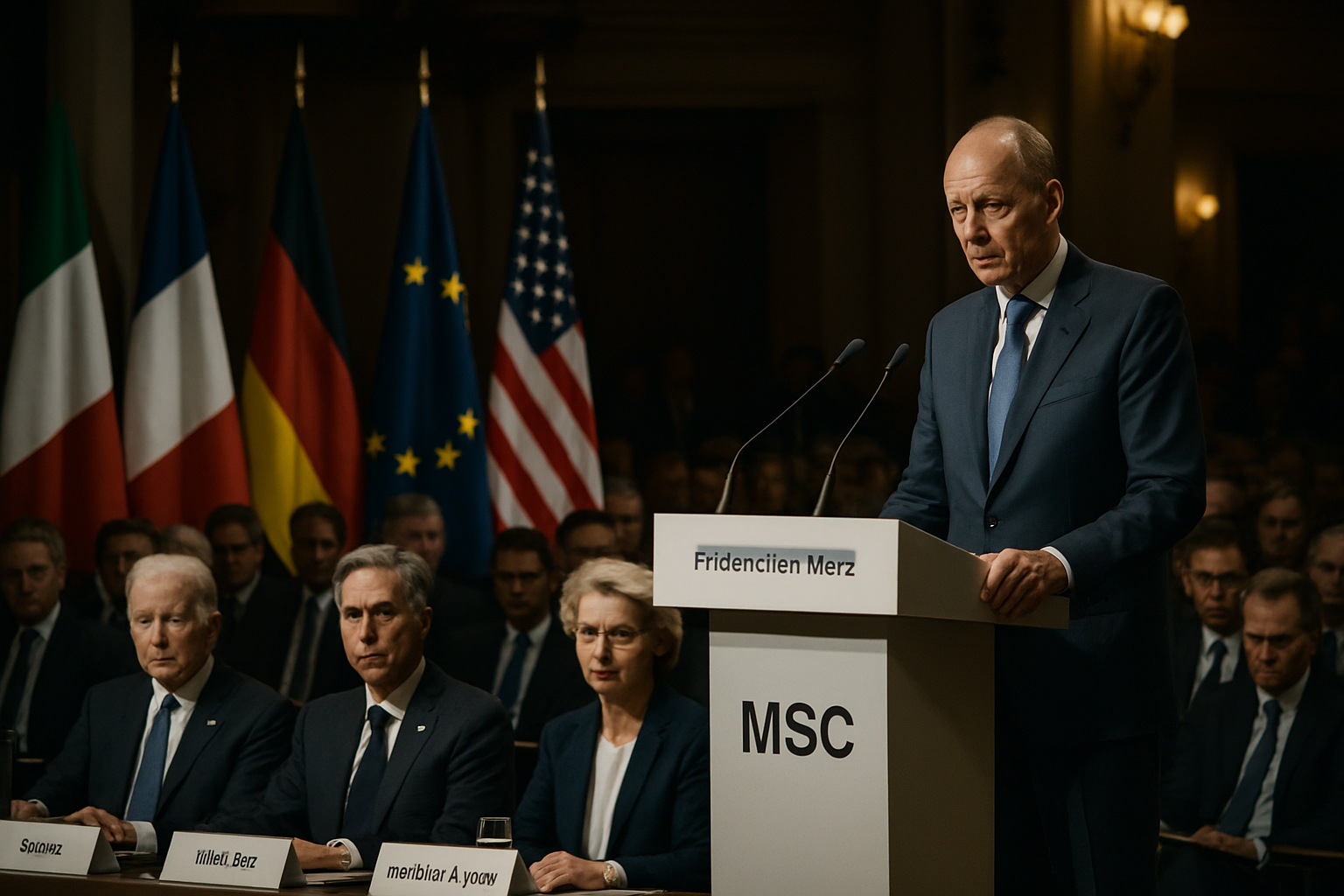
The 62nd Munich Security Conference opened Friday, February 13, 2026, in Munich with world leaders gathering under the sobering theme "The Era of Disruptive Politics: Challenges to International Order," marking one of the most consequential security summits in the conference's six-decade history.
German Chancellor Friedrich Merz delivered the opening address to delegates representing over 60 nations, declaring that "the post-war order no longer exists" as Europe and its allies confront unprecedented challenges ranging from the ongoing Ukraine conflict to deteriorating trans-Atlantic relations and emerging global threats.
High-Stakes Diplomatic Gathering
The conference brings together 15 European Union heads of state and government, with French President Emmanuel Macron scheduled to close the first day's proceedings. Ukrainian President Volodymyr Zelenskyy and U.S. Secretary of State Marco Rubio are set to address delegates on Saturday, in what many view as a critical test of Western unity at a pivotal moment in global affairs.
The gathering occurs against the backdrop of significant diplomatic developments, including recent breakthrough talks in Abu Dhabi that achieved a 314-prisoner exchange between Ukraine and Russia—the first in five months—and the restoration of U.S.-Russia military communications after a four-year suspension.
According to sources familiar with the negotiations, American officials have established a June 2026 deadline for a comprehensive Ukraine peace agreement, with talks potentially moving to Washington venues in the coming weeks, suggesting unprecedented high-level U.S. engagement in conflict resolution efforts.
Trans-Atlantic Relations Under Strain
The conference atmosphere reflects what conference organizers describe as "notably more somber" than previous years, with the 2026 theme representing a significant departure from last year's focus on multipolar world dynamics. This shift reflects harsh geopolitical realities that have emerged since the previous gathering.
European leaders arrive in Munich carrying the weight of strained relations with Washington, particularly following controversial remarks by Vice President J.D. Vance during his 2025 Munich appearance that created what diplomatic sources describe as an "unprecedented breach" in trans-Atlantic relations.
"We Europeans are making our preparations for the new era."
— Chancellor Friedrich Merz, Opening Address
Secretary of State Rubio's participation is viewed as an attempt at diplomatic reset, with the Trump administration seeking to rebuild relationships damaged by previous policy approaches. European officials have described the current U.S. approach as a "wrecking ball" against international systems, creating lasting strain in the alliance.
Ukraine Crisis and Peace Prospects
The conference occurs at a critical juncture in the Ukraine conflict, with Russian forces having accelerated territorial gains to 481 square kilometers in January 2026, compared to 260 square kilometers in December 2025. The humanitarian situation has deteriorated dramatically, with over 1,170 Kyiv buildings without heating during extreme winter conditions reaching minus-30°C.
Despite military escalation, diplomatic momentum has built following the Abu Dhabi breakthrough. Ukrainian Defense Minister Rustem Umerov described recent trilateral talks as "substantial and productive," with detailed ceasefire monitoring discussions providing hope for broader agreements.
The European Union has approved a historic €90 billion loan package for Ukraine—the largest financial assistance program ever provided to a single nation—demonstrating sustained European commitment despite political pressures. Sweden and Denmark have contributed an additional €246 million for air defense systems, including advanced Tridon Mk2 technology.
Global Security Architecture in Question
Conference discussions are overshadowed by the February 5 expiration of the New START nuclear treaty between the United States and Russia—the first time in over 50 years that the superpowers lack bilateral nuclear constraints. UN Secretary-General António Guterres has warned of a "grave turning point," with nuclear risks reaching their highest levels in decades.
The restoration of U.S.-Russia military communications includes deconfliction protocols and incident prevention measures that extend globally, affecting operations in Syria, the Arctic, and Africa. This represents the most significant U.S.-Russia military agreement since the conflict began and provides the only major diplomatic channel between the nuclear superpowers.
Institutional Innovations and Regional Initiatives
Adding to the conference's significance, Ukraine has opened "Ukraine House" for the first time on the sidelines of the Munich gathering. Ukrainian Foreign Minister Andrii Sybiha and German Foreign Minister Johann Wadephul jointly inaugurated the facility, symbolizing enhanced Ukrainian integration into European security discussions.
The conference agenda extends beyond European concerns to address Middle Eastern security challenges, including Gaza reconstruction efforts and Venezuela's political transition. Trump's newly established Board of Peace is scheduled to meet February 19, targeting over $1 billion in reconstruction commitments from 27 nations, with Hungarian Prime Minister Viktor Orbán confirming attendance.
Economic and Energy Security Dimensions
Energy security remains a central conference theme, with natural gas prices having surged 24% in Europe and 78% in the United States. The ongoing Russian strategy of targeting Ukrainian energy infrastructure during extreme winter conditions has been characterized by officials as "energy terrorism," affecting millions of civilians.
The conference addresses critical materials shortages that threaten renewable energy scaling, with China controlling 60% of production and 90% of refining for lithium, cobalt, and rare earth elements. Seven African countries are participating in a U.S.-EU-Japan Critical Minerals Partnership to diversify supply chains away from Chinese dominance.
Security and Logistical Challenges
Munich authorities have deployed approximately 5,000 police officers to secure the conference venues around the Hotel Bayerischer Hof in the historic city center. The security operation represents one of the largest peacetime deployments for the annual gathering, reflecting heightened threat assessments and the gathering's increased geopolitical significance.
The conference provides space not only for official debates but also for informal exchanges and discrete bilateral meetings that often prove crucial for diplomatic breakthroughs. These behind-the-scenes discussions frequently produce more concrete results than public sessions.
Looking Ahead: Critical Decisions
As delegates convene through Sunday, the conference outcomes will significantly influence European security architecture, trans-Atlantic alliance adaptation, and international approaches to conflict resolution. The presence of Ukrainian President Zelenskyy alongside Secretary of State Rubio on Saturday creates potential for breakthrough discussions on peace implementation timelines.
The June 2026 peace deadline established by the Trump administration creates unprecedented pressure for diplomatic innovation in territorial dispute resolution. Success could end Europe's deadliest conflict since World War II and provide a template for international conflict resolution, while failure might intensify military operations and undermine diplomatic credibility globally.
The Munich Security Conference 2026 thus represents both a test of democratic resilience and an opportunity for innovative diplomatic solutions to challenges that threaten the foundations of international order established in the post-war era.