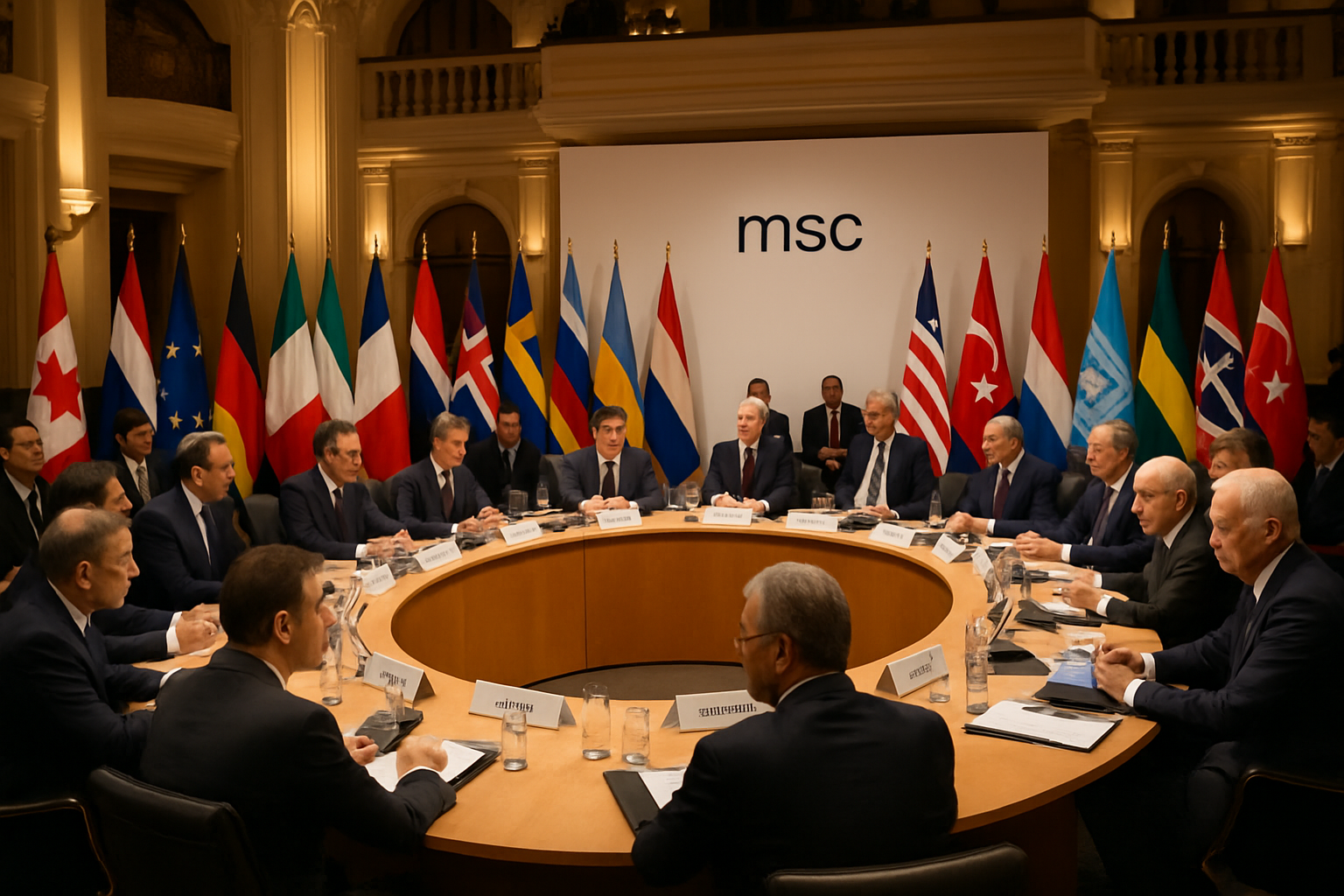
The 62nd Munich Security Conference opened Friday in Munich under the sobering theme "The Era of Disruptive Politics: Challenges to International Order," marking what organizers describe as the most critical gathering in the conference's history as Western leaders grapple with unprecedented strains on transatlantic relations and global security architecture.
German Chancellor Friedrich Merz delivered the opening address with an urgent appeal to Washington and European allies, declaring that the "post-war order no longer exists" and calling for immediate action to "repair and revive transatlantic trust together." Speaking to over 60 nations represented at the Hotel Bayerischer Hof, Merz emphasized that neither the United States nor Europe can face today's complex challenges alone.
Diplomatic Reset Attempt Amid Strained Relations
The conference atmosphere has been notably more somber than previous years, following last year's controversial speech by US Vice President JD Vance that European officials described as creating an "unprecedented breach" in alliance relations. This year, the United States is represented by Secretary of State Marco Rubio, whose early remarks suggest a more conciliatory and cooperative tone toward European allies.
Rubio's participation is viewed as a diplomatic reset attempt after European officials characterized the previous US approach as a "wrecking ball" against international systems. The Secretary of State confirmed he will meet with Ukrainian President Volodymyr Zelensky during the conference, signaling continued American engagement with the Ukraine crisis.
"Let's repair and revive transatlantic trust together. Together we are stronger."
— Friedrich Merz, German Chancellor
Ukraine War Casts Long Shadow
The conference occurs as Ukraine peace negotiations show both promise and peril. Recent Abu Dhabi trilateral talks between Ukraine, Russia, and the United States achieved significant breakthroughs including a historic 314-prisoner exchange—the first in five months—and restoration of US-Russia military communications after a four-year suspension.
However, these diplomatic gains come amid continued military escalation. Russian forces have accelerated territorial gains, capturing 481 square kilometers in January 2026 compared to 260 square kilometers in December 2025. The ongoing "energy terrorism" strategy has left over 1,170 buildings in Kyiv without heating during extreme winter conditions reaching minus-30°C.
Ukrainian Foreign Minister Andrii Sybiha and German Foreign Minister Johann Wadephul inaugurated the first-ever "Ukraine House" on the conference sidelines, demonstrating continued European support. President Zelensky disclosed that 55,000 Ukrainian soldiers have been officially confirmed killed since the invasion began, with a "large number" still missing.
Nuclear Governance Crisis
The conference confronts an unprecedented nuclear governance crisis following the February 5 expiration of the New START treaty between the United States and Russia—marking the first time in over 50 years without bilateral nuclear arms control constraints between the superpowers.
UN Secretary-General António Guterres warned of a "grave turning point" with nuclear weapon use risks "higher than at any time in decades." The treaty's expiration eliminates verification mechanisms, deployment limits, and transparency measures that have provided strategic stability for decades.
With Russia controlling approximately 4,380 nuclear warheads and the United States 3,708—representing 80% of the world's nuclear weapons—the loss of bilateral constraints creates dangerous uncertainty for global security architecture.
European Strategic Autonomy Push
Chancellor Merz's address marked a departure from traditional German diplomatic restraint, advocating for a more assertive European approach while maintaining alliance commitments. He called for Europe to "unlock its defense potential" by reducing bureaucracy and regulation that hampers military capabilities development.
The push for European strategic autonomy reflects growing concerns about American reliability under changing political dynamics. Canadian Prime Minister Mark Carney, speaking at the conference, invoked the potential of "middle powers" to maintain international stability when great power relations become unpredictable.
Romanian Defense Minister Radu Miruță emphasized that European allies increasingly recognize the need to produce more defense capabilities within the European Union, reflecting lessons learned from supply chain vulnerabilities exposed by the Ukraine conflict.
Middle East Tensions and Iran Factor
The conference agenda extends beyond European security to encompass Middle East stabilization efforts. President Zelensky's meeting with Reza Pahlavi, son of the former Shah of Iran and a leading opposition figure, highlights the interconnected nature of regional security challenges.
Iranian exiles gathered in Munich to remember victims of recent protests, while ongoing nuclear negotiations between Iran and the United States add another layer of complexity to the international security landscape.
Broader Geopolitical Realignment
California Governor Gavin Newsom's presence at the conference sent a pointed message to international leaders, emphasizing that "Trump is temporary" and urging global partners to consider planning for the next US president in three years. This reflects deeper questions about American political stability and policy continuity.
The conference occurs as European leaders navigate multiple pressures: maintaining alliance solidarity while building strategic autonomy, supporting Ukraine while managing domestic political pressures, and addressing global challenges while strengthening democratic institutions.
Economic Security Integration
Security discussions increasingly incorporate economic dimensions, with leaders addressing supply chain vulnerabilities, critical materials shortages, and energy security challenges. China's dominance in critical mineral production—60% of global production and 90% of refining capacity—features prominently in strategic discussions about Western economic resilience.
The US-EU-Japan Critical Minerals Partnership, involving 55 countries and seven African suppliers, represents efforts to diversify supply chains away from Chinese control, demonstrating how economic and security policies have become inseparable.
Looking Toward Resolution
The Munich Security Conference serves as a crucial waystation before potential higher-level Ukraine peace negotiations, with Washington venue talks scheduled that could involve presidential-level participation. The June 2026 peace deadline established by the Trump administration creates unprecedented urgency for diplomatic innovation.
Success at Munich could establish frameworks for addressing not only the Ukraine conflict but broader challenges facing the international order. The conference's ability to bridge transatlantic differences while maintaining unified responses to authoritarian challenges will determine whether the Western alliance can adapt to 21st-century realities.
As Chancellor Merz emphasized in his closing remarks, the stakes extend far beyond any single crisis: "The choices we make here will determine whether democratic values and international law remain the foundation of global order, or whether we enter an era where might makes right."