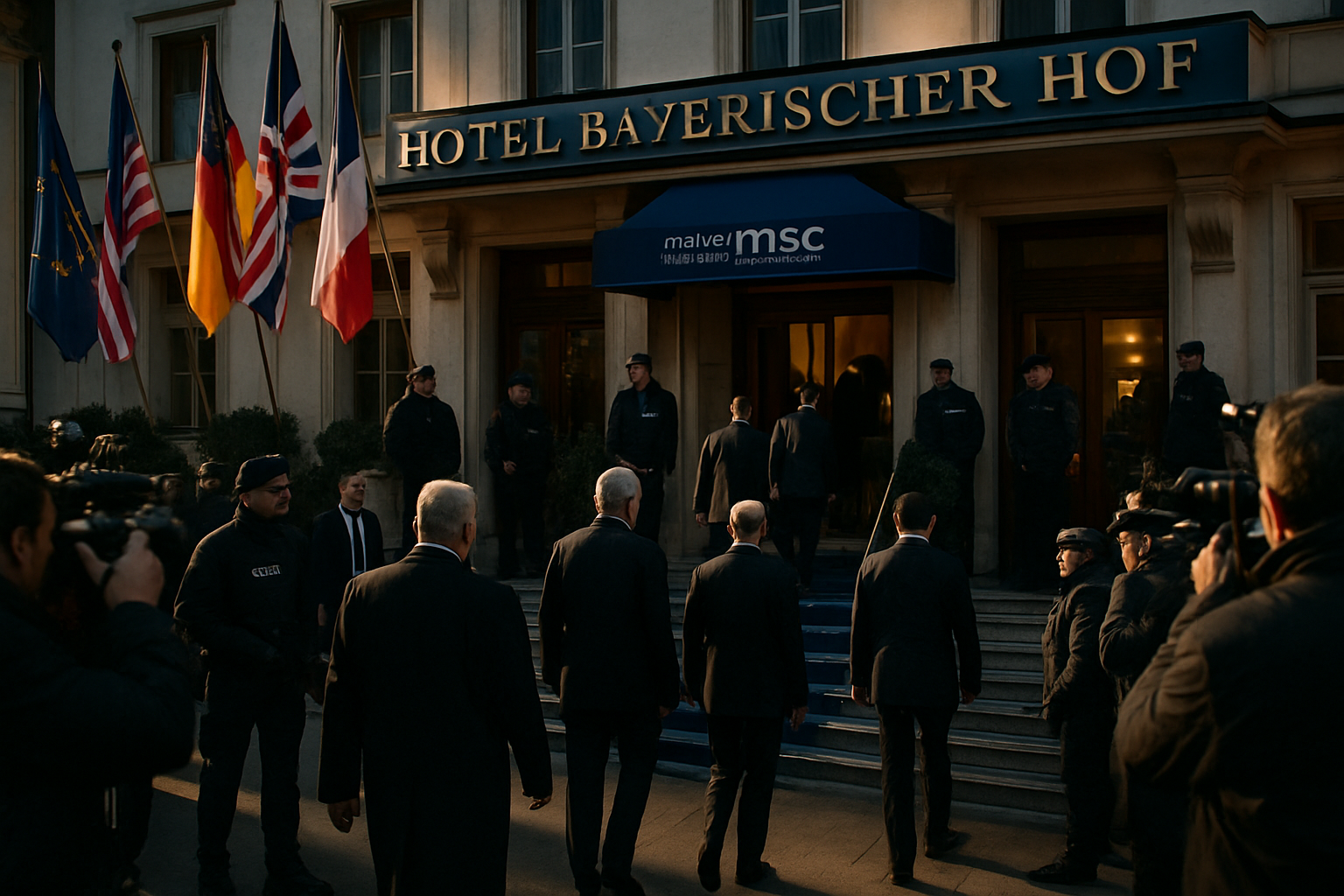
The 62nd Munich Security Conference opened Friday in the shadow of what its own report calls an international order "under destruction," as world leaders gather to address the most pressing security challenges facing the transatlantic alliance.
Global leaders and security experts have converged at Munich's Hotel Bayerischer Hof for the annual security forum that has become the premier venue for international diplomatic dialogue. This year's conference takes on particular significance as it occurs just one year after US Vice President JD Vance's controversial speech that shocked European allies and created lasting tensions in transatlantic relations.
Diplomatic Reset Efforts
US Secretary of State Marco Rubio is leading the American delegation in what many see as an attempt to repair the diplomatic damage from last year's contentious proceedings. German media reports suggest Rubio, described as a more mature "twin brother" of Vance, represents an opportunity to stabilize US-European relations that have been severely strained.
The timing is critical, as Rubio confirmed he will meet with Ukrainian President Volodymyr Zelensky during the conference. This bilateral encounter comes amid ongoing peace negotiations that have seen significant breakthroughs, including the recent Abu Dhabi trilateral talks that achieved a historic 314-prisoner exchange and restored US-Russia military communications after a four-year suspension.
Germany's Foreign Policy Vision
German Chancellor Friedrich Merz is scheduled to deliver a major foreign policy address that observers expect will outline Europe's strategic vision for navigating the evolving global security landscape. Germany's approach to the conference reflects broader European concerns about maintaining unity while adapting to new geopolitical realities.
With thousands of police officers deployed for security, the conference venue itself symbolizes the heightened tensions and security concerns that define contemporary international relations. The heavily fortified Hotel Bayerischer Hof has become emblematic of a world where diplomatic dialogue must occur under unprecedented security measures.
Ukraine at the Center
Ukraine's participation in the conference comes at a pivotal moment in the conflict. Recent diplomatic progress, including prisoner exchanges and restored military communications between the US and Russia, offers hope for meaningful negotiations. However, territorial disputes over eastern Ukrainian regions remain the fundamental sticking point in any comprehensive peace agreement.
The conference occurs as Ukraine faces intensified military pressure, with Russian forces accelerating territorial gains in January 2026, capturing 481 square kilometers compared to 260 square kilometers in December 2025. Energy infrastructure attacks have left over 1,170 Kyiv buildings without heating during extreme winter conditions, demonstrating Russia's continued use of civilian infrastructure as a strategic weapon.
International support for Ukraine remains robust, with the European Union recently approving a historic €90 billion support package - the largest financial assistance program ever provided by the EU to a single nation. Sweden and Denmark have contributed an additional €246 million air defense package, while NATO defense ministers are meeting in Brussels to coordinate continued military assistance.
The Vance Shadow
Last year's Munich Security Conference was marked by Vice President Vance's inflammatory remarks that European observers described as an unprecedented breach of diplomatic protocol. Spanish media characterized the US approach as treating America like a "wrecking ball" against the established international system, while Swedish sources noted the conference must address whether the damaged US-European relationship can be repaired.
The conference's own reporting describes the current international order as being "under destruction," reflecting the deep concerns among traditional allies about the sustainability of existing multilateral frameworks. This characterization underscores the magnitude of the challenges facing transatlantic cooperation.
Broader Security Challenges
Beyond the immediate Ukraine crisis, the conference agenda includes critical discussions on Middle East security, with ongoing tensions around Gaza and Venezuela also requiring attention. Italy's participation, represented by Foreign Minister Antonio Tajani and Defense Minister Guido Crosetto, highlights European commitment to addressing multiple regional conflicts simultaneously.
The nuclear dimension adds urgency to the proceedings, as the New START treaty between the US and Russia expired February 5, 2026 - marking the first time in over 50 years that the two nuclear superpowers operate without formal arms control constraints. UN Secretary-General António Guterres has warned that nuclear risks are now "higher than they have been in decades."
Economic and Diplomatic Dimensions
The conference takes place against a backdrop of evolving economic relationships, with recent agreements including the US-Argentina trade deal that eliminated over 1,600 American tariffs, and ongoing negotiations for expanded partnerships with India and other strategic allies. These bilateral approaches reflect the Trump administration's preference for direct agreements over multilateral frameworks.
Energy security remains a critical component of the discussions, particularly given the ongoing attacks on Ukrainian energy infrastructure and their implications for European energy markets. Natural gas prices have risen 24% in Europe and 78% in the United States, highlighting the economic dimensions of security policy.
Looking Forward
The Munich Security Conference serves as a crucial testing ground for international cooperation at a time when traditional alliances face unprecedented strain. The success of this year's gathering will be measured not just by the formal agreements reached, but by whether it can restore confidence in multilateral approaches to global security challenges.
With June 2026 established as a potential peace deadline for the Ukraine conflict, the discussions in Munich take on added significance as a potential turning point for European security architecture. The conference's outcome will influence whether the transatlantic alliance can adapt to new realities while maintaining its core principles of democratic cooperation and collective security.
As the conference unfolds through Sunday, the international community watches for signs of renewed cooperation and concrete progress on the most pressing security challenges of our time. The stakes could not be higher for the future of international order and transatlantic relations.