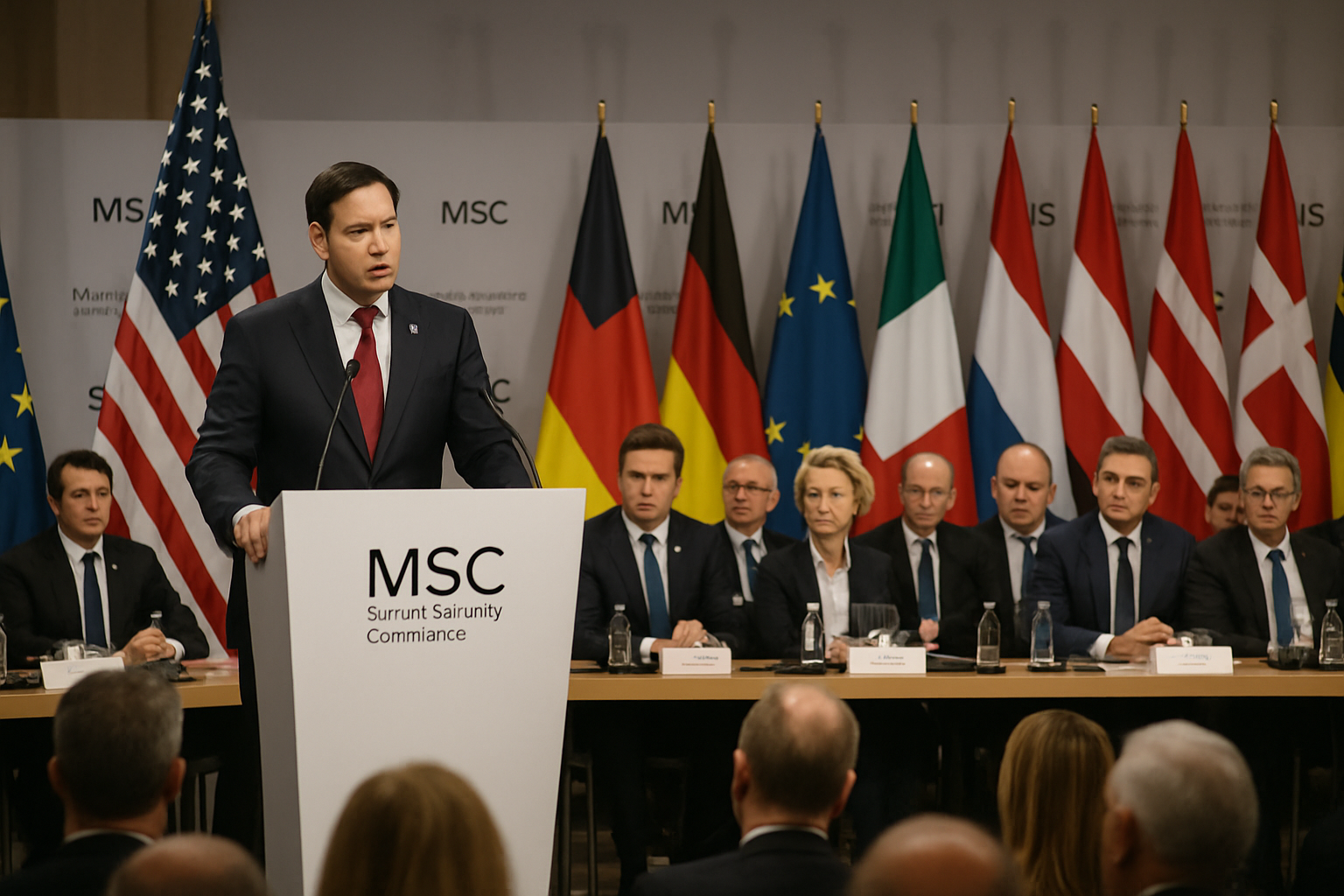
US Secretary of State Marco Rubio delivered a landmark address at the Munich Security Conference on Saturday, declaring that America and Europe "are made to be together" and calling for a revitalized transatlantic alliance, marking a dramatic shift from last year's controversial remarks by Vice President J.D. Vance that severely damaged US-Europe relations.
Speaking to an audience of over 60 heads of state and government at the 62nd Munich Security Conference, Rubio emphasized that "we do not want our allies to be weak, because that weakens us. We want allies capable of defending themselves so that no adversary is ever tempted to test our collective strength." His remarks received a standing ovation from European leaders, signaling cautious optimism for repairing strained transatlantic ties.
European Leaders Demand Strategic Autonomy
German Chancellor Friedrich Merz, who opened the conference on Friday, went on record distancing himself from the United States, declaring that "American leadership is challenged, perhaps already squandered." Merz called for Europe to "switch the mental gear" and assume greater responsibility for its own security, emphasizing that "the cultural struggle of the MAGA movement is not ours."
French President Emmanuel Macron, delivering the conference's closing remarks, made an even bolder declaration that Europe must become "a geopolitical power providing its own security." For the first time since the Cold War's end, European capitals are quietly exploring nuclear umbrella capabilities, with Lithuanian sources suggesting they await signals from Macron on whether France's nuclear deterrent could serve broader European interests.
"Without Europeans, there will be no peace."
— Emmanuel Macron, French President
Addressing the Vance Legacy
Rubio's diplomatic reset comes exactly one year after Vance delivered what European officials characterized as an "unprecedented breach" in alliance relations. Last year's remarks were described by Spanish and Swedish sources as turning America into a "wrecking ball" against international systems, creating lasting strain that conference organizers acknowledged required urgent repair.
The current Munich Security Conference, themed "The Era of Disruptive Politics: Challenges to International Order," reflected what organizers called the most sobering assessment in the conference's 62-year history. The atmosphere was notably more somber than previous years, with multiple European leaders expressing concerns about American reliability under the Trump administration.
Ukraine Context Dominates Discussions
The conference occurs amid critical developments in the Ukraine conflict, with the Trump administration having established a June 2026 peace deadline following breakthrough talks in Abu Dhabi. Recent diplomatic progress includes the restoration of US-Russia military communications after a four-year suspension and a historic 314-prisoner exchange—the first in five months.
However, military escalation continues alongside diplomatic efforts. Russian forces accelerated territorial gains in January 2026, capturing 481 square kilometers compared to 260 square kilometers in December 2025. Energy attacks have left more than 1,170 Kyiv buildings without heating during minus-30°C temperatures, prompting NATO Secretary-General Mark Rutte to condemn the strikes as a "bad signal" during ongoing negotiations.
The European Union has demonstrated unprecedented support for Ukraine, approving a historic €90 billion loan package—the largest assistance program ever for a single nation. Sweden and Denmark have contributed an additional €246 million for air defense systems, including advanced Tridon Mk2 platforms.
Nuclear Governance Crisis Looms
The conference takes place against the backdrop of the New START treaty's expiration on February 5, 2026—the first time in over 50 years that the United States and Russia operate without bilateral nuclear constraints. UN Secretary-General António Guterres warned of a "grave turning point" with nuclear risks "higher than at any time in decades."
This nuclear governance crisis has added urgency to transatlantic coordination, particularly as China expands its nuclear arsenal and refuses to participate in multilateral arms control frameworks. The restoration of US-Russia military communications, achieved through the Abu Dhabi talks, now represents the only major diplomatic channel between the nuclear superpowers.
European Defense Commitments
Romanian Defense Minister Angel Tilvar emphasized that the European Union must produce more defense capabilities internally, reflecting growing consensus that Europe cannot rely solely on American protection. British Prime Minister Keir Starmer called for reducing "excessive dependence" on US military equipment through enhanced European industrial cooperation.
NATO has responded to these challenges by launching the Arctic Sentry mission, with the UK doubling its Norway troop presence from 1,000 to 2,000 over three years. Finland is contributing operational planning expertise, while Sweden is deploying Air Force units and Gripen jets to Greenland exercises, demonstrating enhanced European burden-sharing.
Rubio's Diplomatic Outreach
Despite the diplomatic reset attempts, Rubio notably missed a critical meeting with German, French, and Polish leaders focused on Ukraine support, citing scheduling conflicts. European officials interpreted this absence as evidence of declining American interest in European-led initiatives, highlighting persistent concerns about US commitment levels.
Rubio also used his Munich platform to defend the Trump administration's migration policies, declaring that "mass migration is a crisis that is transforming and destabilizing Western societies." This rhetoric resonated with some European leaders facing similar pressures but concerned others about the administration's broader ideological direction.
Looking Toward June
The Munich Security Conference positioned itself as a critical waystation before the potential Washington venue Ukraine peace talks, with the June 2026 deadline creating unprecedented diplomatic pressure. Success could establish new frameworks for international order adaptation to 21st-century challenges, while failure might accelerate military solutions and undermine diplomatic credibility globally.
The stakes extend far beyond individual conflicts to fundamental questions about democratic values, international law foundations, and global governance mechanisms. European leaders have chosen strategic autonomy over traditional American deference, while maintaining alliance relationships essential for collective security.
"Together we are stronger. But we must be able to defend ourselves."
— Friedrich Merz, German Chancellor
Strategic Implications
The 62nd Munich Security Conference will likely be remembered as a watershed moment when European leaders chose defiance over deference in their relationship with the United States. The success or failure of developing independent capabilities while maintaining transatlantic ties will determine the Western security architecture's future trajectory.
With over 5,000 police officers securing the Hotel Bayerischer Hof venues and unprecedented international attention, this year's conference established templates for crisis management, alliance coordination, and democratic resilience during what organizers called the most critical period for determining international order since World War II.
As the conference concluded, the fundamental question remains whether the transatlantic alliance can adapt to new geopolitical realities while preserving the democratic cooperation principles that have underpinned Western security for over seven decades. The coming months, particularly the June 2026 deadline for Ukraine peace talks, will provide crucial tests of whether renewed Western unity or fragmentation amid global power competition will define the next era of international relations.