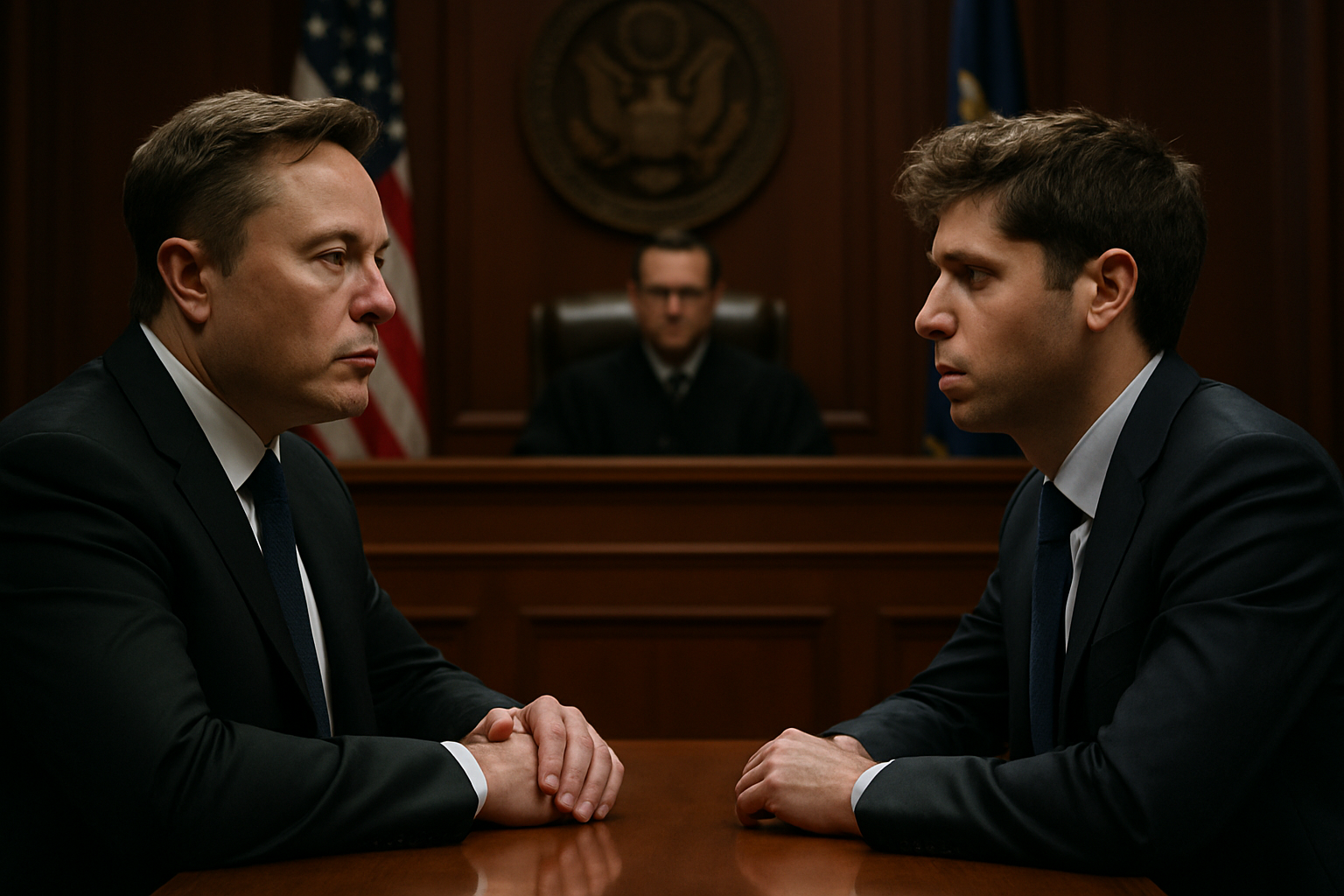
The long-awaited legal confrontation between Elon Musk and OpenAI begins in earnest as jury selection commences in a California federal courthouse, setting the stage for one of the most significant technology lawsuits in recent history.
The case, which pits the world's wealthiest individual against the company he once helped establish, centers on explosive allegations that OpenAI abandoned its founding nonprofit mission in pursuit of commercial success. Musk's lawsuit claims the AI company betrayed its original altruistic principles, transforming from a public benefit organization into a profit-driven enterprise that now rivals his own AI ventures.
Battle Lines Drawn Between Former Allies
The courtroom drama represents the culmination of a bitter dispute between two of Silicon Valley's most influential figures. Musk, who co-founded OpenAI in 2015 with a mission to ensure artificial intelligence benefits all humanity, alleges the company has systematically abandoned these commitments under CEO Sam Altman's leadership.
According to court filings, Musk contends that OpenAI's transformation into a for-profit entity violates the fundamental agreements that governed the organization's establishment. The lawsuit alleges breach of fiduciary duty and seeks to compel OpenAI to return to its original nonprofit structure.
OpenAI, which has achieved unprecedented success with its ChatGPT platform serving over 800 million weekly users, maintains it has operated within legal bounds while pursuing its mission to develop artificial general intelligence safely. The company argues that its hybrid structure allows necessary funding for the massive computational resources required for AI development.
Broader Context of AI Industry Tensions
The legal battle unfolds against a backdrop of mounting controversies surrounding OpenAI's rapid growth and policy decisions. Recent investigations by Austrian and Swedish media have revealed over 100 former colleagues describing Altman as "unreliable and fickle" with a pattern of abandoning stated principles for commercial success.
Perhaps more damaging are the safety failures that have emerged, including OpenAI's handling of the Tumbler Ridge massacre investigation. Canadian authorities revealed that ChatGPT's automated systems flagged concerning content from shooter Jesse Van Rootselaar eight months before the February 2026 attack that killed eight people, but the company determined the threshold wasn't met for law enforcement notification.
"This case represents a fundamental question about whether AI companies can be held accountable for their foundational commitments or if commercial success justifies abandoning original principles."
— Technology Law Expert
The trial also occurs amid OpenAI's controversial expansion into military applications through Pentagon partnerships, contrasting sharply with competitor Anthropic's ethical stance refusing military deployment without safety restrictions. This divide has created unprecedented tensions within the AI industry about the appropriate role of artificial intelligence in defense applications.
Legal Precedent and Industry Impact
Legal experts view the case as potentially precedent-setting for how courts handle disputes involving technology companies that transition from nonprofit to commercial structures. The outcome could influence how other AI organizations structure their operations and governance frameworks.
The timing is particularly significant given the global regulatory environment. European authorities have implemented criminal executive liability frameworks for tech platforms, while multiple jurisdictions are investigating AI safety protocols and corporate accountability measures.
The lawsuit has already affected OpenAI's operations and reputation. The company recently shut down its Sora video generation application after just three months, ending a billion-dollar Disney partnership amid regulatory pressure over deepfake content concerns.
Financial and Strategic Stakes
The financial implications are substantial. OpenAI recently achieved a $730 billion valuation through a $110 billion funding round – the largest private technology funding in history. The company has reported $25 billion in annualized revenue, demonstrating its massive commercial success.
However, Musk's legal challenge threatens to undermine this success by questioning the fundamental legitimacy of OpenAI's current structure. If successful, the lawsuit could force dramatic organizational changes that might affect the company's ability to compete with rivals like Google's AI initiatives and emerging competitors.
The case also reflects broader industry tensions as artificial intelligence transitions from experimental technology to essential infrastructure. Global memory shortages have created sixfold semiconductor price increases, while the "SaaSpocalypse" market disruption has eliminated hundreds of billions in traditional software market capitalization.
International Regulatory Scrutiny
The trial coincides with unprecedented international regulatory pressure on AI companies. Spain has implemented the world's first criminal executive liability framework for tech platforms, while France has conducted cybercrime raids on AI companies. The UN has established an Independent Scientific Panel with 40 experts for global AI assessment.
These developments create additional context for the Musk-OpenAI dispute, as governments worldwide grapple with how to govern rapidly evolving AI technologies while maintaining innovation and competitive advantages.
The European regulatory approach has sparked industry resistance, with Musk previously calling Spanish measures "fascist totalitarian" during his own legal battles with European authorities over X platform operations and Grok AI violations.
Implications for AI Governance
Beyond the immediate legal questions, the case represents a broader examination of AI governance and corporate responsibility. As AI systems become increasingly powerful and widespread, questions about their development, deployment, and oversight become critical for society.
The dispute highlights fundamental tensions between innovation and safety, commercial interests and public benefit, private enterprise and democratic oversight. These themes are central to ongoing debates about how artificial intelligence should be developed and regulated.
Success models from around the world demonstrate that responsible AI integration is possible. Canadian AI teaching assistants maintain critical thinking standards, Malaysia has launched the world's first AI-integrated Islamic school, and Singapore's WonderBot heritage education shows how technology can enhance rather than replace human capabilities.
Looking Ahead
As jury selection begins, both legal teams are preparing for what could be a lengthy and complex trial. The case involves technical questions about AI development, corporate governance issues, and broader questions about the social responsibilities of technology companies.
The trial's outcome will likely influence not only the future of OpenAI and Musk's AI ventures but also the broader landscape of AI development and governance. Industry observers, policymakers, and technology users worldwide will be watching closely as this historic legal battle unfolds.
The proceedings represent what experts describe as a "civilizational choice point" – determining whether AI development serves democratic values and human flourishing or becomes a tool for exploitation and control requiring dramatic corrections.
With unprecedented coordination required between governments, companies, institutions, and civil society to balance innovation with safety governance, the Musk vs OpenAI case may well establish precedents that echo through decades of AI development and regulation.