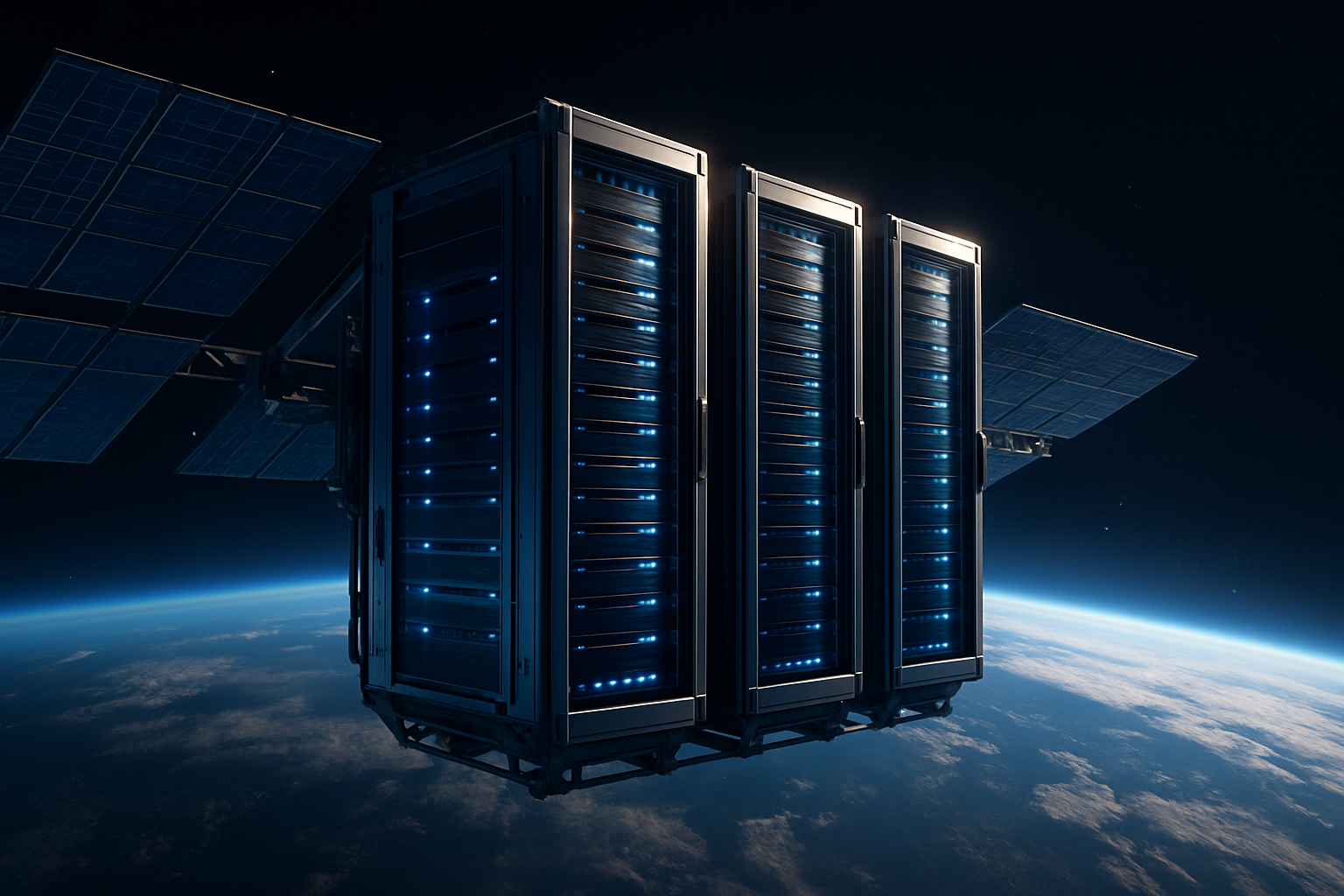
Elon Musk has boldly predicted that AI computing will become more cost-effective in space than on Earth within three years, as the technology industry grapples with an unprecedented global semiconductor crisis that has driven memory chip prices up sixfold.
The visionary announcement comes as part of Musk's broader strategy to revolutionize computing infrastructure through space-based data centers, leveraging the unique advantages of the orbital environment to address terrestrial constraints that are crippling the AI revolution.
The Perfect Storm: AI Demand Meets Supply Crisis
The global technology sector is experiencing what industry analysts are calling a "critical vulnerability window" that extends until 2027. Samsung, SK Hynix, and Micron—the world's three largest memory manufacturers—are operating at full capacity but cannot meet the explosive demand generated by AI development.
Consumer electronics costs have increased 20-30% over the past year, with the ripple effects extending far beyond individual purchases. Major corporations are feeling the squeeze: Alphabet has committed an unprecedented $185 billion to AI infrastructure in 2026, while Amazon's AI development plans exceed $1 trillion, demonstrating the massive capital requirements of modern AI systems.
The World Bank projects that AI systems will require 4.2-6.6 billion cubic meters of water annually by 2027 for data center cooling alone—equivalent to 4-6 times Denmark's total annual water consumption. This staggering demand for both computational resources and environmental resources has created an urgent need for alternative approaches.
Space-Based Computing: The Ultimate Solution
Musk's space-based data center concept, developed through the $1.25 trillion SpaceX-xAI merger, offers several compelling advantages over terrestrial facilities:
- Unlimited Solar Power: Continuous access to solar energy without day-night cycles or weather interference
- No Cooling Requirements: The vacuum of space provides natural heat dissipation, eliminating the massive cooling infrastructure needed on Earth
- Infinite Expansion Potential: Unlike terrestrial data centers constrained by real estate and zoning laws, orbital facilities can scale indefinitely
- Reduced Environmental Impact: Eliminates the billions of gallons of water consumed annually by Earth-based data centers
Industry projections suggest these advantages could make space-based computing cost-effective within 36 months, fundamentally altering the economics of AI development and deployment.
"Space-based AI data centers represent the most ambitious infrastructure project in human history, potentially solving our most pressing technological bottlenecks while opening entirely new possibilities for computation."
— Industry Analysis, March 2026
The Broader Space Economy Context
This development occurs during what experts are calling the transition from the "AI revolution to space economy golden age." SpaceX is preparing for a potentially trillion-dollar IPO in June 2026, while simultaneously pivoting its long-term strategy from Mars colonization to lunar city development within 10 years—a more pragmatic approach that leverages three-day travel times and real-time communication capabilities.
The space industry has demonstrated remarkable maturation, with NASA's fully AI-planned Mars rover missions succeeding in December 2025, and international cooperation continuing through ISS operations despite terrestrial tensions. Countries like Pakistan are sending astronauts to China's Tiangong station, while European nations are building rocket manufacturing facilities to achieve launch independence.
However, the industry also faces significant challenges. Space debris management has become critical, with over 34,000 tracked objects larger than 10 centimeters orbiting Earth at speeds of 17,500+ mph. Austrian scientists have documented the first atmospheric pollution measurements from rocket debris, showing tenfold elevated lithium concentrations—highlighting the need for sustainable space development.
Technical Challenges and Market Realities
Despite the promising advantages, space-based computing faces substantial technical hurdles. Radiation exposure, micrometeorite impacts, and the extreme costs of orbital maintenance represent significant challenges. Launch expenses, while decreasing through SpaceX's reusable rocket technology, remain substantial for the initial deployment of orbital infrastructure.
The current "SaaSpocalypse"—where AI systems have eliminated hundreds of billions in traditional software market capitalization—demonstrates both the disruptive potential and economic volatility surrounding AI development. Companies are scrambling to adapt business models as AI demonstrates direct replacement capabilities rather than mere complementary functions.
Meanwhile, regulatory frameworks are intensifying globally. Spain has implemented the world's first criminal executive liability framework for tech platforms, while France has conducted AI company cybercrime raids. The UN has established an Independent Scientific Panel with 40 experts—the first fully independent global AI assessment body—recognizing that AI governance requires unprecedented international coordination.
International Competition and Cooperation
The race for space-based computing supremacy is unfolding against a backdrop of multipolar competition. China has launched its fourth Shenlong reusable spacecraft, demonstrating growing confidence in cost-effective orbital access capabilities. The country's domestic AI chip development, including advances by companies like Moore Threads Technology, represents strategic moves toward technological sovereignty.
European nations are pursuing digital sovereignty through initiatives like Germany's Deutsche Telekom "Industrial AI Cloud" in Munich, while countries like Malta are positioning themselves as regulatory and financial hubs for the space economy, recognizing that participation doesn't require massive manufacturing infrastructure.
Blue Origin has filed FCC applications for a 51,600-satellite constellation to support space-based data centers, potentially challenging SpaceX's current dominance in orbital infrastructure. This competition could drive innovation and cost reductions, making space-based computing economically viable sooner than anticipated.
Human-Centered AI Development
Amid the technological race, successful AI integration models are emerging that prioritize human enhancement over replacement. Canadian universities have implemented AI teaching assistants that maintain critical thinking standards, Malaysia operates the world's first AI-integrated Islamic school, and Singapore's WonderBot 2.0 provides heritage education through culturally sensitive AI applications.
These examples demonstrate that the most promising path forward involves sophisticated human-AI collaboration that amplifies capabilities while preserving creativity, cultural understanding, and ethical reasoning that define human potential.
The Stakes and Timeline
March 2026 represents what many analysts consider a critical inflection point in the transition from experimental AI to essential infrastructure across all sectors. The convergence of infrastructure constraints, massive corporate investments, regulatory intensification, and international competition creates unprecedented coordination challenges.
Success requires resolving infrastructure constraints while maintaining innovation momentum, developing sustainable business models that prioritize human welfare, and establishing international cooperation frameworks that balance competitiveness with stability.
Musk's three-year timeline for cost-effective space-based AI computing may seem ambitious, but given the accelerating pace of space technology development and the urgent need for solutions to terrestrial computing constraints, it represents a realistic goal that could fundamentally transform how humanity approaches large-scale computation.
The window for effective coordinated action is narrowing rapidly as AI development accelerates. Whether space-based computing becomes a reality within Musk's predicted timeframe will largely determine not just the future of AI development, but humanity's broader relationship with both terrestrial resources and space-based infrastructure for decades to come.