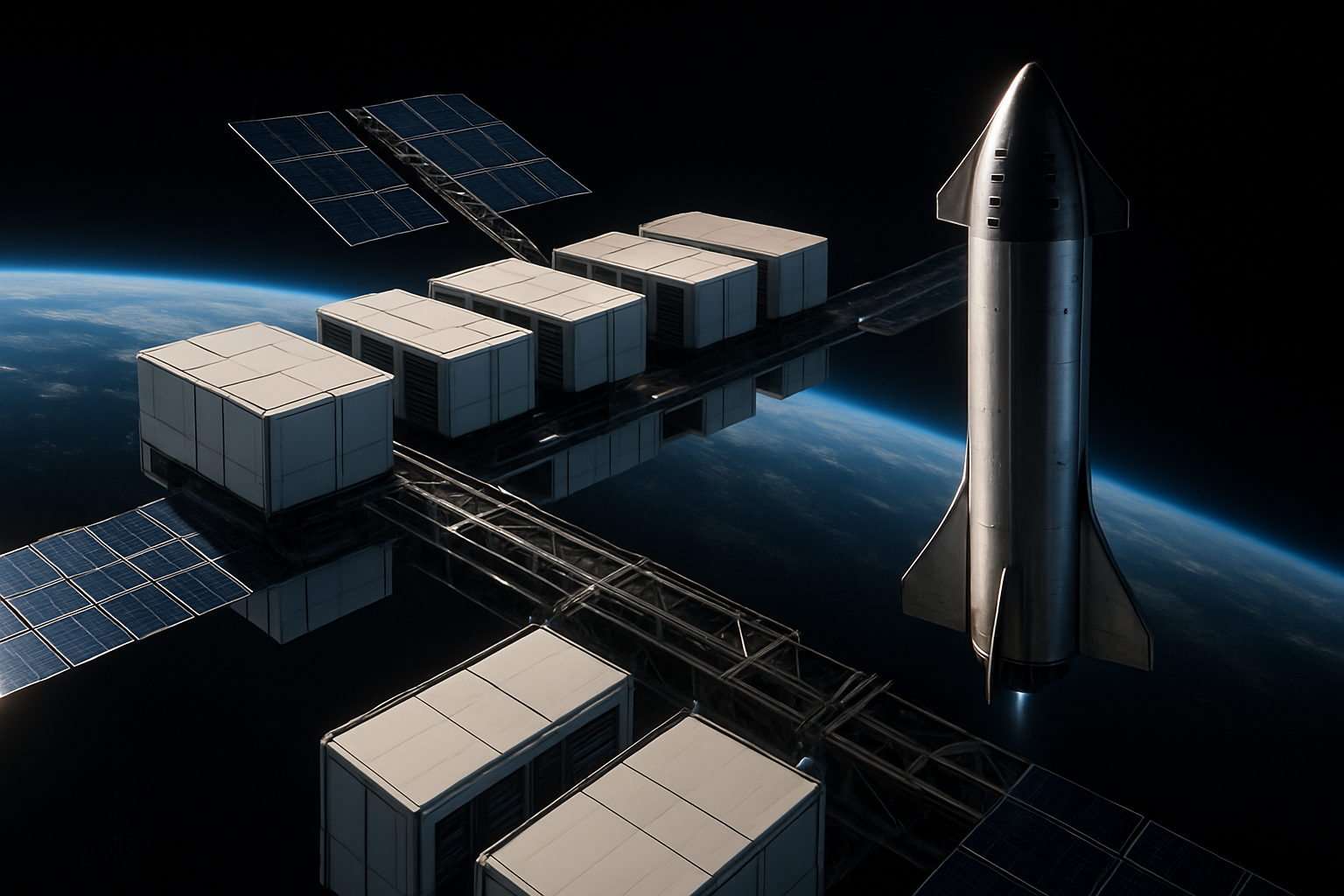
Elon Musk has orchestrated one of the most ambitious corporate mergers in history, with SpaceX acquiring his artificial intelligence startup xAI in a record-setting deal that creates a $1.25 trillion empire and unveils plans for revolutionary space-based data centers to power the future of AI.
The billionaire entrepreneur announced the acquisition on Monday through SpaceX's official website, confirming weeks of speculation about a potential merger between his aerospace and AI ventures. The transaction values SpaceX at $1 trillion and xAI at $250 billion, making the combined entity the world's most valuable private company.
Revolutionary Integration of Space and AI Technologies
The merger represents far more than a simple corporate restructuring. Musk envisions a vertically integrated operation that leverages SpaceX's rocket technology and Starlink satellite network alongside xAI's artificial intelligence capabilities, including the X social platform and Grok AI chatbot service.
According to sources familiar with the transaction, investors in xAI will receive 0.1433 shares of SpaceX for every xAI share they hold, with some executives having the option to receive cash payments instead. The deal unifies two of Musk's most ambitious ventures under a single corporate structure.
"Solar powered and space-based data centres are the only way to meet AI's burgeoning energy demands."
— Elon Musk, CEO
Addressing the AI Energy Crisis
The merger comes at a critical time for the artificial intelligence industry, which faces mounting challenges from skyrocketing energy consumption and infrastructure costs. Traditional data centers require enormous amounts of electricity and cooling, creating sustainability concerns and limiting AI development scalability.
Musk's solution involves constructing orbital data centers powered entirely by solar energy, eliminating terrestrial power grid dependencies and cooling requirements. The space-based approach could theoretically support unlimited expansion while addressing environmental concerns that have plagued the AI industry.
Industry analysts note that AI infrastructure costs have surged dramatically, with memory prices increasing sixfold in recent months. The merger positions the combined company to bypass these terrestrial limitations through innovative space-based solutions.
Market Dominance Strategy
The acquisition creates a formidable competitor in multiple sectors simultaneously. SpaceX brings its proven rocket technology, satellite manufacturing capabilities, and the Starlink constellation, while xAI contributes advanced artificial intelligence platforms that directly compete with OpenAI, Google, Meta, and Amazon-backed Anthropic.
European sources, including reports from France's Le Monde and Germany's Tagesschau, describe the merger as creating "the world's most expensive unlisted company." German media emphasized Musk's vision of operating one million data centers in space, highlighting the unprecedented scale of the proposed infrastructure.
The combined entity's capabilities span from launching satellites and managing space missions to developing cutting-edge AI systems and operating social media platforms. This vertical integration could provide significant competitive advantages across multiple technology sectors.
Public Offering Plans
Norwegian broadcaster NRK reported that Musk plans to take the combined company public at approximately $527 per share, which would represent one of the largest initial public offerings in history. The IPO timing coincides with SpaceX's previously announced plans to go public this year.
The public offering would provide retail investors access to what has been one of the most exclusive investment opportunities in the technology sector. SpaceX has maintained private status since its founding, limiting investment to accredited investors and institutions.
International Reaction and Analysis
International media coverage reflects both excitement and skepticism about the merger's viability. Greek financial publication Naftemporiki described it as one of Musk's "most ambitious career moves," while Italian sources focused on the strategic logic of combining cash-generating SpaceX operations with cash-intensive AI development.
Industry analysts question whether the technical challenges of space-based data centers can be overcome economically. Factors including radiation exposure, maintenance difficulties, and launch costs present significant hurdles to the space data center concept.
Timing and Strategic Context
The merger announcement comes amid several significant developments in Musk's business empire. Recently, SpaceX successfully implemented measures to prevent Russian forces from using Starlink terminals for drone operations in Ukraine, demonstrating the strategic importance of satellite internet infrastructure.
The timing also coincides with heightened competition in the AI sector, where companies are racing to develop more powerful and efficient computing solutions. Traditional tech giants have invested billions in terrestrial data centers, while Musk's space-based approach represents a radically different strategic direction.
Technical Challenges and Opportunities
Space-based data centers would operate in the vacuum of space, eliminating cooling requirements that consume significant energy in terrestrial facilities. Solar panels could generate continuous power without weather interference or day-night cycles affecting specific orbital positions.
However, the concept faces substantial technical obstacles. Radiation exposure could damage sensitive electronic components, while maintenance and upgrades would require costly space missions. Launch costs, despite SpaceX's reusable rocket technology, could make the approach economically challenging.
Proponents argue that advancing technology and economies of scale could make space-based computing economically viable. The unlimited expansion potential and environmental benefits could justify higher initial costs.
Future Implications
The SpaceX-xAI merger represents a paradigm shift in how technology companies approach infrastructure challenges. By combining space transportation capabilities with artificial intelligence development, Musk has created a unique entity capable of implementing solutions that would be impossible for traditional tech companies.
The success or failure of this merger could influence how other technology companies address growing infrastructure demands. If space-based data centers prove viable, the approach could reshape the entire technology industry's approach to computing infrastructure.
As the merged entity moves toward its planned public offering, investors and industry observers will closely watch whether Musk's latest ambitious vision can deliver on its revolutionary promises. The outcome will determine whether space-based computing becomes a reality or remains an expensive experiment in the billionaire's portfolio of bold ventures.