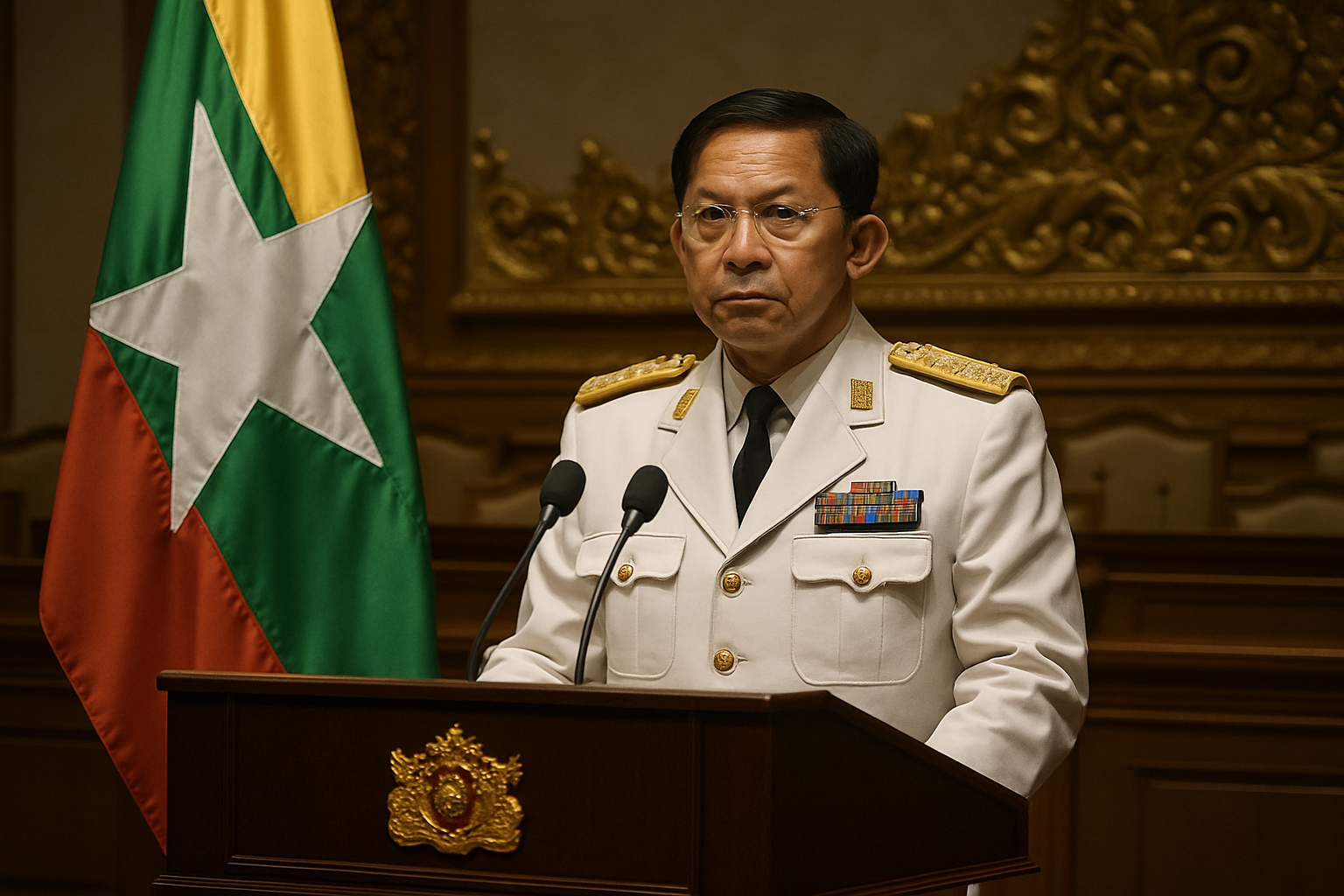
Myanmar's military strongman Min Aung Hlaing has been elected president by the country's pro-military parliament, formalizing his grip on political power in a war-torn nation five years after he orchestrated the coup that overthrew the elected government of Nobel laureate Aung San Suu Kyi.
The 69-year-old general won the parliamentary vote on Friday, April 3, marking a carefully engineered transition from military junta chief to civilian president following elections in December and January that international observers and critics have widely dismissed as a sham designed to perpetuate military rule behind a veneer of democracy.
The Orchestrated Path to Power
Min Aung Hlaing's ascension to the presidency represents the culmination of a systematic campaign to legitimize military rule that began with the February 2021 coup. His name notably did not appear on campaign ballots during the recent elections, nor did his photographs feature on campaign posters, yet he loomed large over the entire process as the architect of Myanmar's authoritarian transformation.
The transition comes amid a devastating civil war triggered by the 2021 coup, which has displaced millions of civilians and left vast swathes of Myanmar's borderlands under the control of armed resistance groups. Despite the ongoing conflict, the military proceeded with its electoral charade, with the army-backed Union Solidarity and Development Party winning in a landslide victory that surprised no international observers.
In the live broadcast of the parliamentary vote count, the chamber was dominated by the election-winning party and the military's constitutionally guaranteed quota of appointed armed forces legislators. The process demonstrated the extent to which Myanmar's democratic institutions have been co-opted to serve military interests.
A General's Journey to Absolute Power
Min Aung Hlaing's rise to power has been marked by systematic violations of human rights and international law. Since ousting Aung San Suu Kyi's democratically elected government, he has overseen a brutal crackdown on pro-democracy protesters that morphed into a nationwide armed resistance movement against military rule.
"The 69-year-old general orchestrated a 2021 coup against the administration of Nobel Peace Prize winner Aung San Suu Kyi and placed her under arrest, sparking widespread protests that morphed into nationwide armed resistance against the junta."
— International media coverage of the election
The carefully engineered electoral process that brought Min Aung Hlaing to the presidency has been denounced by Western governments and democracy advocates as a transparent attempt to provide international legitimacy to an illegitimate regime. The elections were conducted under severe restrictions, with genuine opposition parties banned and civil society organizations suppressed.
International Response and Regional Context
The international community's response to Min Aung Hlaing's presidential election has been muted, reflecting broader patterns of democratic backsliding across the region. The election occurred against the backdrop of significant geopolitical shifts in Southeast Asia, where military governments have increasingly tested the boundaries of acceptable behavior without facing meaningful consequences.
Myanmar's military government has benefited from the changing international landscape, where strategic interests often override democratic principles. The country's participation in regional economic partnerships and its strategic location have complicated international efforts to isolate the regime diplomatically.
The situation in Myanmar mirrors broader trends across the region, where traditional democratic institutions face pressure from authoritarian movements and where international responses have proven inadequate to address systematic violations of democratic norms.
The Human Cost of Military Rule
The transition from coup leader to president has occurred while Myanmar faces one of the world's most severe humanitarian crises. The civil war triggered by Min Aung Hlaing's 2021 coup has created catastrophic conditions for millions of ordinary citizens, with entire regions becoming ungovernable and basic services collapsing.
Armed resistance groups continue to challenge military authority across multiple fronts, while the regime's brutal counter-insurgency operations have targeted civilian populations suspected of supporting democracy movements. The systematic use of violence against civilians has prompted international human rights organizations to document extensive evidence of crimes against humanity.
Despite these conditions, Min Aung Hlaing's government has proceeded with its political engineering project, demonstrating a willingness to prioritize regime survival over human welfare. The presidential election represents an attempt to normalize military rule even as the country remains mired in conflict.
Economic Implications and Regional Stability
Myanmar's economic situation has deteriorated dramatically under military rule, with international sanctions, civil unrest, and the breakdown of governance structures contributing to widespread economic hardship. The formalization of Min Aung Hlaing's presidency is unlikely to address these fundamental problems, as the underlying political crisis remains unresolved.
The regime's attempts to attract international investment and economic partnership have been complicated by ongoing sanctions and the unstable security environment. Major international corporations have withdrawn from Myanmar, while regional economic integration has been hampered by the country's political isolation.
Regional stability has been affected by the spillover effects of Myanmar's crisis, with neighboring countries dealing with refugee flows and cross-border security challenges. The consolidation of military rule under Min Aung Hlaing's presidency may further entrench these problems rather than resolve them.
Looking Forward: Challenges and Prospects
Min Aung Hlaing's presidency begins with Myanmar facing multiple interconnected crises that his military government has proven unable to address effectively. The armed resistance movement shows no signs of weakening, while international pressure continues through targeted sanctions and diplomatic isolation.
The regime's strategy of seeking legitimacy through orchestrated elections has failed to convince international observers or domestic populations of its democratic credentials. Instead, the process has highlighted the extent to which Myanmar's institutions have been captured by military interests.
As Min Aung Hlaing assumes the presidency, Myanmar remains a country divided against itself, with no clear path toward resolution of the fundamental political crisis that has defined the past five years. The formalization of military rule may provide the regime with symbolic legitimacy, but it does nothing to address the underlying grievances that fuel continued resistance to authoritarian governance.
The international community faces critical decisions about how to respond to this latest development in Myanmar's democratic decline. The choice between engagement and isolation carries significant implications not only for Myanmar's future but for regional stability and the global defense of democratic principles in an era of increasing authoritarian assertiveness.