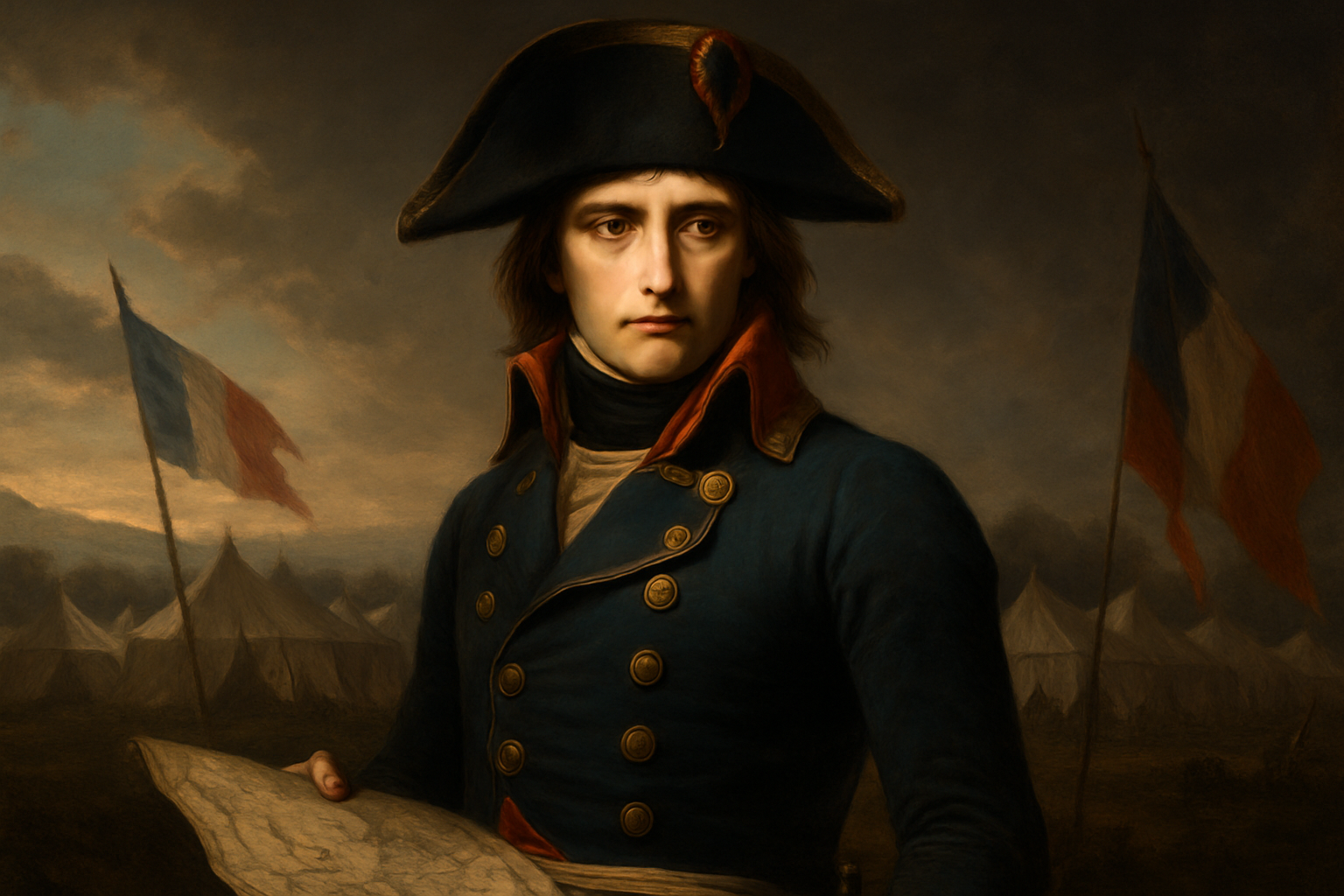
On March 2, 1796, the French Directory made a decision that would reshape European history for decades to come: the appointment of 26-year-old Napoleon Bonaparte as Commander-in-Chief of the Army of Italy. This pivotal moment transformed an ambitious but relatively unknown artillery officer into the military genius whose campaigns would echo through the centuries.
The year 1796 marked a fundamental rupture in both the history of the French Revolution and European geopolitics. The Directory's decision to entrust Napoleon with command of a demoralized, poorly equipped army represented a gamble that would prove to be one of history's most consequential military appointments. At merely twenty-six years of age, Bonaparte assumed responsibility for an army that was numerically inferior to the combined Austrian and Sardinian forces arrayed against it in northern Italy.
The Strategic Context: Revolutionary France Under Siege
By early 1796, revolutionary France found itself besieged on multiple fronts. The First Coalition, comprising Austria, Britain, Spain, and various Italian states, had been waging war against the French Republic since 1792. While French forces had achieved some successes on the Rhine and in Flanders, the Italian theater remained a secondary concern for the Directory, serving primarily as a diversionary front to draw Austrian attention away from Germany.
The Army of Italy, numbering approximately 30,000 men, was in deplorable condition when Napoleon assumed command. Soldiers had not been paid in months, equipment was obsolete or non-existent, and morale had reached its nadir. Facing them were 52,000 Austrian and Sardinian troops under experienced commanders who controlled the strategic mountain passes of the Maritime Alps and the Apennines.
"I found an army, but I found it scattered, without provisions, without discipline, without subordination."
— Napoleon Bonaparte, writing to the Directory in March 1796
The Young General's Revolutionary Approach
What distinguished Napoleon from his predecessors was not merely his tactical brilliance, but his revolutionary approach to warfare itself. Within days of assuming command, he had completely reorganized the army's structure, implementing innovations that would become hallmarks of Napoleonic warfare. His famous maxim, "I may lose a battle, but I shall never lose a minute," was immediately put into practice.
Bonaparte's first strategic insight was to recognize that his numerical disadvantage could be transformed into an advantage through superior mobility and concentration of force. Rather than attempting to engage the entire enemy coalition simultaneously, he developed a plan to defeat his enemies in detail—striking at the junction between Austrian and Sardinian forces before either could effectively support the other.
The Piedmont Campaign: Lightning Strikes
The young commander's first major test came in April 1796 with his lightning campaign against the Kingdom of Sardinia-Piedmont. In a series of battles that would establish his reputation—Montenotte, Millesimo, and Mondovì—Napoleon demonstrated the rapid maneuvering and concentrated attacks that would become his signature style.
The Battle of Montenotte (April 12, 1796) exemplified Bonaparte's tactical genius. By concentrating 20,000 French troops against 8,000 Austrians at the crucial mountain pass, he achieved local superiority despite overall numerical disadvantage. The victory opened the road to Turin and forced King Victor Amadeus III of Sardinia to seek a separate peace, effectively removing Sardinia from the First Coalition.
Transforming Warfare: The Napoleonic System Emerges
The Italian campaigns of 1796-1797 witnessed the birth of what military historians would later term the "Napoleonic system" of warfare. This revolutionary approach combined several key innovations that would dominate European battlefields for the next two decades.
Central to Napoleon's success was his mastery of logistics and communication. Where previous commanders had relied on slow-moving supply trains, Bonaparte pioneered the concept of armies living off the conquered territory—a strategy that dramatically increased mobility while reducing dependence on vulnerable supply lines. His establishment of rapid courier networks enabled unprecedented coordination across extended fronts.
"An army marches on its stomach, but it conquers on the speed of its information."
— Military maxim attributed to Napoleon's Italian campaigns
The Artillery Revolution
Napoleon's background as an artillery officer proved decisive in revolutionizing the role of cannons in warfare. Rather than using artillery as static defensive weapons, he concentrated guns in massive batteries that could be rapidly redeployed to achieve overwhelming firepower at crucial points in battle. This innovation would prove particularly effective at the Battle of Lodi (May 10, 1796), where Napoleon personally aimed cannons to devastating effect, earning him the nickname "Le Petit Caporal" (The Little Corporal) from his admiring troops.
The Conquest of Northern Italy: Victory After Victory
Following his triumph over Sardinia, Napoleon turned his attention to the Austrian forces occupying much of northern Italy. The campaign that followed—from April 1796 to April 1797—would establish him as one of history's greatest military commanders while simultaneously transforming the political landscape of Europe.
The liberation of Milan in May 1796 marked a crucial turning point. Napoleon's triumphant entry into the Lombard capital was orchestrated as a carefully staged political spectacle, presenting the French not merely as conquerors but as liberators bringing the ideals of the Revolution to oppressed Italian peoples. This masterful combination of military victory and political theater would become another hallmark of Napoleonic campaigns.
The Siege of Mantua: Strategic Masterpiece
Perhaps the most brilliant demonstration of Napoleon's strategic thinking came during the protracted siege of the Austrian fortress of Mantua. Rather than investing all his forces in a costly siege, Bonaparte used the fortress as a strategic magnet, repeatedly defeating Austrian relief armies while maintaining the siege. Four separate Austrian attempts to relieve Mantua—at Bassano, Arcole, and Rivoli—were turned into decisive French victories.
The Battle of Arcole (November 15-17, 1796) became legendary for Napoleon's personal leadership, including his famous charge across the bridge under enemy fire. More importantly, it demonstrated his ability to transform a potentially disastrous situation into a strategic triumph through tactical flexibility and inspiring leadership.
Diplomatic Revolution: Creating Client States
Napoleon's Italian successes extended far beyond military victory. His establishment of client republics—the Cispadane Republic, later merged into the Cisalpine Republic—represented a revolutionary approach to conquest that combined French revolutionary ideology with pragmatic political control.
These satellite states served multiple purposes: they provided a buffer against Austrian resurgence, generated substantial financial resources for France, and created a laboratory for implementing revolutionary reforms. The transformation of northern Italy into a collection of French client states would persist, in various forms, until Napoleon's final defeat in 1815.
"I have created a new political order in Italy, based not on ancient privileges but on the rights of man and the sovereignty of the people."
— Napoleon Bonaparte, addressing the Directory, October 1796
The Birth of Modern Military Leadership
The Italian campaigns revealed Napoleon's genius for understanding and manipulating the psychological dimensions of warfare. His famous addresses to his troops before major battles combined practical promises (regular pay, adequate supplies) with appeals to revolutionary idealism and personal glory. The Army of Italy became devoted to their young commander in ways that professional armies had rarely experienced.
This personal loyalty was carefully cultivated through Napoleon's practice of knowing his officers personally, visiting wounded soldiers, and sharing the hardships of campaign life. His famous retort to criticism about sleeping in a common tent—"A bed is for twenty-four hours; glory is for eternity"—epitomized the inspirational leadership style that would make him a legend among his soldiers.
Innovation in Military Organization
The Italian campaigns also witnessed Napoleon's revolutionary innovations in military organization. His development of the corps system—self-contained units combining infantry, cavalry, and artillery under unified command—provided unprecedented tactical flexibility. This organizational innovation would be adopted by virtually every European army by the end of the Napoleonic Wars.
Economic and Social Transformation
Napoleon's conquests in Italy generated enormous wealth for France while simultaneously transforming Italian society. The systematic plundering of Italian art treasures, while controversial, provided France with cultural capital that enhanced its prestige throughout Europe. More significantly, the implementation of revolutionary reforms—the abolition of feudalism, establishment of civil equality, and introduction of the metric system—began the modernization of Italian society that would continue throughout the 19th century.
The economic impact of the Italian campaigns extended far beyond immediate military considerations. The tribute extracted from conquered territories alleviated France's chronic financial crisis while the establishment of the Continental System's precursor trade policies began Napoleon's lifelong struggle against British commercial dominance.
International Ramifications: Reshaping European Balance
The success of Napoleon's Italian campaigns fundamentally altered the European balance of power. Austria's defeat in Italy forced Vienna to concentrate its efforts on defending its German territories, while the establishment of French hegemony in northern Italy threatened the independence of the Papal States and the Kingdom of Naples.
Perhaps most significantly, the Italian campaigns demonstrated to European monarchs that revolutionary France, under competent leadership, posed an existential threat to the old order. This recognition would drive the formation of subsequent coalitions and the escalation of what would become a twenty-year European war.
The Treaty of Campo Formio: Diplomatic Triumph
Napoleon's military victories culminated in the Treaty of Campo Formio (October 17, 1797), which he negotiated personally with Austrian representatives. This diplomatic success, achieved without consulting the Directory, established Napoleon as a political force independent of the revolutionary government that had appointed him. The treaty ceded the Austrian Netherlands to France while recognizing the Cisalpine Republic, effectively ending Austrian influence in Italy for the foreseeable future.
Legacy of the Italian Campaigns
The appointment of Napoleon as Commander-in-Chief of the Army of Italy on March 2, 1796, marked the beginning of a new era in European history. Within eighteen months, an obscure Corsican artillery officer had transformed himself into the most celebrated general in Europe while simultaneously revolutionizing the conduct of warfare itself.
The innovations pioneered during the Italian campaigns—rapid mobility, concentrated firepower, integrated combined-arms tactics, and revolutionary political organization—would dominate European battlefields for the next two decades. More broadly, Napoleon's success demonstrated the potential of revolutionary energy when channeled through military genius, setting the stage for the eventual establishment of the Napoleonic Empire.
"The Italian campaigns were where Bonaparte became Napoleon. They revealed not merely a talented general, but a force of nature that would reshape the destiny of Europe."
— Modern military historian assessment
Historical Significance and Modern Relevance
The events that began on March 2, 1796, continue to fascinate historians and military strategists alike. Napoleon's Italian campaigns represent one of history's most dramatic examples of how individual genius, operating within favorable historical circumstances, can fundamentally alter the trajectory of human events.
For military professionals, the Italian campaigns remain a case study in the principles of warfare that transcend technological change: the importance of speed and surprise, the effectiveness of concentrated force applied at decisive points, and the crucial role of leadership in maintaining unit cohesion and morale under extreme stress.
More broadly, the transformation of Napoleon from revolutionary general to emperor represents a pattern that has recurred throughout history whenever political upheaval creates opportunities for exceptional individuals to reshape their societies. The March 2, 1796 appointment thus stands as both a specific historical milestone and a timeless illustration of how ambitious individuals can exploit moments of crisis to achieve lasting historical significance.
As we reflect on this pivotal moment nearly 230 years later, the Italian campaigns serve as a reminder that individual leadership, strategic innovation, and historical timing can combine to produce consequences that echo across centuries. The young Corsican who accepted command of a demoralized army in March 1796 would, within a decade, crown himself Emperor of the French and reshape the map of Europe—all traceable to that fateful decision by the Directory to entrust their Italian campaign to an ambitious artillery officer whose name would become synonymous with military genius itself.