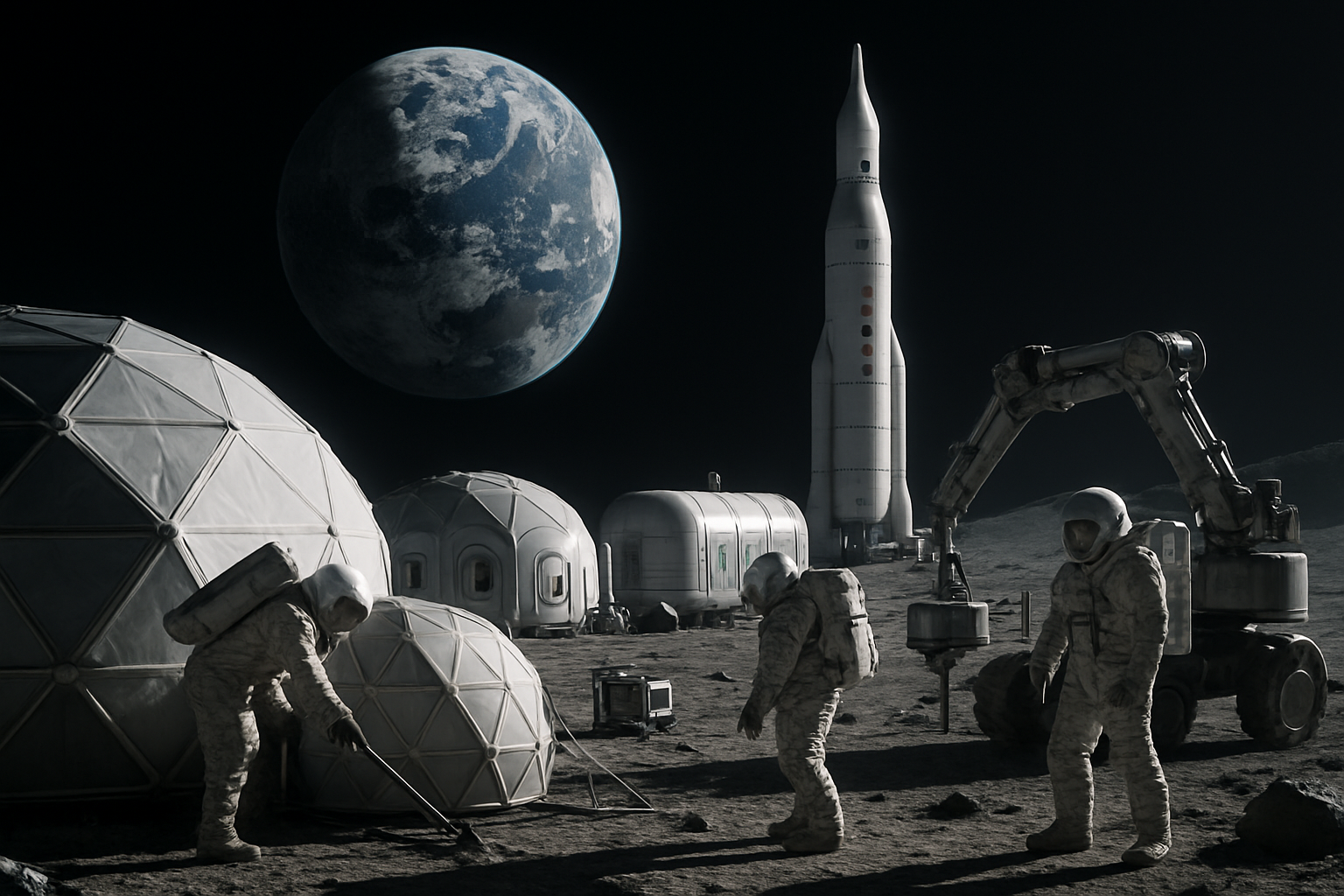
NASA Administrator Jared Isaacman announced a dramatic strategic pivot on Tuesday, canceling the troubled Lunar Gateway orbiting space station and redirecting $20 billion toward establishing a permanent lunar surface base by 2030, fundamentally reshaping America's space exploration priorities.
The decision follows a December presidential directive to accelerate lunar presence amid intensifying international competition. The Gateway components from Northrop Grumman and Vantor (formerly Maxar) will be repurposed for surface infrastructure rather than the originally planned orbiting outpost.
"The orbiting station, known as Gateway, is no longer a priority for the Artemis program, which aims for long-term U.S. presence on the moon," Isaacman stated during the announcement. The ambitious seven-year timeline represents a significant acceleration despite ongoing challenges with the Artemis II mission.
Technical Challenges Continue to Plague Artemis Program
The strategic shift comes as NASA's Artemis II mission faces continued delays due to persistent hydrogen leak issues and helium system failures affecting the Space Launch System (SLS) rocket. The crew of four astronauts—Canadian Jeremy Hansen, NASA's Reid Wiseman, Christina Koch, and Victor Glover—still awaits their historic 10-day lunar flyby, the first crewed mission beyond Earth orbit since Apollo 17 in 1972.
These technical setbacks have forced NASA to adopt a more methodical approach, prioritizing safety over schedule adherence. The SLS rocket, standing 322 feet tall and weighing 5.75 million pounds when fully fueled with over 700,000 gallons of liquid hydrogen and oxygen, represents the most powerful rocket NASA has ever built.
"We will only launch when we believe we are ready. The safety of our crew comes before any schedule pressure."
— Jared Isaacman, NASA Administrator
Nuclear-Powered Mars Initiative
Beyond the lunar base announcement, NASA revealed plans to increase robotic missions to the Moon and launch a nuclear spacecraft called Space Reactor 1 Freedom. This nuclear-powered system represents a crucial component for future Mars exploration, providing the energy density required for interplanetary missions and sustainable power for deep space operations.
The nuclear spacecraft initiative builds on decades of research into space-based nuclear power systems, addressing the fundamental energy challenges of maintaining human presence on Mars where solar power becomes significantly less effective due to the planet's distance from the Sun.
International Competition Drives Strategic Changes
The strategic pivot occurs during what analysts describe as the "space economy golden age," with international competition intensifying rapidly. China has announced plans for lunar crews by 2030, while SpaceX prepares for a potential trillion-dollar IPO in June 2026. Pakistan has selected astronaut candidates for China's Tiangong station missions scheduled for October-November 2026, demonstrating the democratization of space capabilities.
European nations are also asserting space independence, with Germany investing €10 billion in satellite systems and companies like Isar Aerospace building Swedish rocket testing facilities capable of producing 30 engines monthly. This competitive landscape has forced NASA to reconsider its approach to lunar exploration.
Canadian Partnership Under Uncertainty
The Gateway cancellation creates significant uncertainty for Canada's space program, particularly regarding the Canadian robotic arm (Canadarm3) that was specifically designed for the orbiting station. MDA Systems design engineer Beth Lymer and electrical lead Nadia Hiebert had been developing this advanced technology at their Brampton, Ontario facility.
Canadian astronaut Jeremy Hansen's role in the Artemis program continues, but the broader Canadian space industry must now adapt to NASA's surface-focused strategy. The shift may require renegotiation of existing agreements under the Artemis Accords framework.
Scientific and Medical Research Implications
The transition to a surface base approach will significantly impact ongoing space medicine research. Current ISS studies, including Sophie Adenot's record eight-month mission focusing on lung tissue cultivation and Space-Associated Neuro-Ocular Syndrome (SANS), provide crucial data for lunar settlement planning.
A permanent lunar base will require advanced life support systems, radiation shielding, and in-situ resource utilization capabilities. The research conducted on the ISS, combined with new technologies developed for the lunar surface, could revolutionize our understanding of long-duration space habitation.
Economic and Strategic Implications
The $20 billion investment represents one of the largest single commitments to space infrastructure in NASA's history. This massive allocation positions the United States as a leader in the emerging space economy, projected to exceed $1 trillion by 2030.
The permanent lunar base will serve multiple strategic purposes:
- Resource extraction and utilization for future Mars missions
- Technology demonstration for deep space exploration
- Scientific research platform for lunar and Earth sciences
- Training ground for Mars mission crews
- Strategic positioning in the new space economy
The base will also serve as a crucial stepping stone for Mars exploration, allowing astronauts to test equipment, procedures, and life support systems in a challenging environment that's still relatively close to Earth for emergency support.
Commercial Space Integration
NASA's strategy increasingly relies on commercial partnerships, reflecting the maturation of companies like SpaceX, which has demonstrated reliable crew transportation to the ISS and is developing the Starship system for lunar missions. This public-private cooperation model enables NASA to focus resources on exploration while leveraging commercial efficiency for routine operations.
The space-based data center industry, addressing the global memory crisis with sixfold semiconductor price increases, could benefit from lunar base infrastructure. Companies are exploring space-based computing solutions that offer unlimited expansion, continuous solar power, and no cooling requirements compared to terrestrial facilities.
Timeline and Challenges Ahead
The 2030 target for a functioning lunar base represents an ambitious acceleration from previous timelines. Success will require:
- Resolution of current Artemis II technical issues
- Successful completion of lunar flyby missions
- Development of reliable cargo delivery systems
- Construction of radiation-hardened habitats
- Establishment of sustainable life support systems
The project will need to overcome significant engineering challenges, including the harsh lunar environment with its extreme temperature variations, radiation exposure, and micrometeorite impacts. Previous space construction experience from the ISS will be valuable, but the lunar environment presents unique obstacles.
Global Space Governance Implications
NASA's strategic shift occurs as space governance frameworks evolve rapidly. Thailand currently chairs UN space governance discussions, while emerging nations gain increasing influence in space policy. The permanent lunar base project will likely require new international agreements addressing resource utilization, environmental protection, and peaceful use of space.
The Artemis Accords already provide some framework for international cooperation, but a permanent settlement will necessitate more detailed governance structures addressing everything from scientific data sharing to emergency assistance protocols.
Looking Forward
The cancellation of the Lunar Gateway and commitment to a $20 billion surface base represents NASA's most significant strategic pivot since the Space Shuttle program's conclusion. This decision reflects both the technical realities of space exploration and the competitive pressures of the modern space race.
Success in establishing a permanent lunar presence by 2030 could position humanity for the next major leap: crewed missions to Mars. The technologies, procedures, and experience gained from lunar base operations will be directly applicable to the Red Planet, making this investment a crucial stepping stone in humanity's expansion into the solar system.
As Administrator Isaacman emphasized, this represents a transition from temporary lunar visits to permanent human space settlement, requiring a fundamental shift in how we approach space exploration, from short-term missions to sustainable cosmic civilization development.