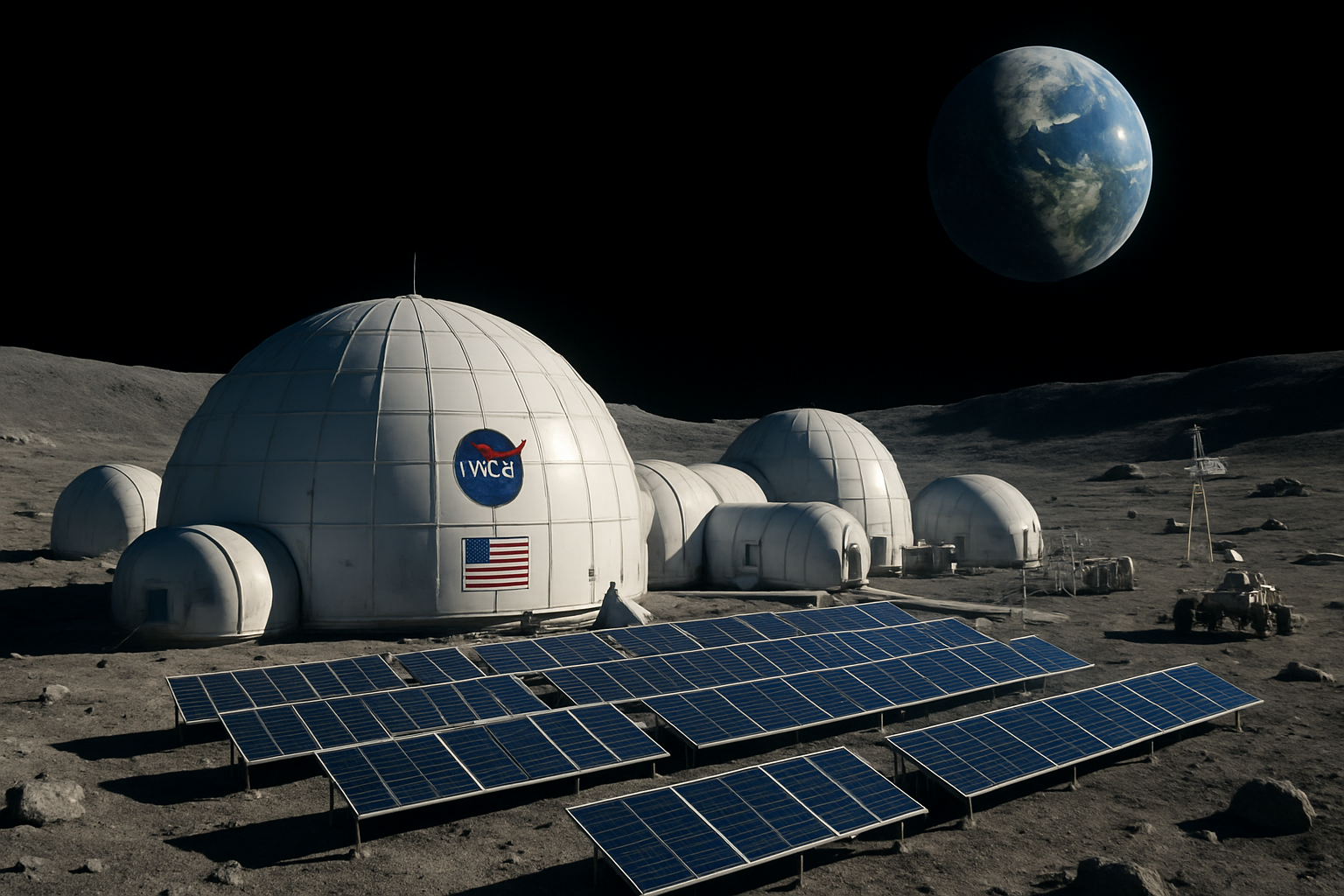
NASA Administrator Jared Isaacman has announced the agency's most ambitious lunar endeavor since Apollo, committing $20 billion to establish a permanent lunar base by 2030 while canceling the planned Lunar Gateway orbiting space station project.
The dramatic strategic pivot, revealed on March 25, 2026, responds to a December presidential directive calling for accelerated lunar presence amid intensifying international space competition. Components originally destined for the Gateway station, manufactured by aerospace contractors Northrop Grumman and Vantor, will be repurposed for surface infrastructure rather than orbital operations.
From Orbital Station to Surface Settlement
The decision represents a fundamental shift in NASA's lunar exploration strategy. Rather than establishing a staging area in lunar orbit, the agency will now focus entirely on creating sustainable infrastructure on the Moon's surface. This approach aims to establish continuous human presence on Earth's closest celestial neighbor within the ambitious seven-year timeline.
"This represents the largest space infrastructure commitment in NASA history," Isaacman stated, emphasizing the project's significance in positioning American leadership within the rapidly expanding space economy, projected to exceed $1 trillion by 2030.
"We're not just visiting the Moon this time – we're staying. This permanent base will serve as humanity's first stepping stone to becoming a truly spacefaring civilization."
— Jared Isaacman, NASA Administrator
Technical Challenges and Infrastructure Requirements
Establishing a permanent lunar base presents unprecedented engineering challenges. The facility will require comprehensive radiation shielding to protect inhabitants from cosmic radiation and solar particle events. Advanced life support systems must recycle air and water with near-perfect efficiency, while in-situ resource utilization technology will extract water and oxygen from lunar ice and regolith.
The base design draws upon decades of research conducted aboard the International Space Station, including critical studies on Space-Associated Neuro-Ocular Syndrome (SANS) and lung tissue cultivation in microgravity environments. French astronaut Sophie Adenot's record eight-month ISS mission has provided invaluable data on long-duration spaceflight effects essential for lunar settlement planning.
International Competition Drives Urgency
The accelerated timeline reflects mounting international competition in lunar exploration. China has announced plans to land crews on the Moon by 2030, while their Shenlong reusable spacecraft program continues advancing. Pakistan has selected astronaut candidates for China's Tiangong space station missions, demonstrating the democratization of space capabilities beyond traditional spacefaring nations.
European nations are also expanding their space independence, with Germany investing €10 billion in satellite systems and Sweden's Isar Aerospace facilities testing 30 rocket engines monthly. This competitive environment has prompted the United States to prioritize tangible lunar presence over gradual orbital development.
Artemis Program Integration
The lunar base initiative integrates with NASA's ongoing Artemis program, despite recent technical setbacks. The Artemis II mission, carrying Canadian astronaut Jeremy Hansen, NASA's Reid Wiseman, Christina Koch, and Victor Glover on a 10-day lunar flyby, has faced multiple delays due to hydrogen leak and helium system failures affecting the Space Launch System rocket.
However, NASA maintains its commitment to lunar surface operations, with the base serving as a destination for future Artemis missions. The facility will enable extended research expeditions, resource extraction activities, and serve as a training ground for eventual Mars exploration missions.
Economic and Scientific Implications
The $20 billion investment represents more than financial commitment – it signals a fundamental transformation in humanity's relationship with space. The lunar base will enable unprecedented scientific research, from astronomy observations in the Moon's radio-quiet environment to geological studies of the solar system's formation.
Resource extraction capabilities could provide materials for future space construction projects, while the base serves as a testbed for technologies required for Mars colonization. Advanced manufacturing in the lunar environment's low gravity and vacuum conditions may enable production of materials impossible to create on Earth.
Commercial Space Economy Integration
The announcement occurs during what analysts describe as the "space economy golden age," with SpaceX preparing a potentially trillion-dollar IPO in June 2026. The company's strategic pivot from Mars colonization to lunar city development aligns with NASA's surface-focused approach, creating opportunities for public-private partnerships.
Commercial space capabilities have matured significantly, with regular ISS crew rotations demonstrating reliable transportation systems. This commercial infrastructure will be essential for supplying the lunar base and transporting personnel during construction and operational phases.
Governance and International Cooperation
Establishing permanent human settlement beyond Earth raises complex governance questions. The Artemis Accords provide a framework for peaceful lunar exploration, but permanent settlements will require detailed agreements addressing resource utilization, environmental protection, emergency protocols, and data sharing arrangements.
The base will operate under international cooperation principles while maintaining American leadership. Canadian participation through the Artemis program, exemplified by Jeremy Hansen's role, demonstrates the collaborative approach essential for major space exploration initiatives.
Technical Timeline and Challenges
The 2030 target requires resolving current Artemis II technical issues and establishing reliable cargo delivery systems. SLS rocket specifications include a 322-foot height, 5.75 million pounds when fully fueled, and requires over 700,000 gallons of liquid hydrogen and oxygen propellant.
Construction will necessitate multiple heavy-lift launches to deliver habitat modules, life support systems, power generation equipment, and scientific instruments. The lunar environment presents extreme temperature variations, micrometeorite impacts, and radiation exposure that all systems must withstand.
Medical and Human Factors Research
Long-duration lunar habitation requires comprehensive understanding of human adaptation to reduced gravity environments. Current ISS research, including lung tissue cultivation studies and SANS investigations, directly informs medical protocols for lunar settlement.
The base will serve as a crucial stepping stone for Mars exploration, allowing researchers to study human adaptation to partial gravity (one-sixth Earth's gravity) over extended periods. This research is essential for planning eventual interplanetary missions requiring years-long journeys and surface operations.
Historical Significance and Future Vision
This lunar base initiative represents NASA's most significant strategic pivot since the Space Shuttle program's conclusion. Success would establish the foundation for sustained human presence beyond Earth, transitioning space exploration from temporary visits to permanent settlement.
The facility positions humanity at the threshold of becoming a multi-planetary species, with the Moon serving as a stepping stone to Mars and beyond. Advanced technologies developed for lunar operations will enable future exploration throughout the solar system.
As Administrator Isaacman emphasized, the project reflects both technical realities and competitive pressures in an era where space capabilities increasingly determine national strategic advantages. The coming years will prove crucial in determining whether this ambitious vision transforms into humanity's first permanent extraterrestrial settlement.