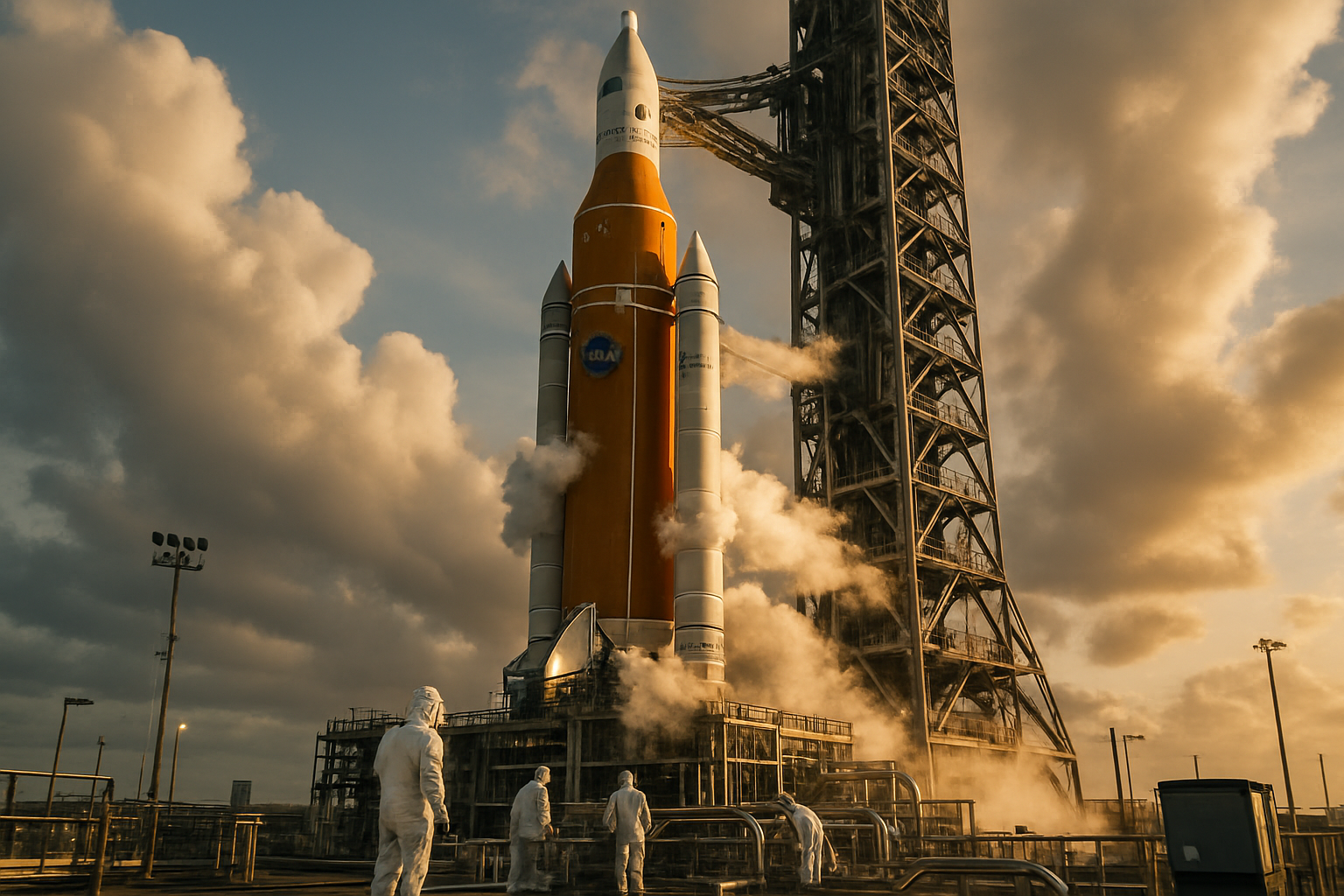
NASA announced another significant delay to the Artemis II lunar flyby mission on February 21-24, 2026, citing critical helium system failures affecting the Space Launch System rocket's upper stage, pushing the historic return to lunar orbit beyond the planned March 2026 launch window.
The latest setback represents the third major delay for the mission originally scheduled for February 2026, as engineers detected helium flow interruptions during final preparations that proved more severe than initially assessed. The helium system plays a crucial role in engine purging and fuel tank pressurization—critical safety functions that cannot be compromised for crewed missions.
Technical Challenges Mount for Artemis Program
According to sources from Azerbaijan and Czech Republic, NASA detected the helium flow issue overnight on February 20-21, following previous hydrogen leak problems during wet dress rehearsal testing. The Czech source described the situation as "another setback" (další technický problém) for humanity's ambitious return to lunar exploration, noting this marks the second major technical failure affecting the mission.
The 322-foot Space Launch System rocket, weighing 5.75 million pounds when fully fueled with over 700,000 gallons of liquid hydrogen and oxygen, represents NASA's most powerful launch vehicle ever constructed. The four-astronaut crew—Canadian Jeremy Hansen, NASA's Reid Wiseman (commander), Christina Koch, and Victor Glover—had been preparing for a 10-day lunar flyby covering 600,000 miles, marking the first crewed mission beyond Earth orbit since Apollo 17 in December 1972.

Safety-First Approach Reflects Institutional Learning
NASA Administrator Jared Isaacman emphasized the agency's commitment to astronaut safety, stating "we will only launch when we believe we are ready." This approach reflects institutional learning from historical space program tragedies, including the recent classification of Boeing's Starliner mission as a "Type A" mishap—the same severity level as the Challenger and Columbia disasters.
The methodical problem-solving approach builds long-term confidence in deep space systems, including life support, radiation protection, and navigation capabilities beyond Earth's magnetic field. These systems are essential for sustainable lunar presence and eventual Mars exploration, representing a fundamental shift in NASA's operational philosophy toward comprehensive safety over schedule adherence.
International Space Technology Surge Continues
While NASA grapples with Artemis delays, the global space technology sector continues experiencing unprecedented growth during what experts term the transition from "AI revolution to space economy golden age." SpaceX maintains regular crew rotations to the International Space Station and prepares for a potential June 2026 IPO that could value the company at over $1 trillion.
International cooperation flourishes through multiple channels: Pakistan has selected astronaut candidates for China's Tiangong space station mission scheduled for October-November 2026, Germany's Isar Aerospace is expanding with Swedish facilities testing 30 rocket engines monthly, and Thailand chairs UN space governance initiatives reflecting emerging nations' growing influence in space policy.
"The space industry at this critical inflection point requires thousands of satellites requiring protection, with massive constellation deployments planned by multiple companies."
— Space Industry Analysis, February 2026
Breakthrough Technologies Despite Program Delays
NASA's technical challenges with Artemis contrast sharply with the agency's remarkable achievements in other areas. The space agency successfully completed the first fully AI-planned Mars rover mission in December 2025, demonstrating autonomous navigation capabilities that eliminate Earth-based mission control delays. The revolutionary DAGGER AI system achieved 30-minute geomagnetic storm prediction capability, protecting satellites and electrical grids from solar storm damage.
Space medicine research continues advancing, with Portuguese scientists leading groundbreaking studies on Space-Associated Neuro-Ocular Syndrome (SANS), a condition affecting astronaut vision during extended missions. This research proves crucial for future lunar settlements and Mars exploration, addressing challenges that could affect crew safety during deep space operations.
Economic and Strategic Implications
The Artemis delays occur during a global memory crisis with sixfold semiconductor price increases affecting companies like Samsung, SK Hynix, and Micron. This shortage drives interest in space-based data center solutions, with SpaceX's merger with xAI potentially creating space-based computing infrastructure offering unlimited expansion without terrestrial constraints.
Commercial space capabilities continue advancing while government-led programs face setbacks. The contrast highlights the emerging dynamics between established space agencies and innovative commercial enterprises, with both approaches contributing essential elements to humanity's expanded space presence.

Global Competition and Cooperation Paradox
The space sector demonstrates a fascinating paradox of simultaneous cooperation and competition. While NASA collaborates internationally through ISS operations and the Artemis Accords, competitive dynamics intensify with China's Shenlong reusable spacecraft program, European manufacturing expansion, and emerging nations developing independent capabilities.
Recent atmospheric pollution research by Austrian scientists documented lithium concentrations elevated tenfold above normal levels from Falcon-9 rocket stage reentry, raising environmental questions as space activity increases exponentially. These findings underscore the need for sustainable space development practices as the industry transitions from experimental to essential infrastructure.
Looking Forward: Implications for Space Exploration
The Artemis II mission serves as a crucial stepping stone toward Artemis III lunar landing planned for 2027 and the establishment of sustainable lunar presence. Mission success would validate deep space life support systems, radiation protection capabilities, and navigation systems operating beyond Earth's magnetic field—technologies essential for Mars exploration and permanent space settlements.
Despite current delays, the mission represents generational achievement potential for the space industry. International collaboration through Canadian participation and broader Artemis Accords partnerships establishes precedents for future deep space missions requiring unprecedented international coordination and cooperation.
The Road Ahead
As NASA works to resolve helium system failures and hydrogen leak issues, the broader space technology ecosystem continues accelerating. The convergence of mature human space capabilities, breakthrough scientific discoveries, and commercial space enterprise growth positions 2026 as a watershed year for space exploration.
The methodical approach to Artemis technical challenges, while frustrating for timeline adherents, establishes the safety culture and technical sophistication necessary for humanity's expansion beyond Earth orbit. Success in overcoming these challenges will determine whether the late 2020s become remembered as the period when humanity truly became a spacefaring civilization.
February 2026 represents a pivotal moment where space exploration strategy has matured toward pragmatic lunar objectives while breakthrough technologies unlock unprecedented capabilities. The combination of international cooperation, commercial innovation, and safety-focused government programs establishes the foundation for sustained human presence throughout the solar system.