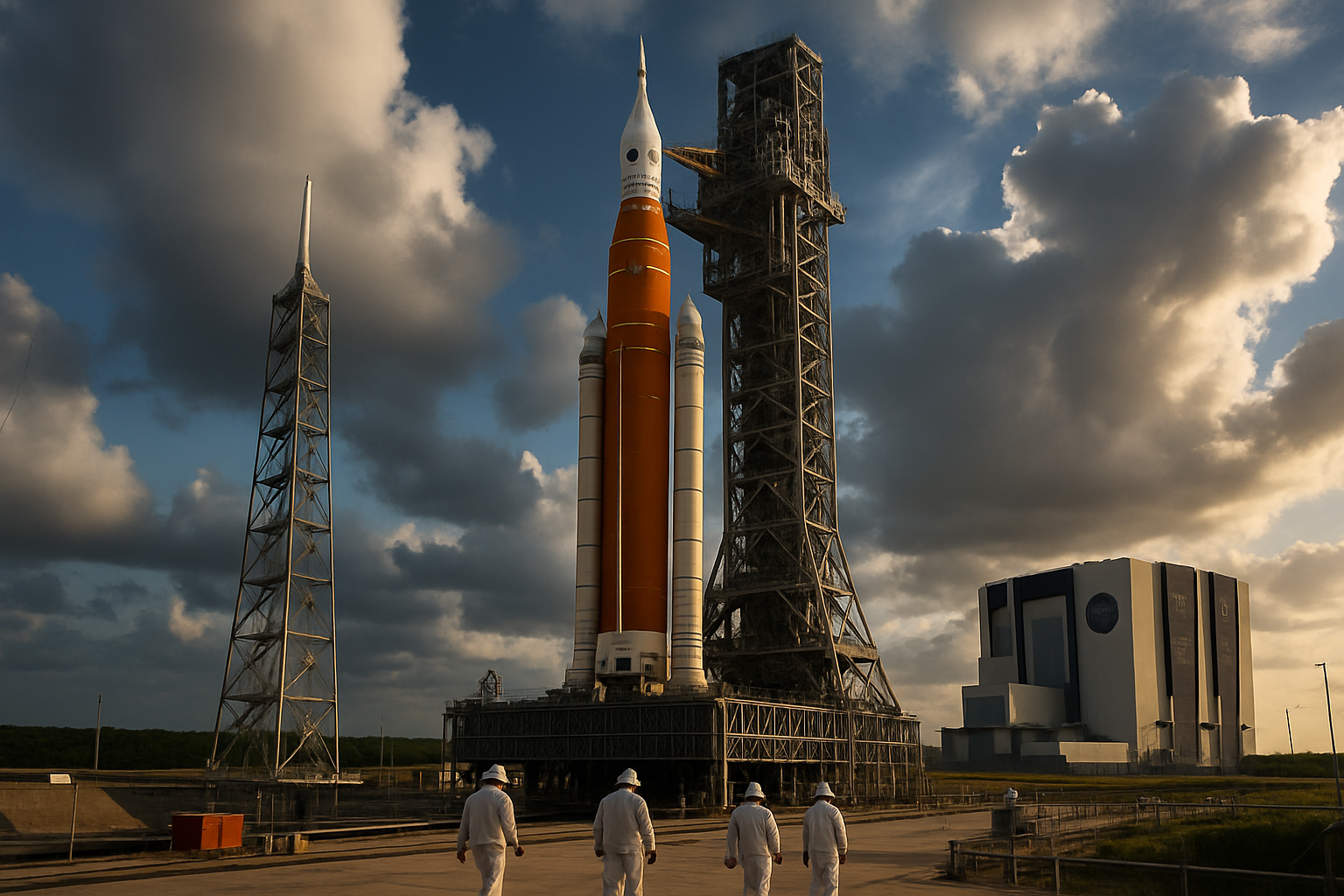
After months of delays and technical challenges, NASA announced Thursday that the Artemis II mission is on track to launch no earlier than April 1, 2026, marking a historic milestone as the first crewed mission to venture beyond Earth's orbit since Apollo 17 in December 1972.
The announcement comes after NASA engineers successfully resolved critical helium system failures and persistent hydrogen leak issues that had plagued the Space Launch System (SLS) rocket during extensive testing phases. Administrator Jared Isaacman confirmed during a press conference that the space agency has completed comprehensive technical assessments and is confident in the mission's readiness.
Mission Overview and International Crew
The Artemis II mission will send four astronauts on a 10-day journey around the Moon, covering approximately 600,000 miles in total. The international crew consists of NASA astronauts Reid Wiseman (commander), Christina Koch, and Victor Glover, along with Canadian Space Agency astronaut Jeremy Hansen, representing the first Canadian to venture beyond Earth orbit.
This diverse crew composition underscores the international cooperation that has become central to NASA's Artemis program, with Canada's participation through the Artemis Accords highlighting the mission's collaborative nature. Hansen's inclusion marks a significant milestone for the Canadian Space Agency and demonstrates the program's commitment to partnership with allied nations.
Technical Challenges Overcome
The path to this announcement has been marked by significant technical hurdles. The most persistent issue involved hydrogen leaks during wet dress rehearsal testing, where the SLS rocket is fully fueled with over 700,000 gallons of liquid hydrogen and oxygen. These leaks, detected during critical countdown simulations at the T-minus 5 minute mark, required extensive engineering analysis and repairs.
Additionally, helium system failures affecting the rocket's upper stage posed another major challenge. The helium system is essential for engine purging and fuel tank pressurization—critical safety functions that cannot be compromised when human lives are at stake. NASA's methodical approach to resolving these issues reflects the agency's commitment to crew safety over schedule adherence.
"We will only launch when we believe we are ready," Isaacman emphasized during the press conference, echoing the safety-first culture that has evolved from hard-learned lessons in NASA's history. This approach reflects institutional learning from past tragedies and demonstrates the agency's maturation in complex operations management.
The Space Launch System: Engineering Marvel
The SLS rocket represents the most powerful launch vehicle NASA has ever built, standing 322 feet tall and weighing 5.75 million pounds when fully fueled. This engineering achievement is designed specifically for deep space exploration, capable of delivering the Orion spacecraft and its crew far beyond low Earth orbit where the International Space Station operates.
The rocket's massive scale and complexity have presented unique engineering challenges. Unlike the frequent launches to the ISS, deep space missions require different fuel compositions, longer-duration burns, and systems capable of operating in the harsh environment beyond Earth's protective magnetic field.
Historical Context and Significance
The Artemis II mission carries profound historical weight as humanity's return to lunar exploration after more than five decades. The last time humans ventured beyond Earth orbit was during the Apollo 17 mission in December 1972, when astronauts Eugene Cernan and Harrison Schmitt became the final humans to walk on the lunar surface.
This 54-year gap represents the longest period in human spaceflight history without deep space exploration. The intervening decades have seen remarkable advances in technology, international cooperation, and our understanding of space medicine—all of which will be put to the test during Artemis II.
Mission Objectives and Scientific Goals
While Artemis II is primarily a test mission to validate systems for future lunar landings, it carries significant scientific objectives. The crew will conduct experiments to understand how humans adapt to the deep space environment, particularly the effects of radiation exposure beyond Earth's magnetic field protection.
The mission will also test the Orion spacecraft's life support systems, communication capabilities, and navigation systems during the challenging journey around the Moon. These tests are crucial for validating technologies that will support the planned Artemis III lunar landing mission, currently scheduled for 2028.
International Competition and Cooperation
The Artemis II announcement occurs during what experts describe as a "space economy golden age," characterized by unprecedented commercial space activity and intensifying international competition. China's advancement with its Shenlong reusable spacecraft program and plans for lunar crews by 2030 have added urgency to American lunar ambitions.
However, the mission also exemplifies successful international cooperation, particularly through the Artemis Accords framework that has united allied nations in peaceful lunar exploration. The inclusion of Canadian astronaut Jeremy Hansen demonstrates how international partnerships can enhance mission capabilities while sharing costs and risks.
Safety Culture and Risk Management
NASA's approach to the Artemis II mission reflects hard-won lessons from previous space program challenges. The agency's recent classification of the Boeing Starliner 2024 mission as a "Type A" mishap—equivalent in severity to the Challenger and Columbia tragedies—has reinforced the importance of comprehensive safety protocols.
This safety-first methodology has guided the decision-making process throughout Artemis II's development, with technical teams prioritizing thorough problem-solving over schedule adherence. The multiple delays, while frustrating, demonstrate NASA's commitment to protecting crew lives above all other considerations.
Economic and Strategic Implications
The Artemis program represents a multi-billion dollar investment in space infrastructure that extends far beyond scientific exploration. Success in returning humans to lunar orbit positions the United States as the leader in the emerging space economy, which analysts project could exceed $1 trillion in value by 2030.
The mission also has strategic implications for resource access, scientific discovery, and technological development that will define spacefaring capabilities for decades to come. Nations that establish sustainable lunar presence will gain advantages in deep space exploration, potential resource extraction, and technological innovation.
Looking Ahead: The Path to Lunar Landing
Artemis II serves as the critical stepping stone toward Artemis III, which aims to land the first humans on the lunar surface since 1972. The lessons learned from this mission will directly inform the more complex landing mission, which will require unprecedented coordination between the SLS rocket, Orion spacecraft, and SpaceX's Starship lunar lander.
Success in Artemis II will validate the fundamental systems needed for sustainable lunar exploration, including life support technologies, radiation protection systems, and navigation capabilities that will eventually support permanent lunar settlements and serve as a foundation for Mars exploration.
The Broader Context of Space Exploration
The timing of NASA's announcement coincides with remarkable progress across the space industry. SpaceX continues its regular International Space Station crew rotations while preparing for a potential IPO that could value the company at over $1 trillion. Meanwhile, space-based data centers are emerging as solutions to global semiconductor shortages, and autonomous navigation systems are revolutionizing robotic space missions.
This convergence of government programs, commercial innovation, and international cooperation is creating unprecedented opportunities for expanding human presence beyond Earth. The success of Artemis II will be measured not just in terms of mission objectives achieved, but in its contribution to this broader transformation of space from an experimental frontier to essential infrastructure for human civilization.
Conclusion: A New Chapter in Human Space Exploration
NASA's confirmation that Artemis II is targeting an April 1 launch date represents more than just another space mission—it marks humanity's renewed commitment to exploring beyond our home planet. After 54 years, humans will once again venture into deep space, carrying with them the hopes and ambitions of a global community united in the quest for knowledge and exploration.
The technical challenges overcome, international partnerships forged, and safety protocols implemented all contribute to a mission that could define the next era of human spaceflight. As the countdown to April 1 begins, the world watches with anticipation as NASA prepares to take the next giant leap in humanity's cosmic journey.