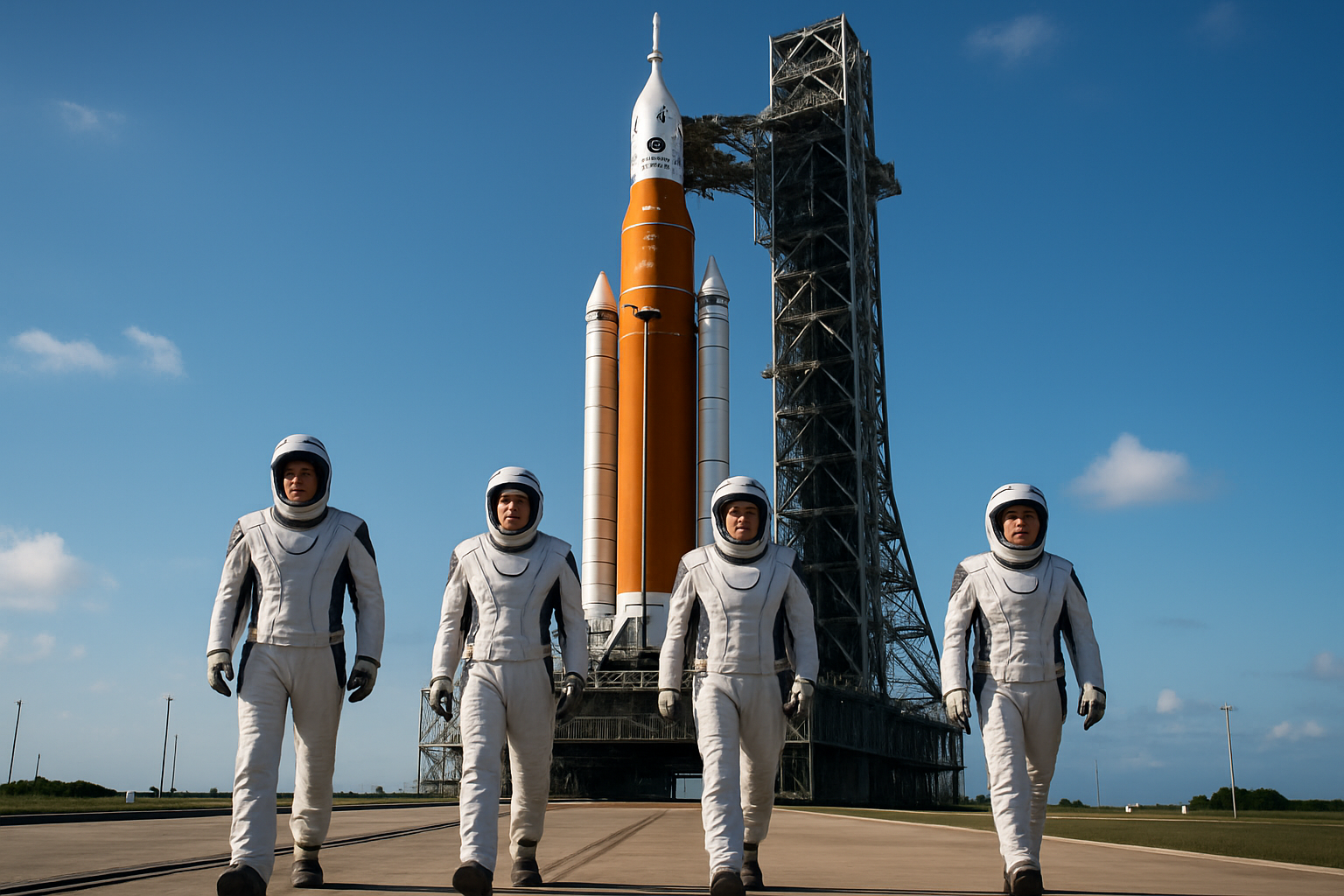
NASA has officially cleared its massive Space Launch System rocket for an April 1, 2026 launch with four astronauts aboard, marking a pivotal moment in humanity's return to deep space exploration after overcoming months of critical technical challenges.
Administrator Jared Isaacman announced Thursday that engineers have successfully resolved the helium system failures and persistent hydrogen leak issues that plagued the Artemis II mission throughout early 2026, pushing the historic lunar flyby from its original February timeline through multiple delays. The 322-foot rocket will begin rolling out to Launch Pad 39B at Kennedy Space Center next week for final preparations.
The four-astronaut international crew—Canadian Jeremy Hansen, NASA Commander Reid Wiseman, Christina Koch, and Victor Glover—will embark on a 10-day lunar journey covering 600,000 miles, marking humanity's first crewed mission beyond Earth orbit since Apollo 17 in December 1972, ending a 54-year gap in deep space human exploration.
Technical Breakthrough After Months of Setbacks
The path to April's launch has been marked by a series of complex technical challenges that demonstrated both the sophistication of modern space systems and NASA's unwavering commitment to crew safety. The most critical issue involved helium system failures affecting the Space Launch System's upper stage—components essential for engine purging and fuel tank pressurization that cannot be compromised.
These problems emerged during wet dress rehearsal testing, with failures occurring consistently at the T-minus 5-minute mark during countdown simulations. Adding to the complexity were persistent hydrogen leak issues that required comprehensive engineering analysis and repairs to the rocket's propulsion systems.
"We will only launch when we believe we are ready,"
— Jared Isaacman, NASA Administrator
The Space Launch System, weighing 5.75 million pounds when fully fueled with over 700,000 gallons of liquid hydrogen and oxygen, represents the most powerful rocket NASA has ever built. Its successful resolution of technical issues validates years of development and billions of dollars in space infrastructure investment.
Mission Objectives and International Cooperation
Artemis II serves as a crucial stepping stone toward NASA's goal of returning humans to the lunar surface by 2028 with the Artemis III mission. The 10-day flyby will test critical deep space systems including life support, radiation protection, and navigation capabilities beyond Earth's magnetic field—technologies essential for sustainable lunar presence and eventual Mars exploration.
The mission exemplifies international cooperation in space exploration, with Canadian Space Agency participation through Jeremy Hansen, who will become the first Canadian to travel beyond Earth orbit. This collaboration validates the Artemis Accords framework for peaceful lunar exploration while maintaining U.S. leadership during the emerging "space economy golden age."
During their lunar journey, the crew will conduct experiments to understand human adaptation to the deep space environment, including radiation exposure effects and long-duration spaceflight challenges. This research directly informs future lunar landing missions and provides essential data for Mars exploration protocols.
Safety-First Culture Amid Competitive Landscape
The multiple delays reflect NASA's institutional maturity and safety-first approach, developed through hard-learned lessons from historical tragedies. Recent classification of Boeing's Starliner mission as a "Type A" mishap—the same severity level as the Challenger and Columbia disasters—reinforced the agency's comprehensive safety assessment protocols.
This methodical problem-solving approach occurs against a backdrop of intensifying international space competition. China is planning lunar crews by 2030, while commercial space companies like SpaceX are preparing for a potentially trillion-dollar IPO in June 2026. Despite these competitive pressures, NASA has prioritized crew protection over schedule adherence.
The delays also highlight the contrast between government space programs' methodical safety approach and the rapid advancement of commercial space capabilities. While NASA works through complex technical challenges, SpaceX continues regular International Space Station crew rotations and advances its lunar colonization plans.
Historical Significance and Strategic Implications
The 54-year gap since Apollo 17 represents the longest period without human deep space exploration in NASA's history. Artemis II's success will mark humanity's renewed commitment to cosmic exploration, utilizing advanced technology, international cooperation, and space medicine knowledge accumulated during decades of ISS operations.
The mission carries profound strategic implications for America's position in space. The multi-billion-dollar investment positions the United States as a leader in the emerging space economy, projected to exceed $1 trillion by 2030. Success is critical for future resource access, scientific discovery, and technological development that will define spacefaring capabilities.
Beyond national interests, Artemis II represents a generational achievement for the global space industry. The mission will validate systems essential for permanent lunar settlements and establish foundations for Mars exploration, potentially defining the next era of human spaceflight and our evolution into a spacefaring civilization.
Looking Ahead to Lunar Surface Return
Following the comprehensive restructuring of the Artemis program in early 2026, NASA has maintained its commitment to returning humans to the lunar surface by 2028. The additional test mission between Artemis II and the actual landing—moved from Artemis III to Artemis IV—reflects lessons learned about the complexity of deep space operations.
Technical data from the April mission will inform the design of lunar habitats, resource utilization systems, and life support technologies for permanent Moon bases. The mission also contributes to broader space medicine research, including ongoing studies of Space-Associated Neuro-Ocular Syndrome (SANS) that affects astronaut vision during extended missions.
As NASA prepares for this historic launch, the agency continues advancing other programs including AI-enhanced Mars rover operations and the revolutionary DAGGER system that provides 30-minute warnings for potentially damaging geomagnetic storms.
A New Chapter in Human Space Exploration
The April 1 launch date represents more than just a mission milestone—it marks humanity's return to deep space exploration with modern technology, international partnerships, and sustainable exploration goals. Unlike the Apollo program's brief lunar visits, Artemis aims to establish permanent human presence beyond Earth orbit.
The successful resolution of technical challenges demonstrates the sophisticated engineering required for deep space transportation while validating NASA's safety-focused methodology. As the Space Launch System prepares for its historic journey, it carries with it not just four astronauts, but humanity's renewed commitment to expanding our presence throughout the solar system.
With international cooperation flourishing through programs like the ISS and emerging partnerships with nations like Canada, the Artemis II mission exemplifies how space exploration continues to unite humanity in pursuit of knowledge and discovery. The April launch will open a new chapter in human space exploration, establishing the foundation for lunar settlements, Mars missions, and humanity's evolution into a truly spacefaring species.