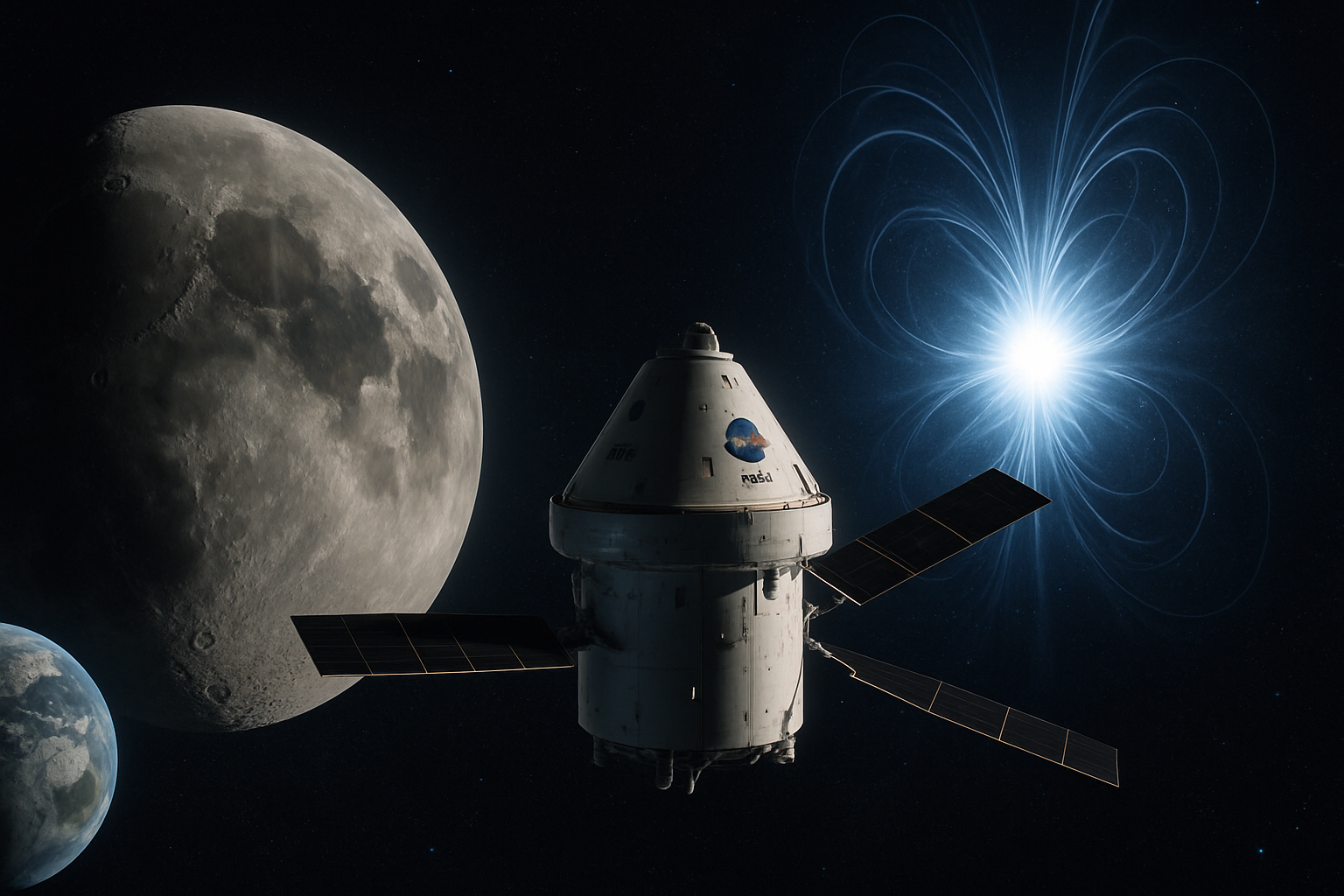
In a remarkable convergence of space exploration milestones and astronomical discovery, NASA Administrator Jared Isaacman confirmed the Artemis II mission will target an April 1, 2026 launch window, while Greek astronomers announced the first-ever observation of magnetar birth—one of the most exotic stellar objects in the universe.
Artemis II Mission Finally Cleared for Launch
After months of technical delays that pushed the mission from February to March and now into April, NASA has successfully resolved the critical helium system failures and persistent hydrogen leak issues that plagued the Space Launch System (SLS) rocket. The announcement marks a significant milestone for the agency's lunar exploration program, which aims to return humans to the Moon for the first time since the Apollo era.
The Artemis II mission will carry four astronauts on a historic 10-day lunar flyby covering approximately 600,000 miles—representing the first crewed mission beyond Earth orbit since Apollo 17 in December 1972, a gap of over 54 years. The international crew includes Canadian astronaut Jeremy Hansen, who will become the first Canadian to travel beyond Earth orbit, alongside NASA Commander Reid Wiseman, Christina Koch, and Victor Glover.
NASA's safety-first approach has been evident throughout the preparation process. "We will only launch when we believe we are ready," Isaacman emphasized, reflecting institutional learning from historical space program tragedies. The agency's methodical problem-solving approach prioritizes astronaut protection over schedule adherence, particularly following the recent classification of Boeing's Starliner mission as a Type A mishap—the same severity level as the Challenger and Columbia disasters.
Technical Challenges Overcome
The SLS rocket, standing 322 feet tall and weighing 5.75 million pounds when fully fueled, required engineers to resolve complex technical issues that emerged consistently during countdown simulations. The helium system, critical for engine purging and fuel tank pressurization, experienced failures that could not be compromised for crew safety. Similarly, hydrogen leak problems during wet dress rehearsal testing posed significant challenges at the T-minus 5 minutes mark.
The rocket requires more than 700,000 gallons of liquid hydrogen and oxygen propellants, making it the most powerful NASA rocket ever built. The successful resolution of these technical hurdles demonstrates NASA's engineering capabilities and commitment to methodical safety protocols essential for deep space missions.
Greek Astronomers Witness Cosmic Marvel
Simultaneously, the scientific community celebrated an extraordinary astronomical discovery as Greek researchers observed the birth of a magnetar for the first time in human history. According to reports from Naftemporiki, astronomers successfully tracked the formation of one of the universe's most exotic objects—a stellar body containing mass equivalent to 500,000 Earth-sized planets compressed into an incredibly dense, highly magnetized neutron star.
Magnetars represent some of the most extreme objects in the cosmos, possessing magnetic fields trillions of times stronger than Earth's. These rare stellar remnants form when massive stars undergo catastrophic collapse, creating conditions so extreme that the resulting magnetic fields can strip electrons from atoms at distances of thousands of kilometers.
The observation marks a significant breakthrough in stellar astronomy, as magnetar formation events are extremely rare and typically occur over cosmological timescales that make real-time observation nearly impossible. The Greek research team's success in capturing this phenomenon provides unprecedented insights into the violent processes that create these cosmic powerhouses.
Space Economy Golden Age Context
These developments occur during what industry experts describe as the transition from the "AI revolution" to the "space economy golden age." The space sector is experiencing unprecedented growth, with SpaceX preparing for a potential trillion-dollar IPO in June 2026, representing one of the largest public offerings in corporate history.
International competition in space is intensifying rapidly. China is advancing its Shenlong reusable spacecraft program and planning lunar crews by 2030, while Pakistan has selected astronaut candidates for China's Tiangong space station mission scheduled for October-November 2026. European nations are pursuing launch independence through expanded manufacturing capabilities, including Germany's Isar Aerospace facilities in Sweden.
The commercial space economy is projected to exceed $1 trillion by 2030, driven by satellite infrastructure expansion, space-based data centers, and emerging orbital manufacturing capabilities. This growth is occurring alongside continued international cooperation through International Space Station operations, despite competitive dynamics in lunar exploration and satellite deployment.
Mission Objectives and Strategic Importance
The Artemis II mission serves as a crucial stepping stone toward the Artemis III lunar landing planned for 2028, following NASA's recent program restructuring that added an additional test mission to build "launch muscle memory." The mission will validate critical deep space life support systems, radiation protection capabilities beyond Earth's magnetic field, and navigation systems essential for sustained lunar presence.
International cooperation through the Canadian Space Agency's participation validates the Artemis Accords framework for peaceful lunar exploration. The mission represents successful integration of international partnerships while maintaining U.S. leadership in space exploration during a period of intense global competition.
Success is critical for establishing the infrastructure necessary for permanent lunar settlements and eventual Mars exploration. The mission will test systems essential for human habitation beyond Earth orbit, building upon decades of knowledge accumulated through International Space Station operations.
Scientific Legacy and Future Implications
The simultaneous occurrence of human space exploration advancement and astronomical discovery exemplifies 2026 as a watershed year for cosmic understanding. The magnetar observation contributes to our knowledge of stellar evolution and the extreme physics governing the universe's most powerful objects, while Artemis II represents humanity's renewed commitment to becoming a spacefaring civilization.
Both achievements demonstrate the importance of sustained investment in scientific research and space exploration capabilities. The magnetar discovery enhances our understanding of cosmic phenomena that could affect space missions and satellite operations, while the Artemis program establishes practical foundations for human expansion throughout the solar system.
As April approaches, the convergence of these milestones signals a new chapter in human cosmic exploration—one characterized by both the ancient wonders of stellar birth and the modern achievement of returning to deep space after more than five decades.