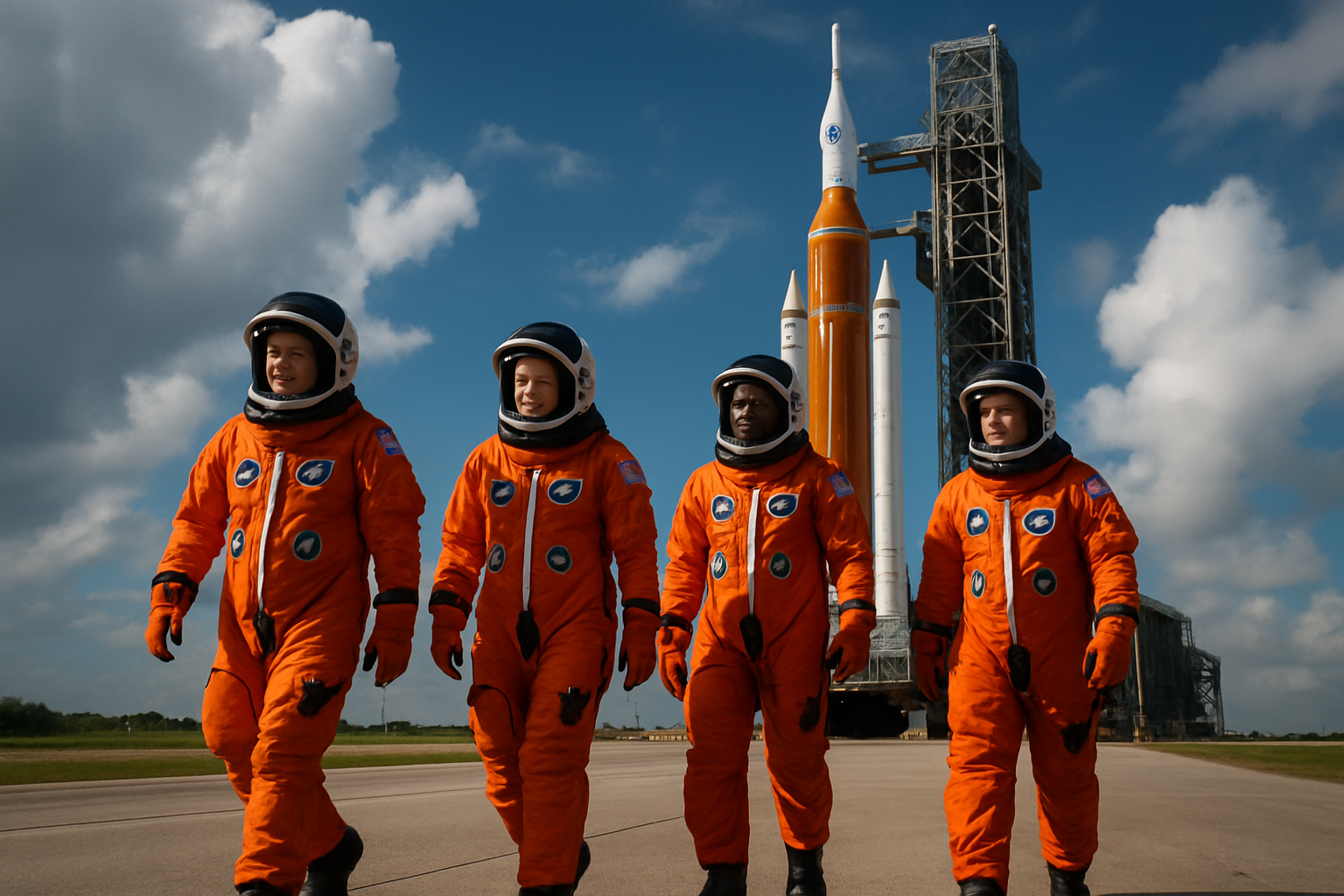
NASA has officially declared the Artemis II mission ready for flight, targeting a six-day launch window that opens April 1, 2026, marking a historic milestone in humanity's return to lunar exploration after more than five decades.
The announcement comes after months of technical challenges that pushed the mission from its original February target through March delays. The four-person international crew will embark on a 10-day lunar flyby covering 600,000 miles – the first crewed mission beyond Earth orbit since Apollo 17 in December 1972, representing a 54-year gap in human deep space exploration.
International Crew Ready for Historic Journey
The Artemis II crew includes Canadian Space Agency astronaut Jeremy Hansen, who will become the first Canadian to travel beyond Earth orbit, alongside NASA veterans Reid Wiseman (mission commander), Christina Koch, and Victor Glover. This international composition underscores the global nature of modern space exploration and validates the Artemis Accords framework for peaceful lunar exploration.
"This mission represents more than just a return to the Moon," said NASA Administrator Jared Isaacman during Thursday's briefing at Kennedy Space Center. "We're establishing the foundation for sustained human presence beyond Earth orbit and eventual Mars exploration."
Technical Challenges Resolved
The path to launch readiness has been marked by significant technical hurdles that NASA engineers have methodically resolved. Persistent hydrogen leak problems during wet dress rehearsal testing plagued the mission throughout late 2025 and early 2026, with issues consistently emerging at the critical T-minus 5 minutes mark during countdown simulations.
More critically, helium system failures affecting the Space Launch System (SLS) rocket's upper stage threatened the mission timeline. The helium system serves essential functions for engine purging and fuel tank pressurization – critical safety operations that cannot be compromised for crew protection.
NASA's approach to these challenges reflects the agency's safety-first culture, developed through institutional learning from historical space program tragedies. "We will only launch when we believe we are ready," Isaacson emphasized, echoing the comprehensive safety protocols that have guided the Artemis program.
The Most Powerful Rocket Ever Built
At the heart of Artemis II stands the Space Launch System, NASA's most powerful rocket ever constructed. Standing 322 feet tall and weighing 5.75 million pounds when fully fueled, the SLS requires more than 700,000 gallons of liquid hydrogen and liquid oxygen propellants.
The rocket will carry the Orion spacecraft and its crew on their lunar journey, utilizing advanced life support systems, radiation protection, and navigation capabilities specifically designed for deep space operations beyond Earth's protective magnetic field. These systems represent decades of technological advancement since the Apollo era.
Strategic Importance for Space Exploration
Artemis II serves as a crucial stepping stone toward Artemis III, currently planned for 2028, which aims to return astronauts to the lunar surface for the first time since 1972. The mission will validate critical systems for sustained lunar presence, including life support, radiation protection, and navigation capabilities operating in the harsh environment of deep space.
The mission occurs during what analysts describe as a "space economy golden age," with unprecedented commercial space activity, international cooperation, and competitive dynamics reshaping space exploration. SpaceX continues to prepare for its potential trillion-dollar IPO, while China advances its lunar exploration capabilities and emerging nations like Pakistan develop independent space programs.
Scientific and Medical Objectives
Beyond the historic achievement of returning humans to lunar vicinity, Artemis II carries significant scientific importance. The crew will conduct experiments studying human adaptation to deep space environments, radiation exposure effects, and long-duration spaceflight challenges that directly inform future Mars exploration protocols.
Concurrent research aboard the International Space Station, including ongoing Space-Associated Neuro-Ocular Syndrome (SANS) studies and lung tissue cultivation experiments, provides complementary data essential for understanding human biology during extended space missions. French astronaut Sophie Adenot's record eight-month ISS mission continues to contribute valuable medical data for deep space exploration planning.
Economic and Strategic Implications
The Artemis program represents a multi-billion dollar investment in space infrastructure that positions the United States as a leader in the emerging space economy, projected to exceed $1 trillion by 2030. Success enables access to lunar resources, scientific discoveries, and technological development that could define spacefaring capabilities for generations.
International partnerships through the Artemis Accords demonstrate how space exploration continues to foster global cooperation even amid terrestrial tensions. Canada's participation through Jeremy Hansen exemplifies the diplomatic and scientific benefits of collaborative space endeavors.
Looking Forward to Deep Space
If successful, Artemis II will mark humanity's renewed commitment to cosmic exploration, utilizing advanced technology, international cooperation, and decades of space medicine knowledge accumulated through International Space Station operations. The mission establishes critical precedents for routine human space presence beyond Earth orbit.
The 54-year gap since Apollo 17 represents the longest period without human deep space exploration in the space age. Artemis II's success could define the next era of human spaceflight, establishing foundations for a true spacefaring civilization with permanent lunar settlements and eventual Mars exploration capabilities.
As NASA continues final preparations for the April 1 launch window, the mission represents more than a return to the Moon – it symbolizes humanity's determination to expand beyond Earth and establish our species among the stars.