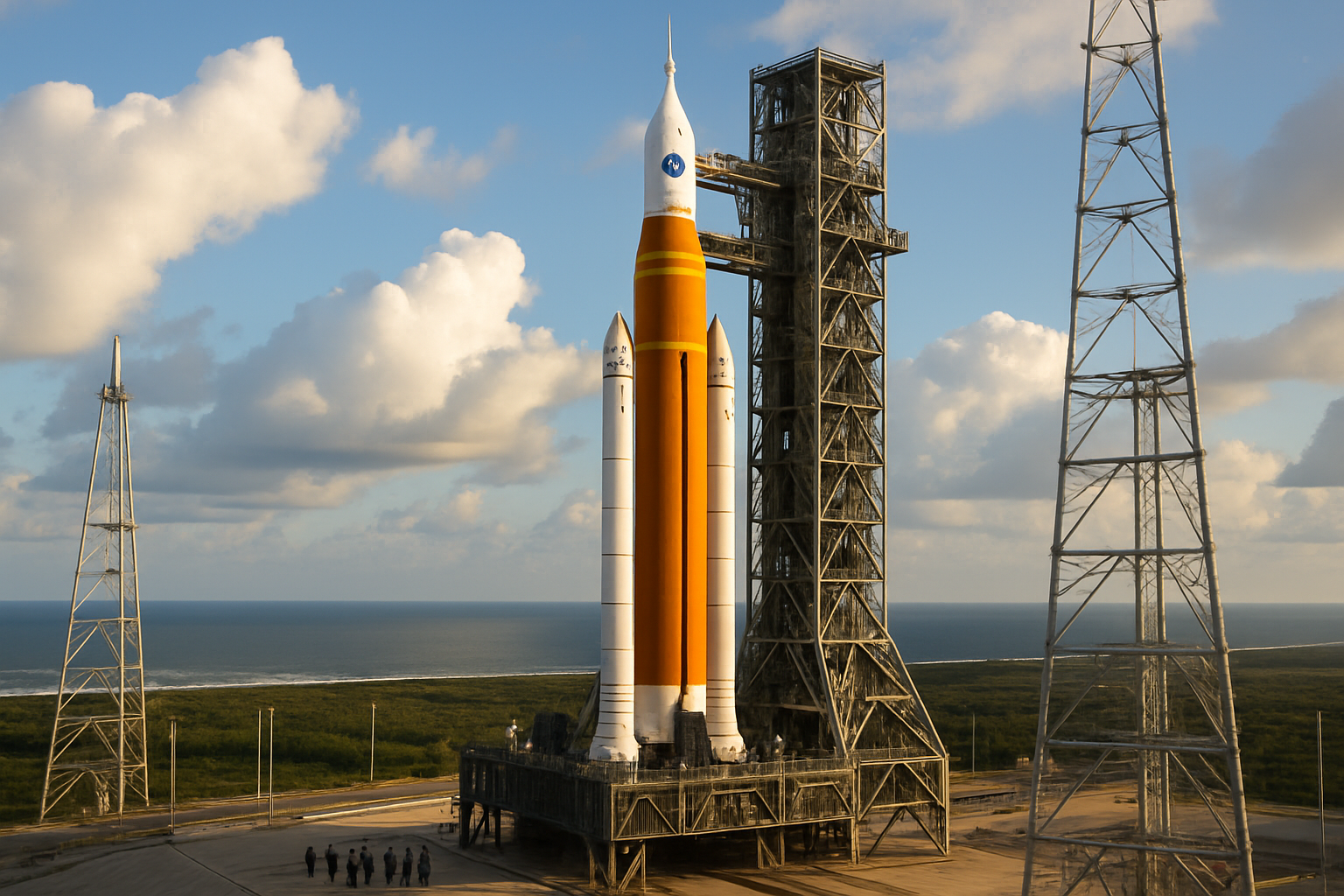
NASA has officially begun the countdown for its most ambitious mission in over half a century, with Artemis II scheduled to launch April 1, 2026, carrying four astronauts on a 10-day journey around the Moon—marking humanity's first venture beyond Earth orbit since Apollo 17 in December 1972.
Administrator Jared Isaacman confirmed the historic launch date after engineers successfully resolved critical technical issues that had plagued the program throughout early 2026, including persistent hydrogen leaks and helium system failures affecting the massive Space Launch System (SLS) rocket.
"The vehicle is ready, the system is ready. The crew is ready," declared Amit Kshatriya, NASA's associate administrator, during Monday's mission briefing. The countdown officially began at 4:44 PM, with the first launch window opening Wednesday, April 1 at 6:24 PM EDT (2224 GMT).
International Crew Makes History
The four-astronaut international crew represents multiple historic milestones. Canadian Jeremy Hansen will become the first Canadian to travel beyond Earth orbit, while the mission includes the first woman, person of color, and non-American on a lunar mission. Alongside Hansen, NASA Commander Reid Wiseman will lead the crew, joined by Mission Specialists Christina Koch and Victor Glover.
The 10-day mission will cover approximately 685,000 miles on a journey around the Moon and back, testing critical deep space life support systems, radiation protection capabilities, and navigation technologies essential for humanity's return to the lunar surface.
"This is a historic moment for the entire international space community. We're not just returning to the Moon—we're building the foundation for permanent human presence beyond Earth."
— Jared Isaacman, NASA Administrator
Technical Triumph After Months of Delays
The path to this moment has been fraught with engineering challenges. The SLS rocket—standing 322 feet tall and weighing 5.75 million pounds when fully fueled with over 700,000 gallons of liquid hydrogen and oxygen—experienced multiple technical setbacks during countdown rehearsals.
Engineers worked tirelessly to resolve helium system failures affecting the rocket's upper stage, which are critical for engine purging and fuel tank pressurization. Hydrogen leak issues that emerged during wet dress rehearsal testing at T-minus 5 minutes during simulations required comprehensive engineering analysis and repairs.
NASA's methodical approach to these challenges reflects the agency's institutional learning from historical tragedies. The recent classification of Boeing's Starliner mission as a "Type A mishap"—the same severity level as the Challenger and Columbia disasters—reinforced the agency's commitment to comprehensive safety protocols over schedule adherence.
A New Era of Space Exploration
The mission occurs during what industry experts call the transition from the "AI revolution" to the "space economy golden age." International competition has intensified significantly, with China planning crewed lunar missions by 2030, and commercial space companies like SpaceX preparing for what could be a trillion-dollar IPO in June 2026.
NASA has responded to this competitive landscape with unprecedented strategic commitments. The agency recently announced a historic $20 billion investment toward establishing a permanent lunar surface base by 2030—the largest space infrastructure commitment in NASA's history. This ambitious timeline includes canceling the previously planned Lunar Gateway orbiting station and redirecting those resources toward surface operations.
Scientific Foundation for the Future
Beyond its symbolic importance, Artemis II will serve crucial scientific and technical validation purposes. The mission will test systems essential for permanent lunar settlements and Mars exploration, including advanced life support technologies, radiation shielding beyond Earth's magnetic field, and precision navigation capabilities.
The crew will conduct experiments examining human adaptation to the deep space environment, building on years of research from the International Space Station. Recent studies, including French astronaut Sophie Adenot's record eight-month ISS mission, have provided valuable data on long-duration spaceflight effects, including research on Space-Associated Neuro-Ocular Syndrome (SANS) that affects astronaut vision during extended missions.
International Cooperation in Competitive Times
Canadian participation through Jeremy Hansen validates the Artemis Accords framework for peaceful lunar exploration, demonstrating how international partnerships can succeed even amid increasing space competition. Hansen's role represents the most significant Canadian human spaceflight contribution since the Space Shuttle era.
Calgary-born astronaut Jenni Gibbons will serve as Earth voice link and backup to Hansen, highlighting the depth of Canadian space expertise. However, the cancellation of the Lunar Gateway project creates uncertainty for some Canadian space industry components, including the Canadarm3 robotic arm developed by MDA Systems in Brampton, Ontario.
Economic and Strategic Implications
The mission's success carries enormous economic implications for the emerging space economy, projected to exceed $1 trillion by 2030. Multi-billion dollar space infrastructure investments position the United States as a leader in this rapidly expanding sector, with applications ranging from resource extraction to space-based data centers addressing Earth's growing memory crisis.
The mission also tests technologies essential for humanity's long-term cosmic expansion. Success could establish the foundation for permanent extraterrestrial settlements, serving as a stepping stone toward Mars exploration and the development of a truly spacefaring civilization.
Weather and Backup Plans
Current weather forecasts appear favorable for the April 1 launch date, though NASA maintains multiple backup opportunities through April 6 if delays become necessary. The agency's safety-first culture means any concerns about weather, technical readiness, or crew safety could result in postponement.
Mission controllers emphasize that 54 years since Apollo 17 represents the longest period in human history without deep space exploration. This extended gap has allowed for technological advancement and international cooperation frameworks that make Artemis II far more sophisticated than its Apollo predecessors.
Looking Beyond Earth's Horizon
As the countdown progresses, Artemis II represents more than just a return to lunar exploration—it marks humanity's renewed commitment to becoming a spacefaring species. The mission serves as a crucial stepping stone toward Artemis III, planned for 2028, which will actually land astronauts on the lunar surface for the first time since 1972.
The successful completion of Artemis II will validate deep space transportation systems, international cooperation frameworks, and human adaptation protocols necessary for sustained space exploration. In an era of rapid technological advancement and international competition, this mission could define the trajectory of human space exploration for decades to come.
With final preparations underway at Kennedy Space Center and the crew conducting last-minute training exercises, April 1, 2026, promises to be a historic date—not just for NASA, but for humanity's cosmic future. After more than half a century, we are finally ready to venture beyond Earth's protective embrace once again, this time with the knowledge, technology, and international partnerships needed to stay.