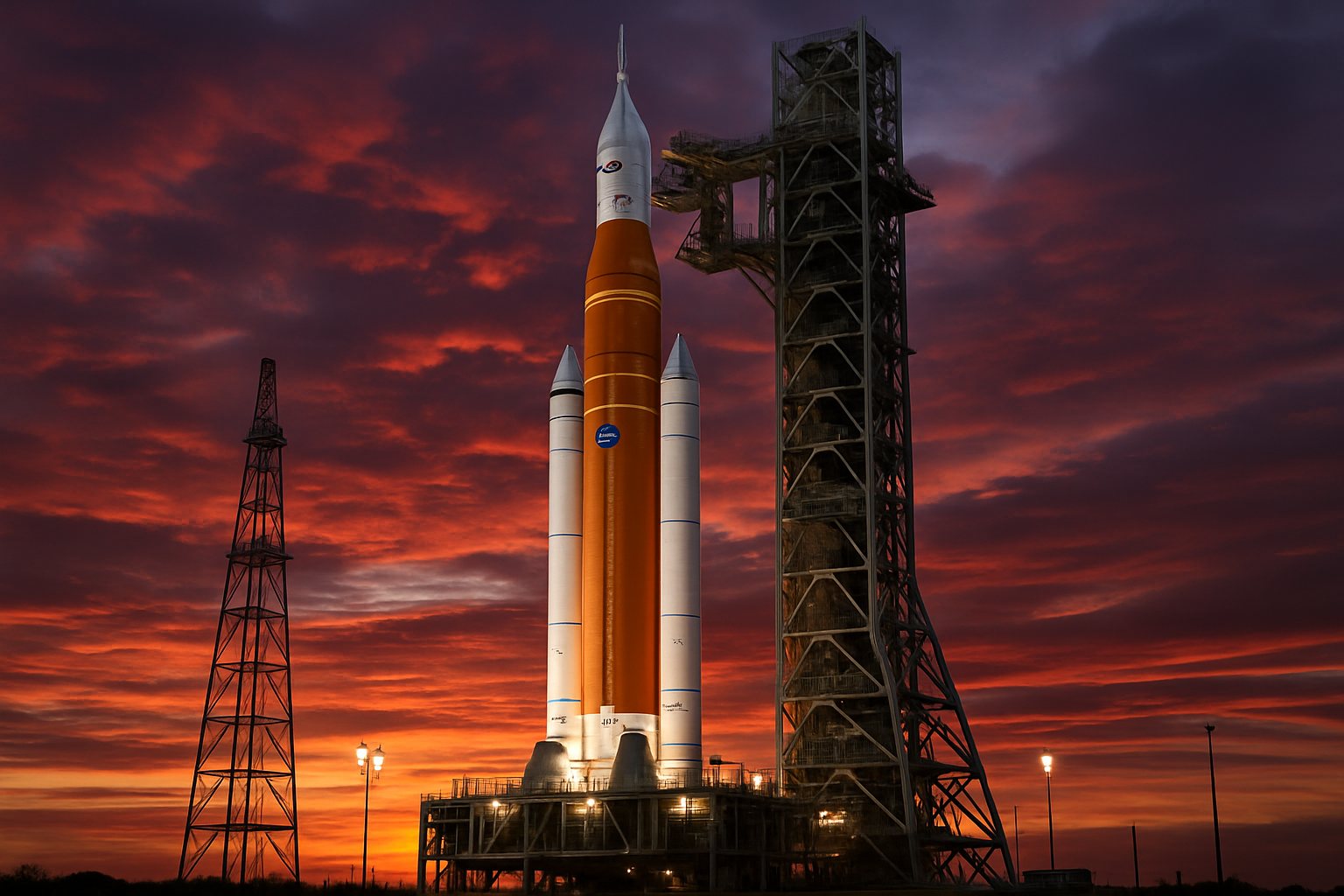
NASA stands poised to launch the most significant human spaceflight mission in over half a century as the Artemis II crew prepares for a historic 10-day lunar flyby, marking humanity's return to deep space exploration after a 54-year gap since Apollo 17.
The four-astronaut international crew—Canadian Jeremy Hansen, NASA Commander Reid Wiseman, Christina Koch, and Victor Glover—awaits liftoff aboard NASA's most powerful rocket ever built, the Space Launch System (SLS), coupled with the Orion spacecraft. This mission represents the first crewed venture beyond Earth orbit since December 1972, when Apollo 17 astronauts last departed the lunar surface.
Technical Triumphs After Persistent Challenges
NASA Administrator Jared Isaacman confirmed the mission is targeting no earlier than April 1, 2026, after engineers successfully resolved critical technical issues that had plagued the program throughout early 2026. The breakthrough came after months of addressing helium system failures affecting the SLS rocket's upper stage—essential for engine purging and fuel tank pressurization—and persistent hydrogen leak problems during wet dress rehearsal testing.
The SLS rocket represents a marvel of modern engineering: standing 322 feet tall, weighing 5.75 million pounds when fully fueled, and requiring over 700,000 gallons of liquid hydrogen and oxygen. The technical challenges that emerged during countdown simulations at the T-minus 5 minute mark tested NASA's commitment to its safety-first approach.
"We will only launch when we believe we are ready. This reflects our institutional learning from historical tragedies."
— Jared Isaacman, NASA Administrator
International Cooperation in a Competitive Era
The mission's international dimension carries profound significance, particularly through Canadian Jeremy Hansen's participation as the first Canadian to venture beyond Earth orbit. This validates the Artemis Accords framework for peaceful lunar exploration and represents Canada's most significant human spaceflight contribution since the Space Shuttle era.
Hansen's involvement comes as the space industry undergoes what experts describe as a transition from the "AI revolution" to the "space economy golden age." The timing is particularly notable as China advances its own lunar ambitions, planning crewed lunar missions by 2030, while SpaceX prepares for a potential trillion-dollar IPO in June 2026.
The mission occurs against a backdrop of intensifying international competition. China has successfully launched its fourth Shenlong reusable spacecraft, demonstrating cost-effective orbital access capabilities, while Pakistan has selected astronaut candidates for China's Tiangong space station missions scheduled for October-November 2026. European nations are also asserting space independence through Germany's €10 billion satellite investments and Sweden's Isar Aerospace facilities testing 30 engines monthly.
Strategic Implications of the Moon Return
Artemis II serves as more than a symbolic return to deep space—it functions as a critical stepping stone toward Artemis III's planned lunar landing in 2028. The mission will validate essential deep space systems including life support capabilities, radiation protection beyond Earth's magnetic field, and navigation technologies required for sustained lunar presence.
NASA's strategic vision has undergone a dramatic shift with the recent announcement of a historic $20 billion commitment to establish a permanent lunar surface base by 2030. This represents the largest space infrastructure investment in the agency's history, achieved through canceling the Lunar Gateway orbiting space station project and redirecting those resources to surface operations.
The economic implications are staggering. Multi-billion dollar space infrastructure investments position the United States for leadership in an emerging space economy projected to exceed $1 trillion by 2030. Success is critical for future resource access, scientific discovery, and technological development that will define spacefaring capabilities for generations.
Space Medicine and Long-Duration Missions
The mission benefits from ongoing research aboard the International Space Station, particularly French astronaut Sophie Adenot's record eight-month mission focusing on lung tissue cultivation and Space-Associated Neuro-Ocular Syndrome (SANS) research. These studies provide essential medical knowledge for astronauts who may spend years on lunar bases or Mars missions without the possibility of Earth medical evacuation.
Recent European research has revealed new challenges for permanent space settlements, including discoveries that microgravity seriously disrupts human sperm navigation, making reproduction extremely difficult in weightless environments. Such findings underscore the importance of artificial gravity systems for future permanent space settlements and directly influence lunar base design requirements.
The Journey Ahead
The 600,000-mile journey will take the crew deeper into space than any human has traveled before, swinging around the Moon's far side in a trajectory that demonstrates the capabilities essential for permanent lunar settlements and eventual Mars exploration. The mission will test Orion spacecraft systems during the lunar journey, with crew members conducting experiments to understand human adaptation to deep space environments and radiation exposure effects.
The success of Artemis II will validate systems essential for humanity's transition to a spacefaring civilization, combining advanced technology with international cooperation and space medicine knowledge accumulated during decades of ISS operations. The 54-year gap since Apollo 17 represents the longest period without human deep space exploration, making this mission a defining moment for the next era of human spaceflight.
Looking Forward: A New Cosmic Era
As NASA prepares for this historic launch, the mission represents far more than a return to the Moon—it marks humanity's renewed commitment to cosmic exploration and expansion. The convergence of technical achievement, international partnership, and commercial space capabilities creates an unprecedented foundation for sustained space exploration.
With China planning lunar settlements, SpaceX pivoting from Mars to lunar colonization strategies, and nations worldwide investing in space capabilities, the Artemis II mission arrives at a crucial juncture. Success could establish the foundation for permanent extraterrestrial settlements and define humanity's path toward becoming a truly spacefaring species.
The mission's impact extends beyond technological achievement to fundamental questions about human adaptation to cosmic environments. As nations invest hundreds of billions in space infrastructure and prepare for unprecedented expansion of human presence beyond Earth, Artemis II represents the critical first step toward a future where space exploration transitions from extraordinary achievement to routine civilization infrastructure.