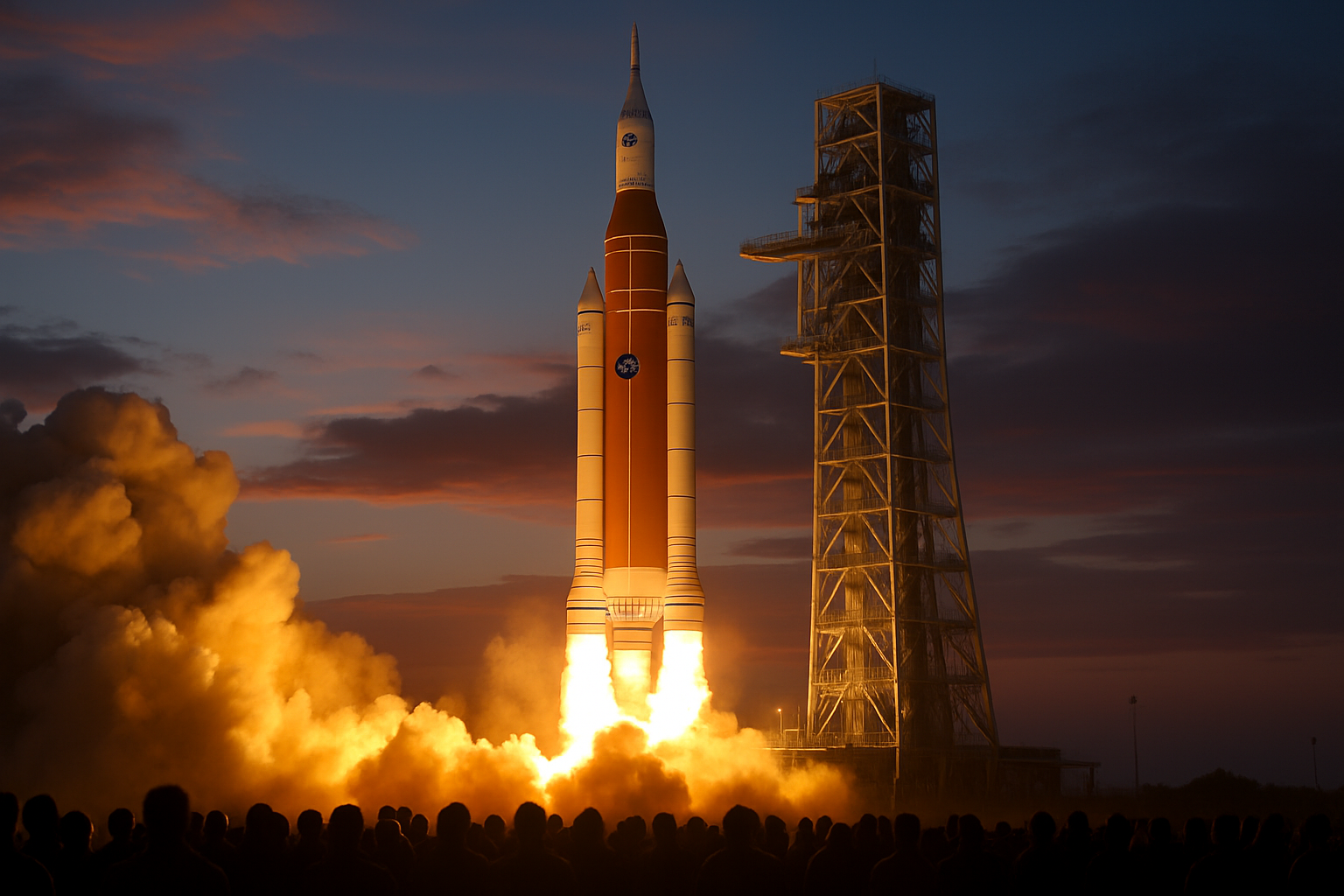
NASA has confirmed the launch of its historic Artemis II mission for April 1, 2026, marking humanity's triumphant return to deep space exploration after a 54-year hiatus since Apollo 17's final lunar journey in December 1972.
Administrator Jared Isaacman announced the launch confirmation after engineers successfully resolved critical technical challenges that had plagued the mission throughout early 2026, including persistent hydrogen leak issues and helium system failures affecting the Space Launch System (SLS) rocket's upper stage.
The four-astronaut international crew arrived at Kennedy Space Center on March 28 for final preparations: Canadian Jeremy Hansen, who will become the first Canadian to venture beyond Earth orbit; NASA Commander Reid Wiseman; and Mission Specialists Christina Koch and Victor Glover. Their 10-day lunar flyby mission will cover approximately 685,000 miles, serving as humanity's boldest space exploration endeavor in over five decades.
Technical Triumph Over Adversity
The path to launch has been marked by NASA's unwavering commitment to crew safety over schedule adherence. Engineers spent months addressing helium system failures critical for engine purging and fuel tank pressurization, alongside hydrogen leak problems that emerged during wet dress rehearsal testing at T-minus 5 minutes in countdown simulations.
The SLS rocket represents NASA's most powerful launch vehicle ever constructed, standing 322 feet tall and weighing 5.75 million pounds when fully fueled with over 700,000 gallons of liquid hydrogen and oxygen. This engineering marvel will propel the Orion spacecraft and its crew beyond Earth's protective magnetic field for the first time since the Apollo era.
"We will only launch when we believe we are ready. This reflects our institutional learning from historical tragedies and our commitment to methodical problem-solving that prioritizes crew protection over schedule pressures."
— Jared Isaacman, NASA Administrator
International Cooperation in the Space Economy Golden Age
The Artemis II mission occurs during what experts describe as the transition from the "AI revolution to the space economy golden age." The mission validates the Artemis Accords framework for peaceful lunar exploration through Canadian participation, representing the most significant Canadian human spaceflight contribution since the Space Shuttle era.
Jeremy Hansen's historic role is supported by fellow Canadian astronaut Jenni Gibbons, who serves as Earth voice link and backup. This international cooperation model demonstrates how space exploration has evolved from purely national endeavors to collaborative ventures that leverage diverse expertise and shared resources.
The mission's timing coincides with intensifying global space competition. China is planning crewed lunar missions by 2030, while SpaceX prepares for a potential trillion-dollar IPO in June 2026. Pakistan has selected astronaut candidates for China's Tiangong space station missions scheduled for October-November 2026, highlighting the democratization of space access worldwide.
Strategic Lunar Pivot and Future Implications
In a dramatic strategic shift, NASA announced a historic $20 billion commitment to establish a permanent lunar surface base by 2030—the largest space infrastructure investment in the agency's history. This decision involved canceling the Lunar Gateway orbiting space station project, instead redirecting those resources and components from contractors Northrop Grumman and Vantor toward surface infrastructure.
This pivotal decision follows December presidential directives for accelerated lunar presence amid China's advancing space capabilities. The permanent lunar base will serve as a stepping stone for Mars exploration while enabling resource extraction, advanced manufacturing, and scientific research that could revolutionize our understanding of the cosmos.
Cutting-Edge Space Medicine and Human Adaptation
The mission builds upon critical space medicine research conducted aboard the International Space Station, particularly French astronaut Sophie Adenot's record-setting eight-month mission. Her research focused on lung tissue cultivation in microgravity and Space-Associated Neuro-Ocular Syndrome (SANS), which affects astronaut vision during extended missions.
These medical studies directly inform protocols for future lunar bases and Mars expeditions, where astronauts may spend years without the possibility of Earth medical evacuation. The research addresses fundamental challenges of human reproduction in space, as recent European studies reveal that microgravity disrupts human sperm navigation, making natural reproduction extremely difficult in space environments—a critical concern for permanent space settlements.
Nuclear Propulsion and Mars Exploration
Alongside Artemis II, NASA announced the Space Reactor 1 Freedom nuclear spacecraft program for Mars exploration. This nuclear propulsion system will provide the energy density necessary for interplanetary missions where solar power proves insufficient, enabling faster transit times, continuous power generation, and reduced radiation exposure for deep space operations.
This technological advancement represents a fundamental shift in space exploration capabilities, positioning humanity for eventual multi-planetary expansion that extends far beyond the Moon.
Safety-First Culture and Institutional Learning
The multiple delays experienced by Artemis II demonstrate NASA's institutional maturity and commitment to comprehensive safety protocols. The recent classification of Boeing's Starliner mission as a Type A mishap—equivalent to the severity of the Challenger and Columbia disasters—reinforced the agency's methodical approach to problem-solving.
This safety-first culture reflects decades of institutional learning, building long-term confidence in deep space transportation systems essential for sustained human presence beyond Earth orbit. The approach contrasts with the rapid innovation pace of commercial space companies while maintaining the rigorous standards necessary for human deep space exploration.
Economic and Strategic Implications
The Artemis II mission represents a multi-billion-dollar investment in space infrastructure that positions the United States as the leader in an emerging space economy projected to exceed $1 trillion by 2030. Success will be critical for lunar resource access, scientific discovery, and technological development that defines spacefaring capabilities.
The convergence of government space programs with commercial capabilities creates unprecedented opportunities for integrated Earth-space technological systems. SpaceX's potential trillion-dollar valuation demonstrates the commercial space sector's maturation, creating new economic models that span terrestrial and cosmic operations.
Historical Significance and Future Vision
The 54-year gap between Apollo 17 and Artemis II represents the longest period without human deep space exploration in the modern space age. This mission marks humanity's renewed commitment to becoming a spacefaring civilization through advanced technology, international cooperation, and comprehensive space medicine knowledge accumulated during decades of ISS operations.
Mission success will determine the trajectory of human space exploration, establishing the foundation for permanent extraterrestrial settlements and the development of our species as truly multi-planetary. The technologies and procedures validated during this 10-day journey will enable sustained human presence beyond Earth, transforming space exploration from brief visits to permanent expansion.
Launch Preparations and Final Countdown
Weather forecasts remain favorable for the April 1 target, with backup launch opportunities extending through April 6. The mission countdown officially began March 31 at 4:44 PM, with NASA maintaining its safety-first approach meaning any technical, weather, or crew safety concerns could result in postponement to prioritize mission success over schedule adherence.
Despite a powerful geomagnetic storm affecting Earth in recent days, NASA has determined conditions remain safe for crew and mission objectives, demonstrating the mission's planning resilience and comprehensive safety protocols.
As humanity prepares to return to deep space, Artemis II represents more than a technological achievement—it embodies our species' enduring drive to explore, discover, and expand our cosmic presence. This generational accomplishment combines advanced rocket technology, international partnerships, and space medicine expertise to enable sustained human presence beyond Earth orbit for the first time in human history.
The mission's success will not only validate critical deep space systems but also inspire a new generation of explorers, scientists, and dreamers who will carry humanity's cosmic future forward to the Moon, Mars, and beyond.