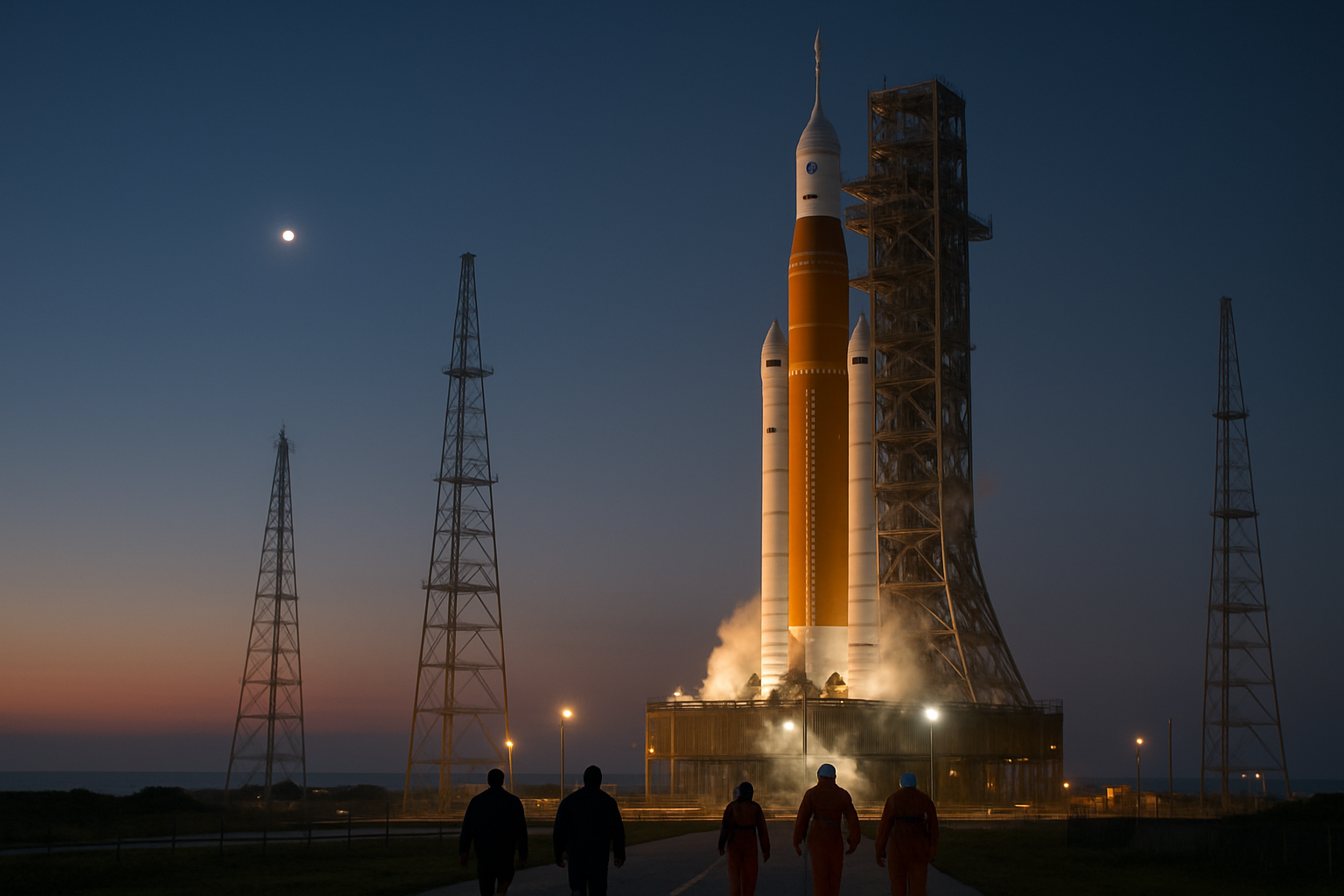
NASA Administrator Jared Isaacman officially confirmed the Artemis II mission will launch no earlier than April 1, 2026, after engineers successfully resolved critical technical issues that had delayed humanity's return to deep space for months.
The historic mission will send four astronauts on a 10-day lunar flyby covering 600,000 miles—the first crewed mission beyond Earth orbit since Apollo 17 landed on the Moon in December 1972, marking the end of a 54-year gap in human deep space exploration.
Crew Ready for Historic Journey
The international crew includes Canadian Space Agency astronaut Jeremy Hansen, who will become the first Canadian to travel beyond Earth orbit, alongside NASA Commander Reid Wiseman, Mission Specialists Christina Koch, and Victor Glover. The crew has completed intensive training regimens covering spacecraft systems, emergency procedures, and scientific experiment protocols unique to operating beyond Earth's protective magnetic field.
"The crew is ready. We will only launch when we believe we are ready,"
— Jared Isaacman, NASA Administrator
Calgary-born astronaut Jenni Gibbons will serve as the crucial voice link from Earth to the Artemis II mission, providing communication support while also serving as backup to Hansen. Her role highlights the expanding international cooperation within NASA's ambitious lunar program.
Technical Challenges Overcome
The mission faced multiple delays throughout early 2026 due to persistent technical problems with the Space Launch System (SLS) rocket. Engineers resolved critical helium system failures affecting the rocket's upper stage—essential for engine purging and fuel tank pressurization—and addressed hydrogen leak issues that emerged during wet dress rehearsal testing at T-minus 5 minutes in countdown simulations.
The SLS rocket represents NASA's most powerful launch vehicle ever built, standing 322 feet tall and weighing 5.75 million pounds when fully fueled with over 700,000 gallons of liquid hydrogen and oxygen propellants. The engineering challenges reflected the sophisticated requirements of deep space transportation systems capable of carrying human crews far from Earth's protective environment.
Artemis vs. Apollo: A New Era Begins
As comparisons between the historic Apollo program and NASA's new Artemis initiative become inevitable, significant differences emerge in both approach and ambition. While Apollo was designed as a sprint to demonstrate technological superiority, Artemis represents a methodical, sustainable approach to establishing permanent human presence on the Moon.
The current mission serves as a crucial stepping stone toward Artemis III, now scheduled for 2028, which will attempt the first lunar surface landing since the Apollo era. The program's restructuring earlier this year added an additional test mission to build "launch muscle memory" and moved the actual Moon landing from Artemis III to Artemis IV, demonstrating NASA's commitment to safety over schedule adherence.
Jupiter Science Advances
While Artemis captures headlines for human spaceflight, robotic exploration continues advancing our understanding of the outer solar system. Recent analysis of data from NASA's Juno mission revealed that Jupiter is slightly smaller than previously calculated, providing new insights into planetary formation models and the architecture of our solar system.
Chinese scientists at the Shanghai Institute of Technical Physics achieved a historic breakthrough using artificial intelligence to determine the chemical composition of the Moon's far side for the first time. The team analyzed samples from China's Chang'e-6 mission using advanced AI models to decode chemical signatures from previously unmapped lunar regions—nearly half the Moon's surface that permanently faces away from Earth.
International Competition Intensifies
The Artemis program operates within an increasingly competitive international space environment. China has announced plans for crewed lunar missions by 2030, while their Shenlong reusable spacecraft program continues advancing with multiple successful launches. Pakistan has selected astronaut candidates for China's Tiangong space station missions scheduled for October-November 2026, demonstrating the democratization of space capabilities beyond traditional spacefaring nations.
European nations are pursuing space independence through significant investments, including Germany's €10 billion satellite program and Sweden's Isar Aerospace facility that tests 30 rocket engines monthly. This competitive landscape has prompted NASA's strategic pivot, including Administrator Isaacman's announcement of a $20 billion investment to establish a permanent lunar surface base by 2030—the largest space infrastructure commitment in NASA's history.
Space Medicine Preparations
Critical to the success of extended lunar missions is ongoing space medicine research aboard the International Space Station. French astronaut Sophie Adenot's record-setting eight-month mission has provided invaluable data on long-duration spaceflight effects, including research on lung tissue cultivation in microgravity and Space-Associated Neuro-Ocular Syndrome (SANS), which affects astronaut vision during extended missions.
This research directly informs medical protocols for future lunar bases and Mars expeditions, where astronauts may spend years without the possibility of emergency evacuation to Earth. The convergence of human factors research, advanced life support systems, and radiation protection technologies represents essential preparation for sustainable human presence beyond Earth orbit.
Economic and Strategic Implications
The space economy is transitioning from what industry analysts call the "AI revolution" to a "space economy golden age," with projections suggesting the sector will exceed $1 trillion by 2030. SpaceX's preparation for a potentially trillion-dollar June 2026 IPO exemplifies the commercial space sector's rapid maturation from experimental ventures to essential infrastructure.
NASA's safety-first approach, prioritizing comprehensive testing over schedule pressures, reflects institutional learning from historical tragedies including the Challenger and Columbia disasters. Recent classification of Boeing's Starliner issues as a Type A mishap—the same severity level as those historic disasters—reinforces the agency's commitment to methodical problem-solving and crew protection.
Looking Beyond the Moon
The success of Artemis II will validate critical deep space systems including life support, radiation protection, and navigation capabilities operating beyond Earth's magnetic field. These technologies are essential not only for permanent lunar settlements but also serve as stepping stones for eventual Mars exploration and humanity's expansion into a spacefaring civilization.
The mission represents more than a return to the Moon; it marks humanity's renewed commitment to cosmic exploration using advanced technology, international cooperation, and space medicine knowledge accumulated through decades of International Space Station operations. Success could define the next era of human spaceflight, establishing the foundation for routine human presence beyond Earth orbit.
As the April 1 launch date approaches, the convergence of technical achievement, international cooperation, and ambitious long-term goals positions 2026 as a watershed year in space exploration—one that may be remembered as the moment humanity truly began its transformation into a multi-planetary species.