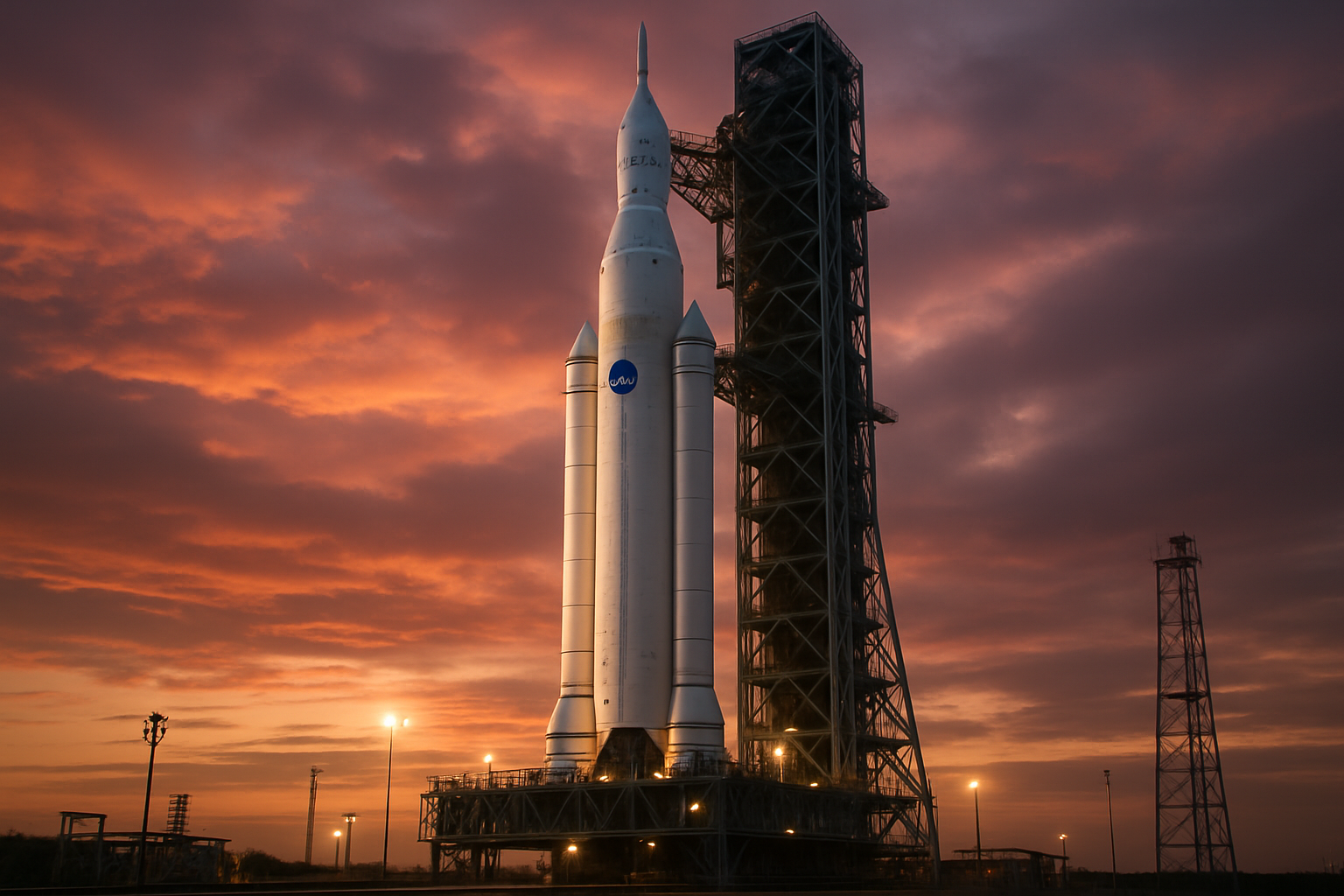
NASA has confirmed March 6, 2026 as the target launch date for the historic Artemis II mission, which will send four astronauts on humanity's first crewed journey to lunar orbit since the Apollo 17 mission in 1972.
The announcement comes after NASA Administrator Jared Isaacman reported "major progress" following successful completion of the second wet dress rehearsal on Thursday evening, February 20, 2026. The test marked a significant milestone after hydrogen leak issues disrupted the first countdown rehearsal earlier this month and forced delays from the originally planned February launch window.
Mission Details and Crew
The Artemis II mission will carry four astronauts on a 10-day journey around the Moon's far side, traveling more than 600,000 miles in what NASA describes as humanity's farthest venture into space to date. The international crew includes Canadian astronaut Jeremy Hansen, alongside NASA astronauts Reid Wiseman, Christina Koch, and Victor Glover.
The mission represents a crucial stepping stone toward the Artemis III lunar landing planned for 2027, which aims to return humans to the Moon's surface for the first time in over half a century. The crew will use NASA's most powerful rocket ever built, the Space Launch System (SLS), paired with the Orion spacecraft launching from Kennedy Space Center in Florida.
Technical Challenges Overcome
NASA's path to the March launch date has been marked by persistent technical challenges, particularly with hydrogen fuel system leaks that plagued earlier testing phases. The space agency's methodical approach to resolving these issues reflects lessons learned from previous space program tragedies.
"We will only launch when we believe we are ready," Isaacman emphasized, reinforcing NASA's safety-first culture that prioritizes astronaut protection over schedule pressures. The successful completion of the second wet dress rehearsal, which involved loading over 700,000 gallons of liquid hydrogen and oxygen into the SLS rocket, demonstrated the team's ability to manage these complex fuel systems.
"This test was a big step toward America's return to the lunar environment."
— Jared Isaacman, NASA Administrator
International Collaboration
The inclusion of Canadian astronaut Jeremy Hansen highlights the international nature of the Artemis program, which builds upon decades of cooperation through the International Space Station program. Canada's participation through the Canadian Space Agency represents a significant investment in lunar exploration capabilities and strengthens the partnership between North American space agencies.
The mission occurs during what industry experts describe as a transition from the "AI revolution to space economy golden age," with unprecedented commercial and international investment in space infrastructure. Recent developments include SpaceX's preparation for a potential June 2026 IPO valued at over $1 trillion and the successful restoration of the International Space Station to full seven-person operational capacity through the Crew-12 mission.
Historical Significance
The Artemis II mission marks humanity's return to deep space exploration after more than five decades of operations limited to low Earth orbit. The last humans to venture beyond Earth orbit were the crew of Apollo 17 in December 1972, making this mission a generational achievement for space exploration.
The mission's success will validate critical technologies needed for sustained lunar presence, including the Orion spacecraft's deep space life support systems, radiation protection capabilities, and navigation systems designed to operate far from Earth's protective magnetic field.
Broader Space Industry Context
The Artemis II announcement comes amid a remarkable period of global space activity. Recent achievements include NASA's successful deployment of fully AI-planned Mars rover missions, demonstrating autonomous navigation capabilities crucial for future deep space operations. International cooperation continues through various programs, with Pakistan recently selecting astronaut candidates for China's Tiangong space station and European nations expanding their space capabilities.
The global space industry is experiencing unprecedented growth, with emerging technologies addressing challenges from Earth's ongoing memory crisis through space-based data centers to advanced weather forecasting through AI-powered satellite constellations. The success of Artemis II will likely accelerate these trends and establish new paradigms for human space exploration.
Looking Forward
The March 6 launch date represents the earliest possible opportunity for the mission, with NASA maintaining flexibility to adjust based on final system validations and weather conditions. The mission's success will directly enable the Artemis III lunar landing mission, planned for 2027, which aims to establish the foundation for sustained human presence on the Moon.
Beyond its immediate objectives, Artemis II serves as a proving ground for technologies and procedures that will eventually enable human missions to Mars and other destinations in the solar system. The mission represents a critical step in humanity's expansion into the cosmos, building on the legacy of Apollo while incorporating five decades of technological advancement and international cooperation.
As NASA prepares for this historic launch, the space agency continues to emphasize that the mission will proceed only when all systems meet the rigorous safety standards developed through decades of human spaceflight experience. The March 2026 launch window offers the promise of witnessing humanity's bold return to lunar exploration, marking the beginning of a new era in space exploration that could define the next century of human achievement beyond Earth.