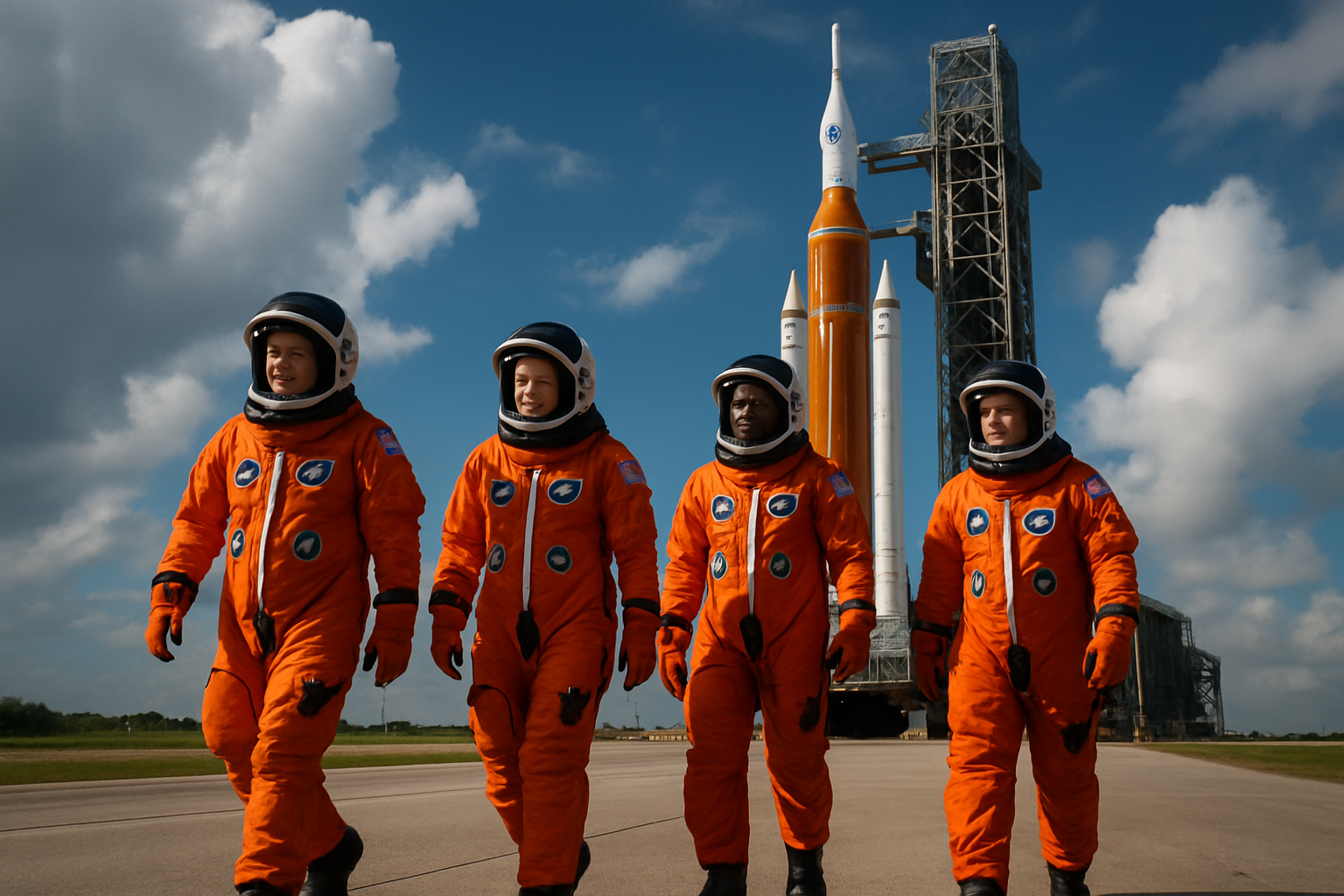
NASA Administrator Jared Isaacman confirmed Thursday that the Artemis II mission is targeting an April 1, 2026 launch window, marking humanity's first crewed lunar mission in over five decades after successfully resolving critical technical challenges that have delayed the historic flight for months.
The announcement represents a major milestone for NASA's ambitious Artemis program, which aims to return humans to the lunar surface for the first time since Apollo 17 in December 1972. The four-astronaut crew will embark on a 10-day lunar flyby covering approximately 600,000 miles, venturing farther from Earth than any human has traveled in 54 years.
International Crew Ready for Historic Journey
The Artemis II crew includes Canadian Space Agency astronaut Jeremy Hansen, who will become the first Canadian to travel beyond Earth orbit, alongside NASA's Reid Wiseman serving as mission commander, Christina Koch, and Victor Glover. Their selection represents the culmination of years of intensive training and preparation for what NASA describes as one of the most challenging human spaceflight missions ever attempted.
"We have an incredible crew ready to make history," Isaacman emphasized during the announcement. "This mission will validate our deep space exploration capabilities and pave the way for sustainable lunar presence."
Technical Challenges Successfully Resolved
The path to this announcement has been fraught with technical obstacles that have tested NASA's engineering capabilities and safety-first culture. The Space Launch System (SLS) rocket, standing 322 feet tall and weighing 5.75 million pounds when fully fueled, experienced persistent issues throughout 2026 that threatened the mission timeline.
Critical helium system failures affecting the rocket's upper stage posed significant safety concerns, as the helium system is essential for engine purging and fuel tank pressurization. Additionally, persistent hydrogen leak problems during wet dress rehearsal testing repeatedly emerged at T-minus 5 minutes during countdown simulations, forcing engineers to halt preparations.
"We will only launch when we believe we are ready. This philosophy reflects our institutional learning from historical tragedies and demonstrates our unwavering commitment to crew safety."
— Jared Isaacman, NASA Administrator
The SLS rocket represents the most powerful launch vehicle NASA has ever built, requiring over 700,000 gallons of liquid hydrogen and oxygen propellants. The technical complexity of managing these systems while ensuring absolute crew safety has demanded methodical problem-solving approaches that prioritized thoroughness over schedule adherence.
Safety-First Culture Drives Decision Making
NASA's approach to the Artemis II delays reflects hard-learned lessons from past space program tragedies. The recent classification of Boeing's Starliner mission as a Type A mishap—the same severity level as the Challenger and Columbia disasters—has reinforced the agency's comprehensive safety assessment protocols.
This methodical approach has drawn both praise and criticism as the space industry undergoes what analysts describe as a transition from the "AI revolution" to the "space economy golden age." While commercial space companies like SpaceX maintain regular operational schedules, NASA's government-led programs face different pressures and safety standards.
Strategic Context and International Competition
The Artemis II mission launch comes amid intensifying international space competition. China has announced plans for crewed lunar missions by 2030, while the nation's Shenlong reusable spacecraft program continues advancing. Pakistan has selected astronaut candidates for China's Tiangong space station missions scheduled for October-November 2026, demonstrating the democratization of space access capabilities.
European space independence efforts are also accelerating, with Germany's Isar Aerospace constructing facilities in Sweden capable of testing 30 rocket engines monthly. These developments underscore the strategic importance of NASA's successful return to deep space exploration capabilities.
Meanwhile, SpaceX is preparing for a potentially trillion-dollar initial public offering in June 2026, reflecting the commercial space sector's explosive growth during this transformative period for the industry.
Mission Objectives and Scientific Goals
Artemis II serves multiple critical objectives beyond its symbolic importance as humanity's return to deep space. The mission will validate life support systems, radiation protection capabilities, and navigation technologies required for operations beyond Earth's protective magnetic field.
The crew will conduct experiments examining human adaptation to deep space environments, building on research conducted aboard the International Space Station. This includes studying Space-Associated Neuro-Ocular Syndrome (SANS), which affects astronaut vision during extended missions—a critical concern for future lunar settlements and Mars exploration.
The mission directly supports ongoing ISS research, including the groundbreaking lung tissue cultivation studies being conducted by French astronaut Sophie Adenot during her record-setting eight-month mission. Such research provides essential medical knowledge for sustained human presence beyond Earth orbit.
Economic and Strategic Implications
The successful execution of Artemis II carries implications extending far beyond scientific achievement. The mission represents a multi-billion dollar investment in space infrastructure designed to position the United States as a leader in the emerging space economy, projected to exceed $1 trillion by 2030.
Success will provide access to lunar resources, enable advanced scientific research, and validate technologies essential for permanent lunar settlements and eventual Mars exploration. The mission also tests systems that will be critical for resource utilization, manufacturing capabilities, and sustained human presence on other worlds.
Looking Toward Artemis III and Beyond
While Artemis II focuses on lunar flyby objectives, it serves as a crucial stepping stone toward Artemis III, which aims to return astronauts to the lunar surface by 2028. Recent program restructuring has added additional test missions to build "launch muscle memory" and moved the actual lunar landing from Artemis III to Artemis IV, reflecting NASA's commitment to methodical capability building.
The Canadian Space Agency's participation through Jeremy Hansen validates the Artemis Accords framework for international cooperation in peaceful lunar exploration. This collaboration model provides a template for future deep space missions requiring diverse international expertise and sustained partnership.
Historical Significance
The 54-year gap since Apollo 17 represents the longest period in modern history without human deep space exploration. Artemis II marks humanity's renewed commitment to cosmic exploration, utilizing advanced technology, international cooperation, and space medicine knowledge accumulated through decades of International Space Station operations.
The mission occurs during what experts characterize as a "golden age of astronomical observation," with unprecedented technological capabilities enabling discoveries about distant worlds, stellar formation, and cosmic phenomena. This convergence of human spaceflight capabilities with advanced robotic exploration and astronomical research positions 2026 as a watershed year for space science.
Success could define the next era of human spaceflight, establishing foundations for a truly spacefaring civilization capable of sustained presence throughout the solar system. The mission represents more than technological achievement—it embodies humanity's enduring drive to explore, discover, and expand our presence in the cosmos.
As NASA prepares for this historic launch, the world watches with anticipation for humanity's next giant leap into the cosmic frontier, carrying hopes not just for scientific discovery, but for the future of human civilization among the stars.