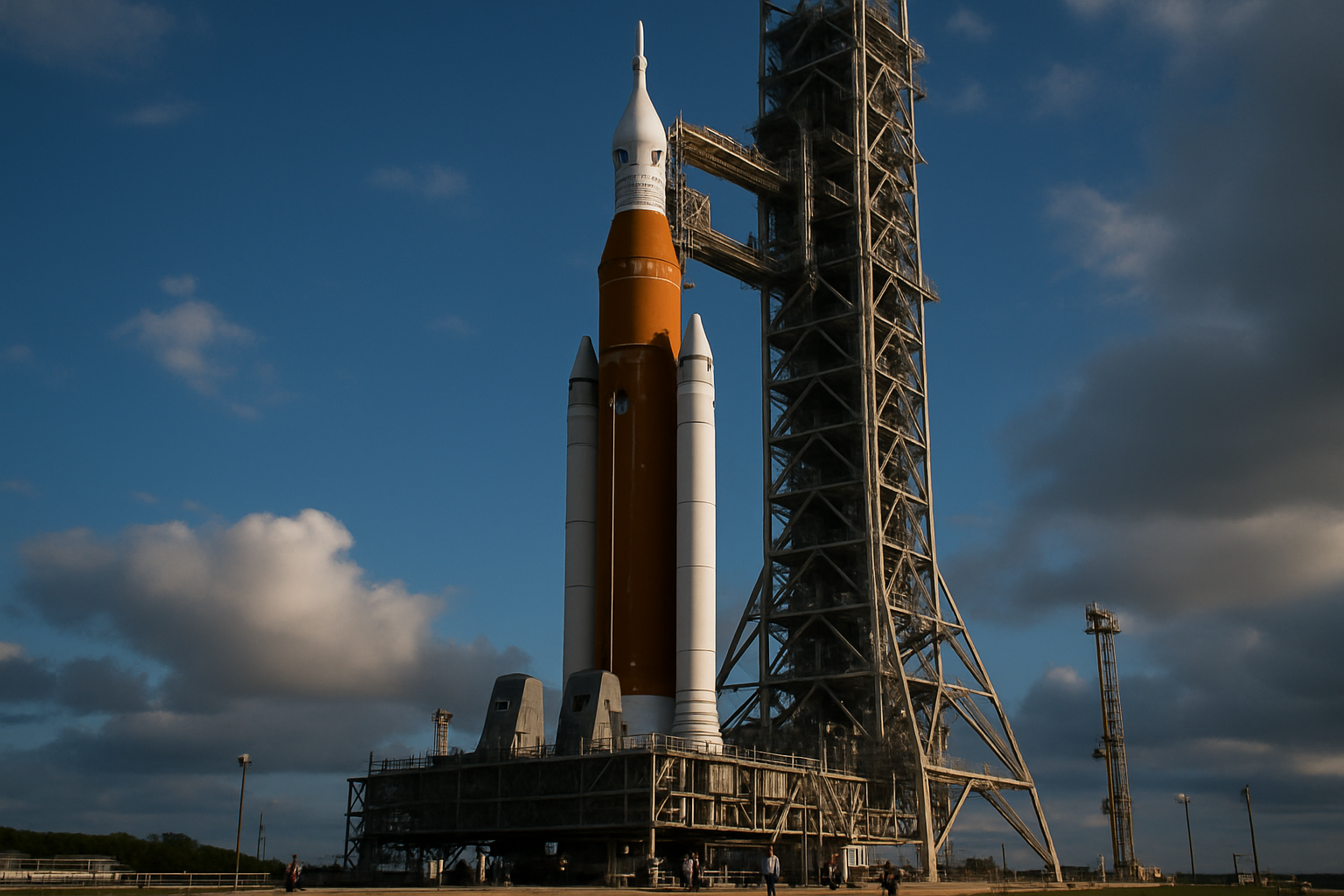
NASA has officially ruled out a March 2026 launch for its highly anticipated Artemis II lunar mission after discovering critical technical issues with the Space Launch System (SLS) rocket's helium flow system, dealing another significant blow to the agency's timeline for returning humans to lunar orbit.
The setback emerged just one day after NASA had announced it was targeting March 6, 2026, as the launch date for the historic mission that would send four astronauts around the Moon for the first time since Apollo 17 in 1972. The technical problems center on an "interrupted flow" of helium to the rocket's upper stage system, a critical component essential for engine purging and fuel tank pressurization.
Critical Technical Challenges
According to NASA officials, the helium system failure represents a serious safety concern that cannot be compromised. The helium flow interruption affects the rocket's upper stage propulsion system, which is vital for the spacecraft's trajectory beyond Earth's orbit. This latest issue compounds previous hydrogen leak problems that had already delayed the mission from its original February launch window.
The Space Launch System, standing 322 feet tall and weighing 5.75 million pounds when fully fueled, requires flawless operation of multiple critical systems to safely transport the four-person crew on their 600,000-mile journey around the Moon. The complexity of the mission demands that every system function perfectly, as there is no room for error when human lives are at stake beyond Earth's protective magnetic field.
"We will only launch when we believe we are ready. Safety is our top priority, and we will not compromise on that principle."
— NASA Administrator Jared Isaacman
Mission Details and Crew
The Artemis II mission represents a critical stepping stone in NASA's ambitious plan to establish a sustainable human presence on the Moon. The 10-day lunar flyby will carry an international crew of four astronauts: Canadian Jeremy Hansen, NASA's Reid Wiseman serving as mission commander, Christina Koch, and Victor Glover. This diverse crew reflects the international nature of the Artemis program and its commitment to collaborative space exploration.
The mission will use NASA's Orion spacecraft, launched atop the powerful SLS rocket from Kennedy Space Center in Florida. The crew will travel approximately 7,400 kilometers beyond the Moon's far side before returning to Earth, testing critical life support systems, radiation protection, and deep space navigation capabilities that will be essential for the planned Artemis III lunar landing mission scheduled for 2027.
Historical Context and Significance
The Artemis II delay represents more than just a scheduling setback—it underscores the immense technical challenges of human deep space exploration. The mission would mark humanity's first crewed venture beyond Earth's orbit in over 50 years, making it one of the most significant space exploration milestones of the 21st century.
The current delay follows a pattern of technical challenges that have plagued the Artemis program. Previous setbacks included hydrogen leak issues during wet dress rehearsal testing, which caused the initial postponement from February to March 2026. These recurring problems highlight the complexity of developing and operating the most powerful rocket NASA has ever built.
Safety-First Approach
NASA's decision to delay the mission reflects the agency's institutional commitment to astronaut safety, a philosophy shaped by hard-learned lessons from previous space program tragedies. The agency's safety-first culture prioritizes thorough preparation and comprehensive testing over adherence to ambitious launch schedules.
This approach has been reinforced by recent experiences, including the classification of Boeing's Starliner mission as a "Type A" mishap—the same severity level as the Challenger and Columbia disasters. These experiences have strengthened NASA's resolve to address all technical issues comprehensively before committing to human spaceflight missions.
International Implications
The delay has particular significance for international partners in the Artemis program, especially the Canadian Space Agency. Jeremy Hansen's participation represents Canada's major contribution to human spaceflight and its first astronaut to venture beyond Earth orbit. The mission serves as a cornerstone of international cooperation in space exploration, building on the successful model established by the International Space Station program.
The Artemis II mission also occurs during what analysts describe as a "space economy golden age," characterized by unprecedented commercial space activity and intensifying international competition. China's advancing Shenlong spacecraft program, European rocket manufacturing expansion, and emerging nations' growing space capabilities create a competitive environment where delays can have strategic implications.
Technical Resolution and Timeline
NASA engineers are now working to resolve the helium system issues, which may require rolling the massive SLS rocket back to the Vehicle Assembly Building for additional testing and repairs. This process, if necessary, would further extend the mission delay, potentially pushing the launch to April 2026 or beyond.
The rocket has already undergone extensive testing, including a successful wet dress rehearsal that loaded over 700,000 gallons of liquid hydrogen and oxygen propellants. However, the emergence of new technical issues during final preparations demonstrates the unpredictable nature of complex space systems and the importance of thorough pre-flight testing.
Broader Space Industry Context
The Artemis II delay occurs during a period of rapid transformation in the space industry. SpaceX is preparing for a potential June 2026 IPO that could value the company at over $1 trillion, while simultaneously pivoting its focus from Mars colonization to lunar city development within the next decade. This shift aligns with NASA's lunar-focused strategy and could provide complementary capabilities for sustained Moon exploration.
The global space economy is also grappling with challenges including a semiconductor memory crisis that has increased prices sixfold, affecting space technology development. These broader industry pressures underscore the importance of international cooperation and resource sharing in ambitious projects like Artemis.
Looking Forward
Despite the current setbacks, NASA remains committed to the Artemis program's long-term objectives. The lessons learned from resolving the helium system issues and other technical challenges will contribute to the overall safety and reliability of future missions, including the planned Artemis III lunar landing.
The delay, while disappointing, reflects NASA's maturation as a space exploration organization that prioritizes methodical problem-solving over schedule pressure. This approach, though sometimes frustrating for eager space enthusiasts, builds confidence in the agency's ability to conduct safe and successful human missions to the Moon and eventually to Mars.
As NASA works to resolve the current technical issues, the space community continues to look forward to the day when humans will once again venture beyond Earth's orbit, marking a new chapter in humanity's exploration of the cosmos. The Artemis II mission, whenever it ultimately launches, will represent not just a return to deep space, but a foundation for humanity's sustainable future among the stars.