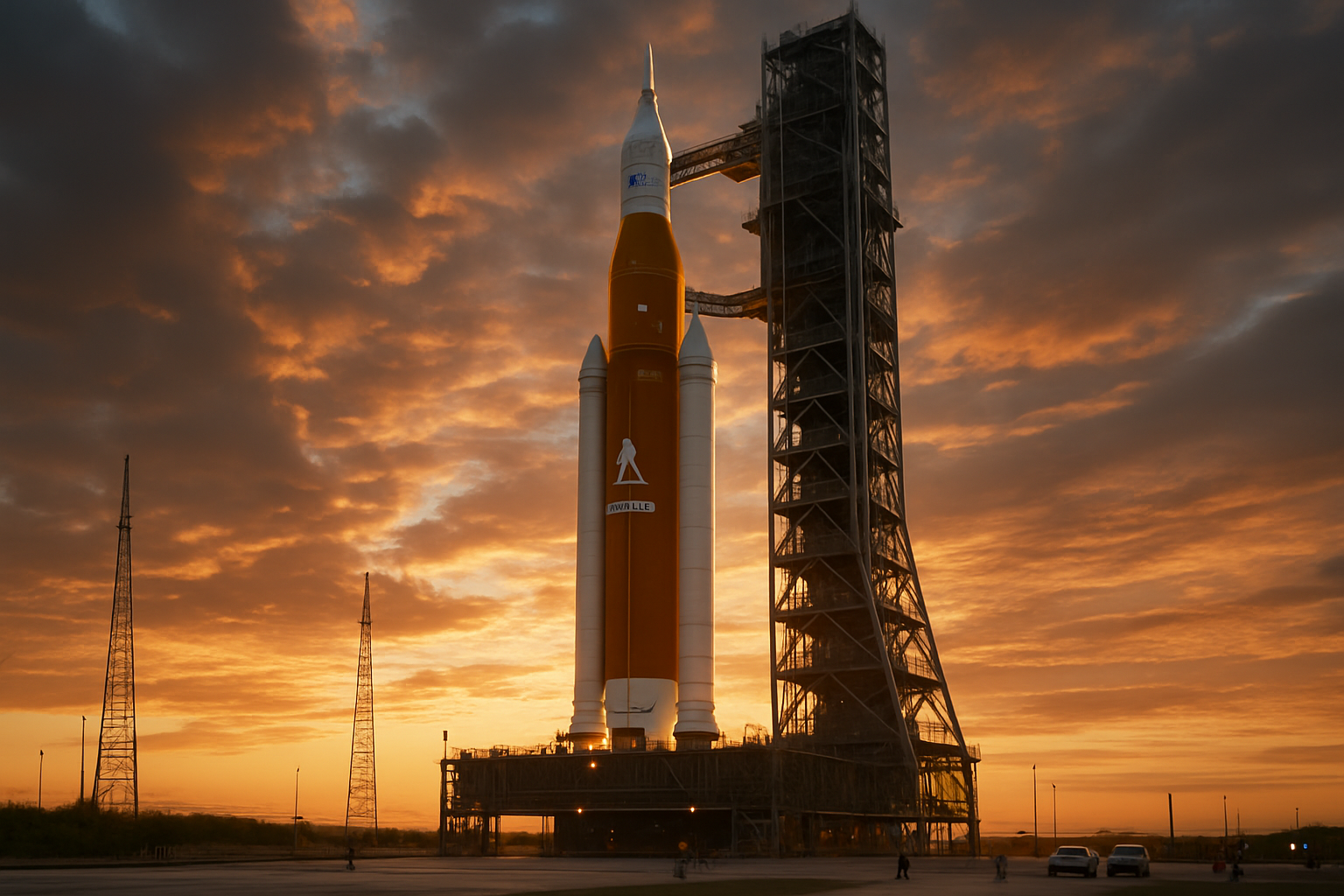
NASA has announced significant changes to the Artemis program timeline, now targeting April 1 as the earliest possible launch date for Artemis II after months of technical delays and system failures forced a comprehensive reshuffling of the lunar exploration schedule.
The space agency's announcement represents the culmination of persistent engineering challenges that have plagued the program throughout early 2026, including critical hydrogen leak issues and helium system failures affecting the Space Launch System (SLS) rocket. Administrator Jared Isaacman confirmed the new target date after engineers successfully resolved the technical problems that caused multiple postponements.
Technical Challenges Drive Mission Reshuffling
The Artemis II mission has faced a series of setbacks since its original February 2026 target, with NASA implementing what sources describe as a comprehensive "reshuffling" of mission priorities and timelines. The primary issues centered on the SLS rocket's propulsion systems, where hydrogen leak problems emerged during wet dress rehearsal testing and helium system failures affected the rocket's upper stage.
"We will only launch when we believe we are ready. This is not about meeting arbitrary deadlines—this is about ensuring the safety of our crew and the success of America's return to deep space exploration."
— Jared Isaacman, NASA Administrator
The helium system failures proved particularly challenging, as this system is critical for engine purging and fuel tank pressurization—safety functions that cannot be compromised. Technical problems consistently emerged at T-minus 5 minutes during countdown simulations, forcing engineering teams to extend their troubleshooting timeline.
International Crew Awaits Historic Journey
The four-astronaut international crew remains ready for what will be the first crewed mission beyond Earth orbit since Apollo 17 in December 1972—a gap of 54 years. The crew includes Canadian Jeremy Hansen, who will become the first Canadian to travel beyond Earth orbit, NASA Commander Reid Wiseman, Christina Koch, and Victor Glover.
The mission is planned as a 10-day lunar flyby covering approximately 600,000 miles, serving as a crucial stepping stone toward the Artemis III lunar landing now scheduled for 2028. The crew will test critical deep space systems including life support, radiation protection, and navigation capabilities that will be essential for sustained lunar presence.
Hardware Rethinking and Program Restructuring
Beyond the immediate technical fixes, NASA has been "rethinking hardware" for its Space Launch System rocket on future missions, according to the announcement. This represents a broader strategic reshuffling that includes the cancellation of multibillion-dollar Boeing upgrades to the SLS rocket core stage—a decision designed to control costs while maintaining safety priorities.
The SLS rocket represents NASA's most powerful launch vehicle ever built, standing 322 feet tall and weighing 5.75 million pounds when fully fueled with over 700,000 gallons of liquid hydrogen and oxygen. The technical complexity of this system has proven challenging to master, but NASA emphasizes that each problem solved builds confidence in long-term deep space transportation capabilities.
Broader Artemis Program Timeline Adjustments
The mission reshuffling extends beyond Artemis II, with NASA having previously announced the addition of a new test mission between Artemis II and the actual lunar landing to build what officials call "launch muscle memory." This has effectively moved the first lunar landing from Artemis III to Artemis IV, though NASA maintains its commitment to returning humans to the Moon's surface by 2028.
These changes reflect NASA's institutional learning from historical space program tragedies, with the recent classification of Boeing's Starliner mission as a Type A mishap—the same severity level as the Challenger and Columbia disasters—reinforcing the agency's comprehensive safety assessment approach.
International Competition and Cooperation Context
The Artemis reshuffling occurs during what analysts describe as a "space economy golden age," with intensifying international competition. China is planning to send crews to the lunar surface by 2030, while SpaceX prepares for a potentially trillion-dollar IPO in June 2026. Pakistan has selected astronaut candidates for China's Tiangong space station missions scheduled for October-November 2026.
Despite competitive pressures, international cooperation continues through the Artemis Accords framework, with Canadian participation in Artemis II serving as a model for peaceful lunar exploration partnerships. The mission represents successful integration of international capabilities while maintaining American leadership in space exploration.
Safety-First Culture Drives Decisions
NASA's approach to the Artemis reshuffling exemplifies the agency's safety-first culture, prioritizing crew protection over schedule adherence. This methodical problem-solving approach mirrors the systematic methodology that made the Apollo program successful, emphasizing incremental capability building rather than rushing toward ambitious deadlines.
The space agency's transparency in reporting delays and technical challenges demonstrates institutional maturity in complex operations management, balancing ambitious exploration goals with rigorous engineering standards. Multiple delays, while frustrating, build confidence in NASA's commitment to technical excellence.
Economic and Strategic Implications
The Artemis program represents a multi-billion dollar investment in space infrastructure that positions the United States as a leader in the emerging space economy, which is projected to exceed $1 trillion by 2030. Success is critical for resource access, scientific discovery, and technological development that will define 21st-century spacefaring capabilities.
The program's restructuring and timeline adjustments, while challenging in the short term, are designed to establish a sustainable lunar presence that serves as a foundation for Mars exploration. The methodical approach validates systems essential for permanent lunar settlements and eventual interplanetary expansion.
Looking Ahead to April Launch
With the April 1 target now confirmed, NASA teams are conducting final preparations for what promises to be a historic milestone in human space exploration. The mission will serve as humanity's return to deep space after more than five decades, testing technologies and procedures that will enable the next phase of cosmic exploration.
The success of Artemis II will validate the program's reshuffled approach and demonstrate that careful, methodical problem-solving can overcome the technical challenges of deep space transportation. For the international crew and the global space community, April 2026 represents not just a launch date, but the beginning of humanity's sustained return to the cosmos.
As Administrator Isaacman noted, the Artemis reshuffling reflects NASA's maturation as a space exploration organization, combining ambitious vision with practical engineering wisdom to ensure that America's return to the Moon establishes a foundation for spacefaring civilization that extends far beyond our home planet.