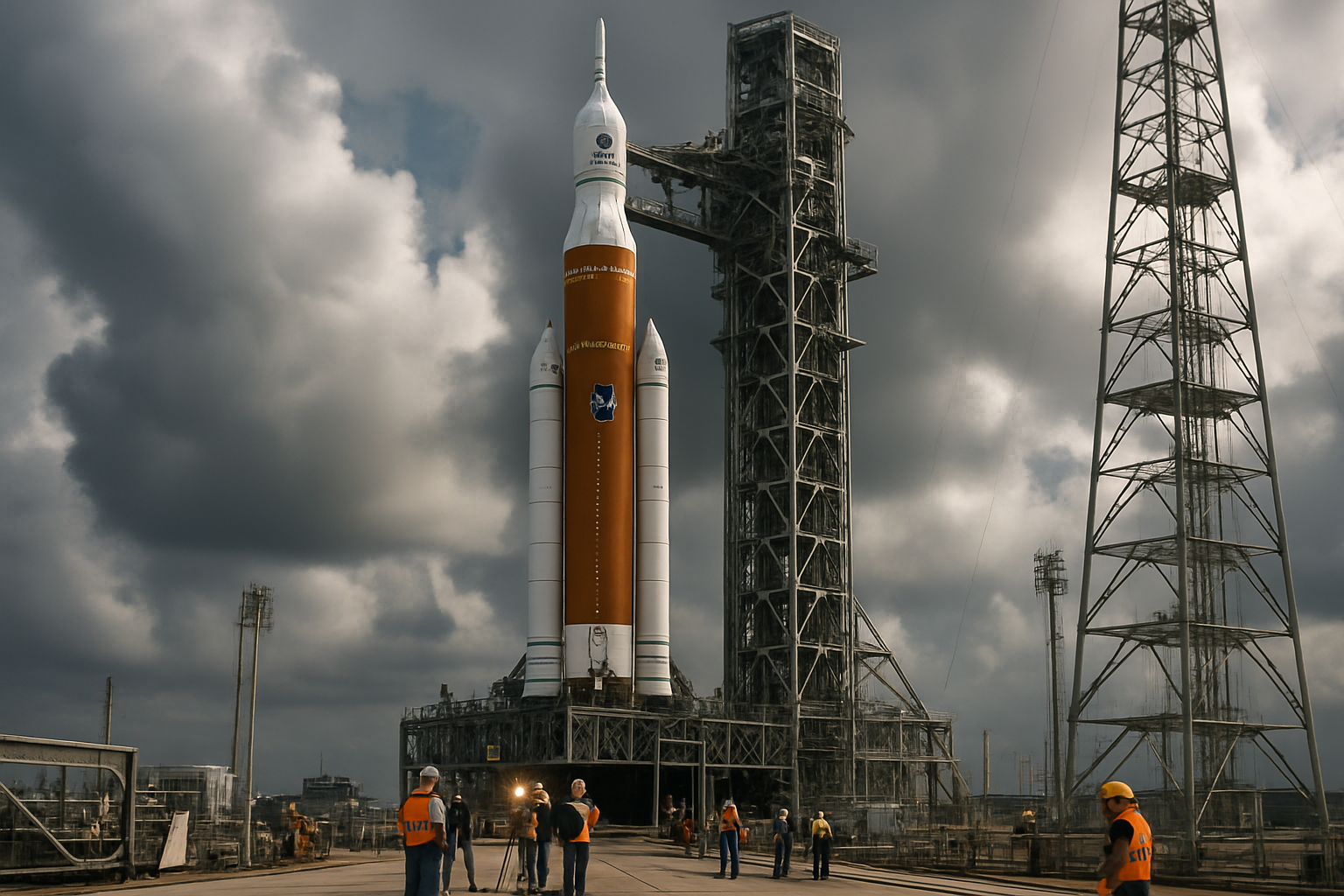
NASA has once again postponed its highly anticipated Artemis II lunar flyby mission, pushing the launch date beyond the planned March 2026 window due to persistent technical problems with the Space Launch System (SLS) rocket, marking another significant setback for humanity's return to the Moon.
The latest delay, announced following additional technical evaluations, represents the third major postponement for the mission that was originally scheduled for February 2026. Technical teams discovered continuing issues with the rocket's helium systems and hydrogen leak problems during recent testing phases, forcing mission planners to extend the timeline once again.
Technical Challenges Continue to Plague Mission
The Artemis II mission has been beset by a cascade of technical difficulties, primarily centered around the massive 322-foot Space Launch System rocket's fuel systems. During recent wet dress rehearsal testing – a critical full-scale countdown simulation – engineers encountered persistent hydrogen leaks that worsened at crucial moments in the countdown sequence.
"We discovered helium flow interruptions to the rocket's upper stage during final preparations," explained NASA Administrator Jared Isaacman in a recent briefing. "The helium system is essential for engine purging and fuel tank pressurization – critical safety functions that cannot be compromised."
The helium system failures represent just the latest in a series of technical setbacks that have plagued the mission. Earlier testing revealed hydrogen leak problems during wet dress rehearsal procedures, which initially caused the delay from February to March 2026. The deteriorating situation at T-minus 5 minutes during simulated countdowns has forced teams back to the drawing board.
Mission Stakes and International Implications
The Artemis II mission carries enormous significance as the first crewed mission beyond Earth orbit since Apollo 17 in December 1972. The 10-day lunar flyby will carry four astronauts – including Canadian Jeremy Hansen, NASA's Reid Wiseman (commander), Christina Koch, and Victor Glover – on a journey covering approximately 600,000 miles around the Moon.
The mission serves as a crucial stepping stone toward the more ambitious Artemis III lunar landing planned for 2027, which aims to establish a sustainable lunar presence and eventually support Mars exploration. The delays have implications beyond NASA, affecting international partners including the Canadian Space Agency and other Artemis Accord signatories.
"We will only launch when we believe we are ready. This reflects our institutional learning from historical space program tragedies."
— Jared Isaacman, NASA Administrator
Safety-First Culture vs Schedule Pressure
NASA's approach to the delays demonstrates the agency's commitment to a safety-first culture, prioritizing crew protection over schedule adherence. This methodology reflects hard-learned lessons from previous space tragedies, including the Challenger and Columbia disasters.
The Space Launch System represents the most powerful rocket NASA has ever built, requiring the successful operation of multiple critical systems simultaneously. When fully fueled, the rocket weighs 5.75 million pounds and must load over 700,000 gallons of liquid hydrogen and oxygen propellants – a complex process that has revealed ongoing challenges with advanced propulsion systems.
Recent mission evaluations have also taken into account lessons learned from Boeing's Starliner mission complications, which NASA classified as a "Type A" mishap – the same severity level as the Challenger and Columbia disasters. The comprehensive safety assessment underscores NASA's systematic approach to risk management across all programs.
Broader Context of Space Exploration Challenges
The Artemis delays occur during what industry analysts describe as a transition from the "AI revolution to the space economy golden age." While NASA grapples with technical challenges, commercial space companies continue advancing their capabilities, with SpaceX preparing a potential trillion-dollar IPO in June 2026.
The contrast is notable: while NASA's government-led program faces technical setbacks, commercial entities like SpaceX have successfully maintained regular crew rotations to the International Space Station. The recent Crew-12 mission successfully restored the ISS to full seven-person operational capacity, highlighting the maturation of commercial space transportation systems.
International Space Cooperation Continues
Despite the delays, international cooperation in space exploration continues to strengthen. Recent developments include Pakistan's selection of astronaut candidates for China's Tiangong station mission in October-November 2026, and the successful deployment of European rockets carrying commercial satellites.
The delays also come as other nations advance their space capabilities. China's fourth Shenlong reusable spacecraft launch and European rocket manufacturing expansion through facilities like Germany's Isar Aerospace in Sweden demonstrate the increasingly competitive global space environment.
Technical Innovation Amid Setbacks
While the Artemis II mission faces delays, NASA continues to achieve breakthroughs in other areas. The agency recently completed the first fully AI-planned Mars rover mission, demonstrating autonomous navigation capabilities that will be crucial for future deep space exploration.
Additionally, NASA's DAGGER AI system achieved a revolutionary 30-minute geomagnetic storm prediction capability, representing a quantum leap in space weather forecasting that protects satellites and electrical grids from solar storm damage.
Looking Ahead: Implications for Lunar Exploration
The repeated delays raise questions about the timeline for America's return to the Moon and the broader Artemis program objectives. Each postponement affects not only the immediate mission but also the cascade of subsequent missions planned to establish a permanent lunar base by the end of the decade.
However, the methodical approach to resolving technical challenges may ultimately benefit long-term exploration goals. The extensive testing and problem-solving process builds confidence in the systems that will eventually carry humans back to the lunar surface and, eventually, to Mars.
Space medicine research continues alongside the technical development, with ongoing studies of Space-Associated Neuro-Ocular Syndrome (SANS) and other challenges affecting astronauts during extended missions. This research directly informs the medical and operational protocols necessary for future lunar bases and Mars missions.
Economic and Strategic Considerations
The delays occur within a broader context of unprecedented space industry growth. The global space economy is transitioning toward commercial leadership, with private companies increasingly driving innovation beyond traditional government programs.
Space-based infrastructure development, including data centers addressing Earth's memory crisis caused by sixfold semiconductor price increases, represents emerging opportunities that may reshape both space exploration and terrestrial technology infrastructure.
The successful resolution of Artemis II's technical challenges will be crucial for maintaining American leadership in space exploration during this competitive period. The mission's success would validate deep space life support systems, radiation protection, and navigation technologies operating beyond Earth's magnetic field – capabilities essential for sustainable space presence.
The Path Forward
NASA teams continue working to resolve the technical issues, with the next launch window likely opening later in 2026. The systematic approach to problem-solving, while frustrating for mission timelines, reflects the agency's commitment to crew safety and mission success.
The eventual success of Artemis II will represent more than a return to lunar orbit – it will mark humanity's first steps toward becoming a truly spacefaring civilization. The mission will test technologies and procedures essential for establishing permanent human presence beyond Earth, setting the stage for lunar bases and eventual Mars exploration.
As NASA Administrator Isaacman emphasized, the agency will launch only when fully prepared. This patience, while costly in terms of schedule and budget, may prove essential for the long-term success of humanity's expansion into the solar system.