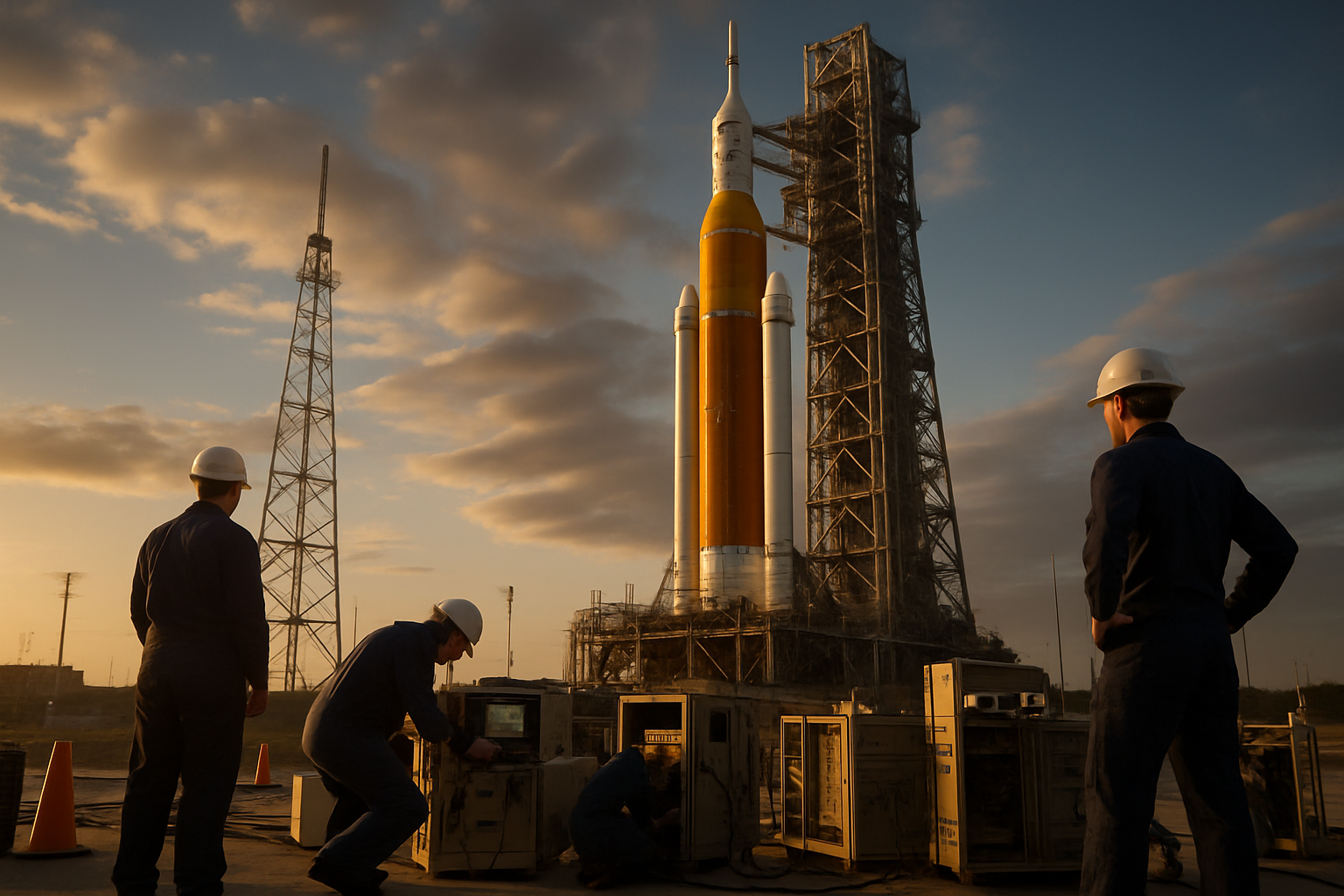
NASA announced a comprehensive overhaul of its ambitious Artemis lunar program on Friday, adding a new test mission and postponing the moon landing to 2028, as astronomers worldwide prepare for a spectacular six-planet alignment visible this weekend.
The sweeping changes to America's flagship space exploration program come after persistent technical challenges, including hydrogen leaks and helium system failures that have plagued the Space Launch System (SLS) rocket during testing. Meanwhile, nature provides its own cosmic spectacle with Mercury, Venus, Saturn, Jupiter, Uranus, and Neptune aligning in a rare celestial formation.
Artemis Program Gets Major Restructuring
NASA Administrator Jared Isaacman announced the program changes at a Kennedy Space Center press conference alongside Associate Administrator Amit Kshatriya, outlining four key modifications to the lunar exploration timeline:
- Addition of a new test mission between Artemis II and the actual moon landing to build "launch muscle memory"
- Moving the lunar surface mission from Artemis III to Artemis IV
- Canceling Boeing's multibillion-dollar upgrade to the SLS rocket core stage
- Maintaining the 2028 deadline for American astronauts' return to the lunar surface
The restructuring addresses ongoing technical challenges that have repeatedly delayed the program. Persistent hydrogen leak issues during wet dress rehearsal testing and helium system failures affecting the rocket's upper stage have forced NASA to adopt a more methodical approach.
"We will only launch when we believe we are ready," Isaacman emphasized, reflecting NASA's institutional learning from historical tragedies.
— Jared Isaacman, NASA Administrator
The SLS rocket, standing 322 feet tall and weighing 5.75 million pounds when fully fueled with over 700,000 gallons of liquid hydrogen and oxygen, represents NASA's most powerful rocket ever built. However, technical problems have emerged consistently at T-minus 5 minutes during countdown simulations, particularly with systems critical for engine purging and fuel tank pressurization.
International Crew Awaits Mission Green Light
The eventual Artemis II mission will carry a four-astronaut international crew on a 10-day lunar flyby covering 600,000 miles—the first crewed mission beyond Earth orbit since Apollo 17 in December 1972. The crew includes Canadian Jeremy Hansen, NASA's Reid Wiseman (commander), Christina Koch, and Victor Glover.
The mission represents more than a technological achievement; it embodies international cooperation through the Artemis Accords partnerships and serves as a crucial stepping stone toward establishing a sustainable lunar presence and eventual Mars exploration.
Recent context includes NASA astronaut Mike Fincke's historic revelation that he was the first person ever medically evacuated from the International Space Station, marking an unprecedented event in NASA's 65-year human spaceflight history. This experience has provided valuable data for emergency medical protocols that will be essential for deep space missions where Earth evacuation is impossible.
Spectacular Planetary Alignment Captivates Global Audience
While NASA engineers work through technical challenges, the cosmos provides its own spectacular show. Six planets—Mercury, Venus, Saturn, Jupiter, Uranus, and Neptune—are aligning in a rare celestial "parade" visible globally this weekend.
NASA planetary scientist Heidi Haviland from Marshall Space Flight Centre in Huntsville, Alabama, explains that the alignment occurs due to orbital mechanics around the sun. Mercury, Venus, Saturn, and Jupiter will be visible to the naked eye, while Uranus and Neptune require binoculars or telescopes.
Optimal viewing occurs for early risers before sunrise and night owls right after sunset. Venus appears as the brightest "morning/evening star," Jupiter shows as a steady golden-white point, Saturn appears dimmer but visible, while Mercury presents challenges due to its solar proximity. Uranus appears as a faint blue-green dot through binoculars, and Neptune requires telescope observation.
Space Economy Golden Age Context
These developments occur during what industry analysts describe as the transition from the "AI revolution" to the "space economy golden age." SpaceX is preparing a potential June 2026 IPO that could value the company at over $1 trillion, while international space competition intensifies with China's Shenlong program advancement and Pakistan's selection of astronaut candidates for China's Tiangong station mission in October-November 2026.
The current ISS operations continue successfully, with the recent Crew-12 mission restoring the station to full seven-person capacity. French astronaut Sophie Adenot became the first French woman on the ISS in 25 years, conducting crucial research including lung tissue cultivation and Space-Associated Neuro-Ocular Syndrome (SANS) studies essential for future lunar settlements and Mars missions.
This research addresses critical challenges for extended space missions, as SANS affects astronaut vision during long-duration flights—a condition that Portuguese scientists are leading breakthrough research to understand and mitigate.
Safety-First Approach Drives Decision Making
NASA's methodical problem-solving approach reflects institutional maturity prioritizing comprehensive safety over schedule pressure. The recent classification of Boeing's Starliner mission as a "Type A" mishap—the same severity level as the Challenger and Columbia disasters—reinforces the agency's commitment to thorough safety assessments.
The Artemis restructuring mirrors the methodical Apollo program approach, emphasizing incremental capability building rather than rushing toward ambitious deadlines. This strategy aims to establish sustainable lunar presence while building long-term confidence in deep space transportation systems.
Despite the delays and additional test mission, NASA maintains its 2028 goal for human return to the lunar surface. The agency's transparency in reporting failures and systematic approach to problem-solving demonstrates the evolution of space exploration from experimental ventures to essential infrastructure for humanity's spacefaring future.
Looking Beyond Earth's Horizon
The convergence of technical challenges in human spaceflight and spectacular natural astronomical phenomena highlights 2026 as a pivotal year for space exploration. While engineers work to ensure astronaut safety through rigorous testing and problem-solving, the cosmos continues its ancient dance, reminding humanity of the vast frontiers awaiting exploration.
The Artemis program's success will validate critical deep space systems including life support, radiation protection, and navigation beyond Earth's magnetic field—technologies essential for the eventual establishment of permanent lunar settlements and Mars missions. These capabilities represent billions in space infrastructure investment and position America to maintain space leadership amid expanding international competition.
As the six-planet alignment graces Earth's skies this weekend, it serves as a cosmic reminder of humanity's place in the solar system and the ambitious goals that drive space exploration forward, despite the technical challenges that require patience, persistence, and unwavering commitment to safety.