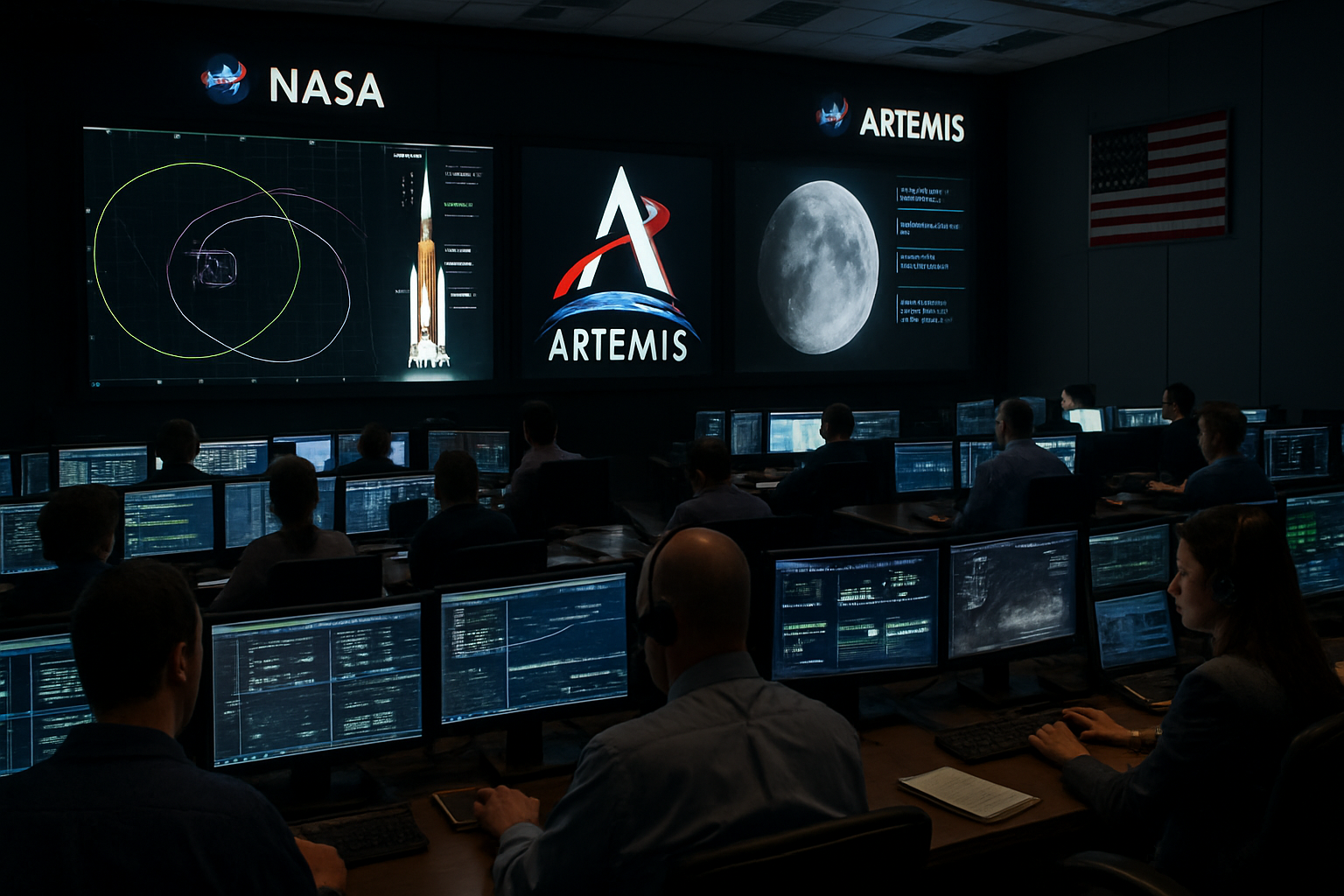
Under mounting pressure from China's advancing space capabilities, NASA's Artemis lunar program is undergoing a fundamental strategic transformation as the United States attempts to preserve its space dominance in an increasingly competitive international environment.
The American space agency finds itself at a critical juncture as Chinese lunar ambitions accelerate while NASA's own Artemis program faces persistent technical challenges and strategic uncertainties. According to Austrian media reports, the pressure from Chinese competition has forced NASA to completely rebuild its approach to lunar exploration.
China's Growing Space Ambitions Create Strategic Urgency
China's space program has achieved remarkable momentum in recent months, positioning the nation as a formidable challenger to American space leadership. The successful launch of China's fourth Shenlong reusable spacecraft in February 2026 demonstrated Beijing's growing confidence in cost-effective orbital access capabilities, directly competing with NASA's traditional advantages.
Chinese space achievements extend beyond launch vehicles. In March 2026, Chinese scientists at the Shanghai Institute of Technical Physics made history by using artificial intelligence to determine the chemical composition of the Moon's far side for the first time. This breakthrough, achieved through analysis of samples from China's Chang'e-6 mission, provided the first detailed chemical mapping of regions representing nearly half of the Moon's surface permanently facing away from Earth.
"The convergence of China's AI capabilities with space exploration demonstrates a systematic approach to gaining strategic advantages in cosmic research."
— Space Industry Analysis, March 2026
China's timeline for crewed lunar missions by 2030 has intensified pressure on NASA to accelerate its own lunar presence. The Chinese program includes plans for permanent lunar settlements, resource extraction capabilities, and advanced scientific research stations that would establish Beijing as a dominant lunar power.
Artemis Program Faces Mounting Technical Challenges
NASA's Artemis program has encountered a cascade of technical problems that have repeatedly delayed America's return to lunar exploration. The Artemis II mission, originally scheduled for early 2026, has faced multiple postponements due to critical hydrogen leak issues and helium system failures affecting the Space Launch System (SLS) rocket.
The SLS rocket, standing 322 feet tall and weighing 5.75 million pounds when fully fueled, represents the most powerful rocket NASA has ever built. However, persistent technical problems emerging during countdown simulations at the T-minus 5 minute mark have forced engineers to extend timelines repeatedly.
Administrator Jared Isaacman has maintained NASA's safety-first approach, stating "we will only launch when we believe we are ready." This philosophy, while prioritizing crew protection, has allowed international competitors to gain strategic advantages while American missions remain grounded.
Critical Mission Parameters Under Pressure
The four-astronaut international crew for Artemis II includes Canadian Jeremy Hansen, NASA's Reid Wiseman (commander), Christina Koch, and Victor Glover. Their planned 10-day lunar flyby covering 600,000 miles would mark the first crewed mission beyond Earth orbit since Apollo 17 in December 1972 – a gap of over 54 years.
Recent reports indicate NASA has restructured the entire Artemis timeline, adding a new test mission between Artemis II and the actual lunar landing, moving the Moon landing from Artemis III to Artemis IV, and canceling multibillion-dollar Boeing upgrades to the SLS rocket core stage.
Strategic Pivot Toward Lunar Dominance
In response to competitive pressures, NASA announced a historic $20 billion strategic pivot in March 2026. Administrator Isaacman revealed the cancellation of the Lunar Gateway orbiting space station project, redirecting funds toward establishing a permanent lunar surface base by 2030.
This represents the largest space infrastructure investment in NASA history, following December 2025 presidential directives for accelerated lunar presence. Gateway components from Northrop Grumman and Vantor will be repurposed for surface infrastructure rather than orbital operations.
The decision reflects a fundamental shift from temporary lunar visits to permanent settlement, establishing the foundation for a spacefaring civilization. The permanent base will enable resource extraction, advanced manufacturing, scientific research, and Mars mission training while positioning American leadership in the emerging trillion-dollar space economy.
International Cooperation Amid Rising Competition
Despite intensifying competition, international cooperation continues through various space initiatives. Canadian participation in Artemis through Jeremy Hansen validates the Artemis Accords framework for peaceful lunar exploration. However, the cancellation of Lunar Gateway creates uncertainty for Canadian space industry contributions, including the Canadarm3 robotic arm developed by MDA Systems.
Pakistan's selection of astronaut candidates for China's Tiangong space station missions scheduled for October-November 2026 demonstrates how space capabilities are becoming democratized beyond traditional spacefaring nations. This trend challenges American assumptions about space leadership while creating new alliance structures.
European nations are pursuing space independence through substantial investments, including Germany's €10 billion satellite systems and Sweden's Isar Aerospace facilities capable of testing 30 engines monthly. These developments suggest a multipolar space environment where American dominance faces challenges from multiple directions.
Space Economy Golden Age Transition
The current period represents what industry analysts describe as the transition from the "AI revolution" to the "space economy golden age." SpaceX's preparation for a potentially trillion-dollar IPO in June 2026 exemplifies how commercial space capabilities are reshaping the industry landscape.
Space-based data centers are emerging as solutions to Earth's memory crisis, with semiconductor prices increasing sixfold due to supply constraints affecting companies like Samsung, SK Hynix, and Micron. The convergence of terrestrial technology limitations with space capabilities creates new economic opportunities while requiring sustained international cooperation.
"The space economy is projected to exceed $1 trillion by 2030, with countries investing in space capabilities positioning themselves for leadership in emerging markets."
— Industry Economic Analysis, 2026
Critical Research Supporting Long-Term Goals
Current International Space Station operations provide essential research supporting future lunar and Mars missions. French astronaut Sophie Adenot's record eight-month mission focuses on lung tissue cultivation and Space-Associated Neuro-Ocular Syndrome (SANS) research, addressing medical challenges for extended space missions.
SANS affects astronaut vision during long-duration spaceflight, representing a critical challenge for permanent lunar settlements and Mars exploration where astronauts may spend years without Earth medical evacuation possibilities. Portuguese scientists are leading breakthrough research in this field, demonstrating how international scientific cooperation continues despite competitive dynamics.
Looking Forward: Strategic Implications
March 2026 represents a watershed moment for human space exploration, where the convergence of Chinese advancement, American restructuring, and commercial space expansion creates unprecedented challenges and opportunities. The success of NASA's strategic pivot will determine whether America maintains space leadership or cedes influence to rising competitors.
The permanent lunar base commitment requires resolving persistent technical challenges while maintaining international partnerships and public support for long-term objectives. Success would establish the foundation for sustainable human space presence, serving as a stepping stone to Mars exploration and multi-planetary human civilization.
The coming months will prove crucial in determining the trajectory of humanity's cosmic future. Whether NASA can overcome technical hurdles while China advances its lunar timeline will shape the balance of space power for decades to come, affecting everything from resource access to scientific discovery and technological development.
As the space race evolves into a complex multilateral competition involving government programs, commercial enterprises, and international partnerships, the stakes extend far beyond national prestige to encompass the fundamental question of which nations will lead humanity's expansion into the cosmos.