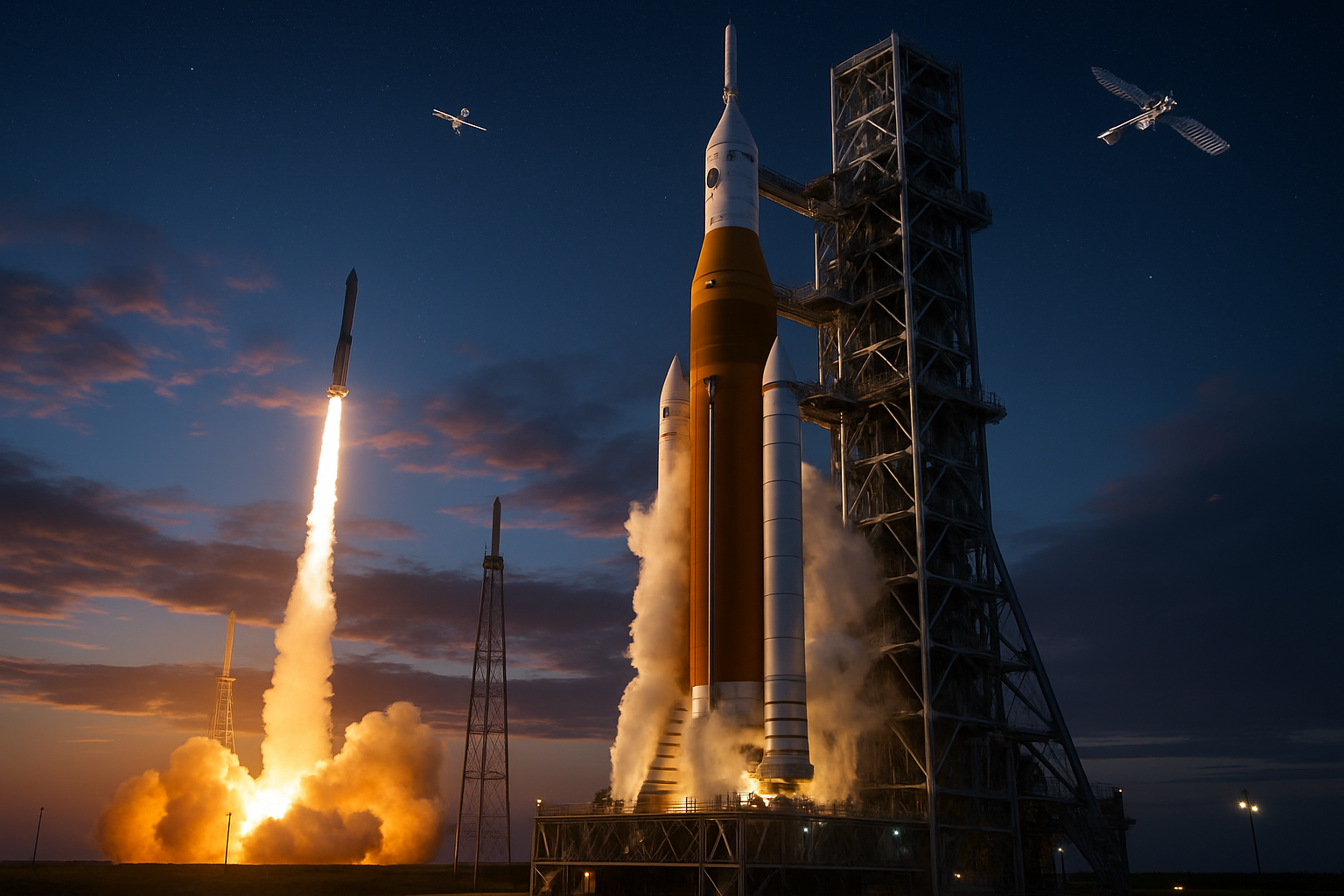
February 20, 2026 marks a pivotal moment in space exploration as NASA successfully completed critical Artemis II launch rehearsals despite ongoing technical challenges, while SpaceX continued its aggressive Starlink deployment with the launch of 29 additional internet satellites from Cape Canaveral Space Force Station.
The convergence of these missions represents the maturation of space exploration from experimental ventures to essential infrastructure, occurring during what space industry analysts are calling the transition from the "AI revolution to the space economy golden age."
NASA Artemis II: Overcoming Technical Hurdles
NASA's Artemis II mission, designed to send four astronauts on humanity's first crewed lunar flyby since Apollo 17 in 1972, has faced significant technical challenges that pushed the mission timeline from February to March 2026. The Space Launch System (SLS) rocket, NASA's most powerful launch vehicle ever constructed, encountered persistent hydrogen leak issues during wet dress rehearsal testing.
The four-astronaut crew includes Canadian Jeremy Hansen, alongside NASA's Reid Wiseman, Christina Koch, and Victor Glover, who will embark on a 10-day journey that will take them 7,400 kilometers beyond the Moon's far side. This mission represents a critical milestone toward the Artemis III lunar landing planned for 2027.
"We will only launch when we believe we are ready. Safety over schedule remains our absolute priority."
— NASA Administrator, emphasizing safety-first approach
The technical challenges demonstrate NASA's commitment to systematic safety improvements across all programs. The hydrogen leak assessment, classified as requiring the same attention level as previous major incidents, reflects the agency's methodical approach to astronaut protection following historical lessons from the Space Shuttle program.
SpaceX Maintains Launch Cadence
While NASA addressed technical challenges, SpaceX demonstrated the routine nature of modern space operations with its Starlink 10-34 mission. The Falcon 9 rocket launched at 8:41:40 p.m. Eastern Time from Space Launch Complex-40, deploying 29 new internet satellites into low-Earth orbit.
The mission utilized first-stage booster B1077, making its 26th flight after previous missions including Crew-5, CRS-28, and NG-20. The booster successfully landed on SpaceX's drone ship "Just Read the Instructions," marking the 150th landing for that vessel and SpaceX's 573rd booster recovery overall.
This launch continues SpaceX's relentless expansion of its global broadband network, which has become critical infrastructure for communications, internet access, and even military operations worldwide. Weather officials rated launch conditions as better than 95 percent favorable, demonstrating the reliability of modern launch operations.
International Space Cooperation Continues
Despite growing competition between space-faring nations, international cooperation remains strong through programs like the International Space Station. Recent successful missions have included Crew-12, which restored the ISS to full seven-person operational capacity after an unprecedented medical evacuation earlier in 2026.
The February developments occur within a broader context of expanding global space capabilities. Pakistan has selected astronaut candidates for China's Tiangong space station mission scheduled for October-November 2026, while European nations continue developing independent launch capabilities through facilities like Germany's Isar Aerospace operations in Sweden.
Commercial Space Economy Evolution
The space industry is undergoing unprecedented transformation, with SpaceX preparing for a potential June 2026 IPO that could value the company at over $1 trillion. This follows the historic SpaceX-xAI merger valued at $1.25 trillion, combining rocket technology with artificial intelligence for space-based data centers.
Commercial space activities now extend far beyond government contracts. Private companies are addressing global challenges including the current memory crisis affecting semiconductor manufacturers Samsung, SK Hynix, and Micron. Space-based solutions offer unlimited expansion potential without terrestrial constraints like cooling requirements or power grid limitations.
Technological Integration and AI Revolution
The convergence of space exploration with artificial intelligence is accelerating capabilities across multiple domains. NASA's successful deployment of fully AI-planned Mars rover missions in December 2025 demonstrated autonomous navigation crucial for future operations across cosmic distances.
AI integration enables real-time decision-making that reduces dependence on Earth-based control systems, particularly valuable for lunar missions where communication delays are manageable. This technology positions both NASA and commercial partners for more sophisticated operations as human presence expands beyond Earth orbit.
Global Competition and Cooperation
February 2026's space activities occur within intensifying international competition. China continues advancing its Shenlong reusable spacecraft program, while European nations pursue launch independence to reduce dependence on foreign launch providers.
Simultaneously, collaborative frameworks continue through organizations like the UN Scientific and Technical Subcommittee, now chaired by Thailand, reflecting the growing influence of emerging space nations. This balance between competition and cooperation characterizes the current space exploration environment.
Space Medicine and Long-Duration Mission Preparation
Both NASA and international partners are addressing critical space medicine challenges including Space-Associated Neuro-Ocular Syndrome (SANS), which affects astronaut vision during extended missions. Portuguese scientists lead breakthrough research essential for lunar bases and Mars missions, while ISS crews conduct lung tissue cultivation research understanding microgravity effects on human biology.
These medical research programs directly support future lunar settlements and Mars exploration by identifying and addressing health challenges before they become mission-critical problems during deep space operations.
Economic and Strategic Implications
The February 2026 space developments represent more than technological achievements—they establish infrastructure for sustained human space presence and potential resource utilization. The space economy's transition to essential infrastructure status affects national competitiveness, international cooperation frameworks, and long-term strategic planning.
Success in space exploration increasingly determines access to future resources, technological capabilities, and strategic positioning for both national security and economic development. The convergence of commercial capabilities, international partnerships, and technological innovation positions space as a critical frontier for human civilization's expansion.
Looking Forward: March 2026 and Beyond
With NASA targeting March 2026 for the Artemis II launch and SpaceX continuing its rapid launch cadence, the coming months will determine whether current technical challenges can be resolved and ambitious timelines met. The success of these missions will influence public support, funding decisions, and international cooperation frameworks for years to come.
February 2026 represents a watershed moment where space exploration strategy matured toward pragmatic objectives while breakthrough technologies enabled unprecedented capabilities. The combination of safety-focused methodical approaches with rapid commercial innovation establishes the foundation for the next phase of human space exploration beyond Earth orbit toward sustainable cosmic civilization development.