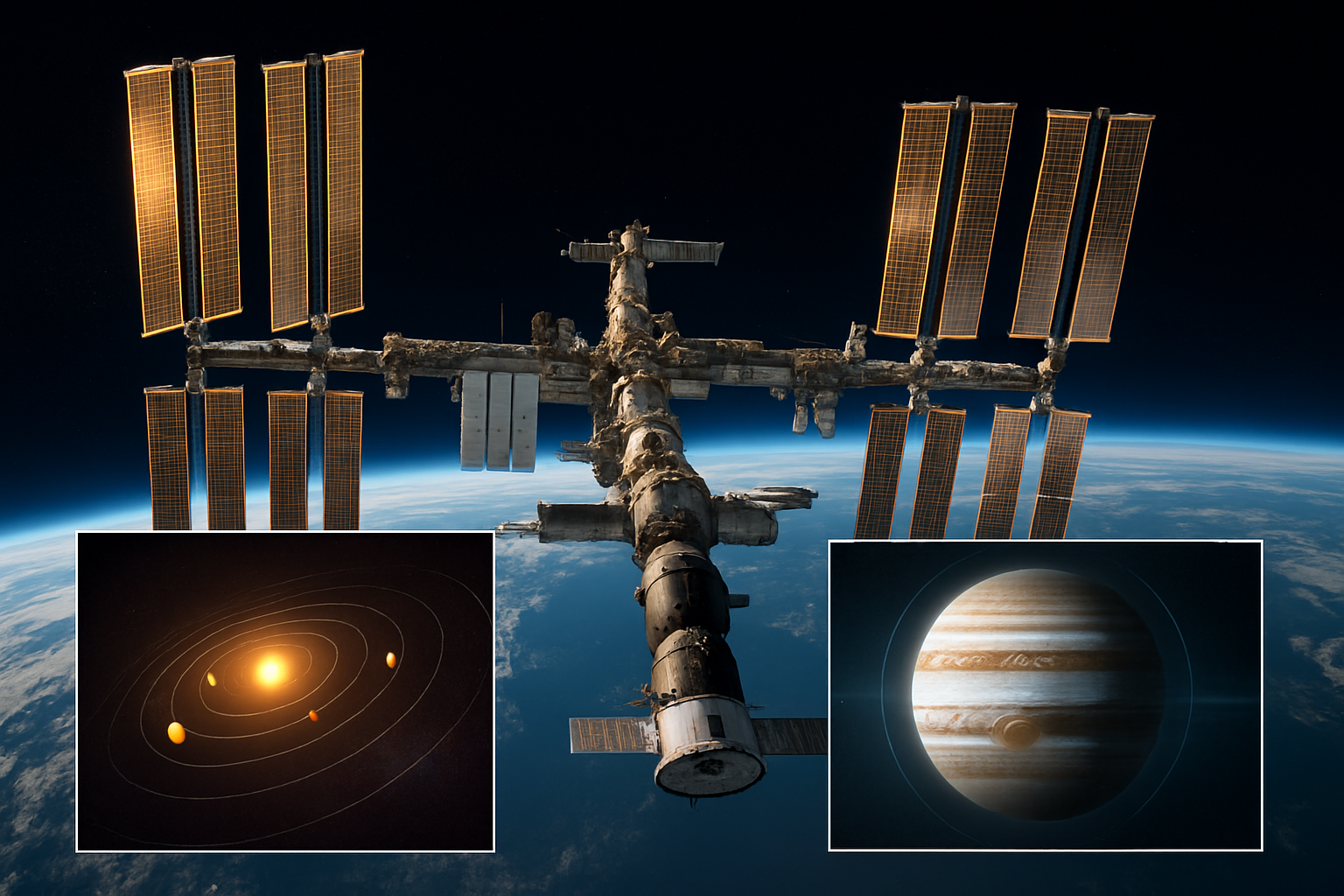
Four astronauts successfully docked at the International Space Station Saturday, restoring full operational capacity while groundbreaking planetary discoveries from Europe and updated Jupiter measurements from NASA are fundamentally challenging decades-old theories about how planetary systems form.
The NASA Crew-12 mission, featuring French astronaut Sophie Adenot as the second French woman to reach space, represents a critical milestone in sustained human space presence. Simultaneously, revolutionary astronomical discoveries are reshaping scientific understanding of planetary formation processes across the universe.
Historic ISS Crew Rotation Success
The international crew of four astronauts docked at the ISS on Saturday following their launch from Kennedy Space Center. The mission includes Sophie Adenot (French ESA Mission Specialist), becoming only the second French woman to travel to space after a 25-year gap since Claudie Haigneré, alongside American astronauts and one Russian cosmonaut.
This crew rotation was particularly crucial as it replaces a previous crew that was forced to return to Earth early due to a medical emergency - the first such medical evacuation in the ISS's operational history. The mission restores the space station to its full seven-person complement, enabling the continuation of critical scientific research programs.
Sophie Adenot's eight-month mission represents a record duration for European astronauts, positioning her uniquely to conduct extensive long-term research that will prove invaluable for future lunar settlements and Mars exploration initiatives.
Revolutionary Planetary System Discovery
Meanwhile, a European Space Agency satellite has identified what researchers are calling an "inverted" planetary system that fundamentally challenges established theories about planetary formation. The discovery, reported by Romanian space research institutions, reveals planets arranged in a completely unexpected order around a distant star.
This finding represents more than an astronomical curiosity - it suggests that scientists' understanding of how planetary systems develop may require comprehensive revision. Traditional models predict certain arrangements based on gravitational dynamics and material distribution during system formation, but this newly discovered system appears to defy those expectations.
"This discovery puts old ideas about planetary system formation to the test and opens entirely new avenues for understanding cosmic evolution."
— European Space Agency Research Team
The implications extend beyond theoretical astronomy. Understanding planetary formation processes is crucial for predicting where potentially habitable worlds might exist and how common Earth-like conditions may be throughout the universe.
Jupiter Measurements Upend Textbook Knowledge
Adding to the week's scientific revelations, NASA has released new data showing that Jupiter is both smaller and more flattened than scientists have believed for the past 50 years. This discovery forces a complete revision of historical measurements and updates fundamental knowledge about the solar system's largest planet.
The findings represent a significant paradigm shift in planetary science. Jupiter's actual size and shape directly influence its gravitational effects on other objects in the solar system, including asteroid trajectories, comet paths, and even the orbital dynamics of other planets.
These updated measurements of Jupiter's dimensions will require textbook revisions and could influence calculations related to the formation of our entire solar system. The discovery demonstrates how continued technological advancement enables scientists to refine and correct even well-established astronomical knowledge.
Space Economy Golden Age
These developments occur during what space industry analysts are calling the transition from the "AI revolution" to the "space economy golden age." The successful ISS crew rotation demonstrates mature international cooperation capabilities, while the planetary discoveries highlight the accelerating pace of space-based scientific research.
The convergence of human space presence and breakthrough astronomical research establishes 2026 as a watershed year for space exploration. Advanced AI systems are increasingly supporting both crewed missions and automated discovery processes, enabling unprecedented scientific productivity.
Current ISS research focuses on critical areas including lung tissue cultivation experiments essential for understanding microgravity effects on human biology, and Space-Associated Neuro-Ocular Syndrome (SANS) studies addressing astronaut vision problems during extended missions. This research directly supports future lunar settlements and Mars exploration preparation.
International Cooperation Amid Competition
The successful ISS mission demonstrates continued international cooperation through NASA, ESA, and Roscosmos partnerships despite intensifying global competition in space capabilities. Countries worldwide are developing independent space programs while maintaining collaborative research relationships through the space station.
Recent developments include Pakistan's selection of astronaut candidates for China's Tiangong space station, Germany's expansion of rocket testing facilities in Sweden, and Thailand's appointment to chair UN space governance frameworks. This pattern suggests space capabilities are democratizing globally while established space powers maintain technological leadership.
The European planetary discovery and NASA's Jupiter findings underscore the value of international scientific cooperation. Space-based observations require global coordination of telescopes, satellites, and research institutions to achieve breakthrough discoveries that advance human understanding of the universe.
Future Implications
These simultaneous achievements in human spaceflight and planetary science create a foundation for the next phase of space exploration. The ISS crew's extended research mission will provide essential data for long-duration space travel, while the planetary discoveries inform our search for potentially habitable worlds beyond our solar system.
The updated Jupiter measurements demonstrate that even within our own solar system, fundamental discoveries await. As space-based observational capabilities continue advancing through AI integration and international cooperation, scientists expect additional paradigm-shifting discoveries in the coming years.
February 2026 represents a convergence moment where mature human space capabilities meet breakthrough scientific discoveries, establishing unprecedented opportunities for advancing both our presence in space and our understanding of the cosmos. The combination of international cooperation, technological innovation, and scientific discovery positions humanity for expanded exploration of both nearby planetary destinations and distant star systems.