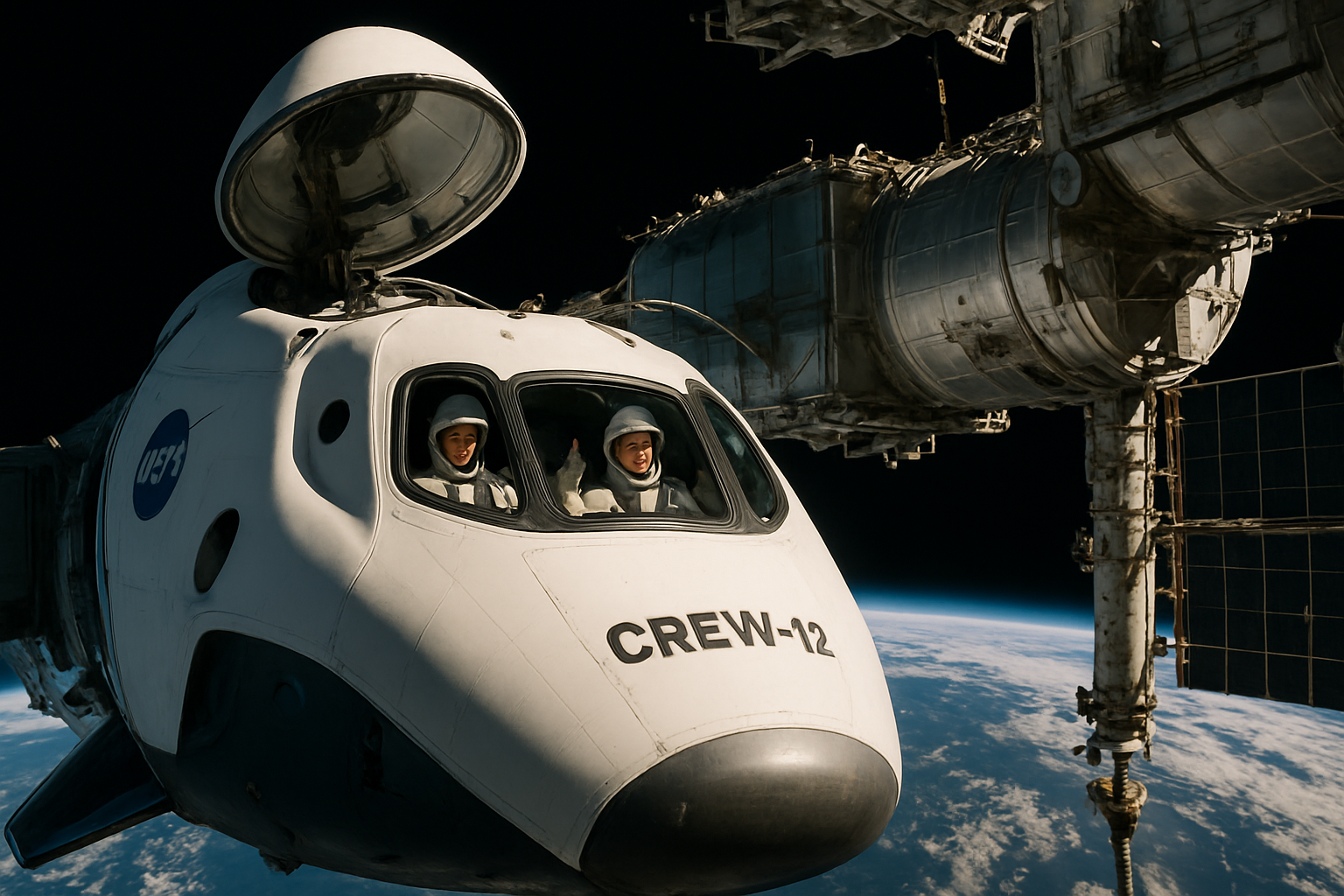
NASA has confirmed the Crew-12 mission to the International Space Station will proceed on February 13, 2026, while Russian scientists launch their first comprehensive assessment of life prospects in outer space, marking significant advances in both human spaceflight and astrobiology research during a pivotal year for global space exploration.
The developments come as the space industry transitions from what analysts call the "AI revolution" to the "space economy golden age," with multiple nations advancing ambitious programs amid growing international cooperation and competition in Earth's orbital environment.
NASA Crew-12 Mission Proceeds After Delays
According to NASA announcements, the Crew-12 mission featuring a SpaceX Dragon spacecraft will launch February 13, continuing regular crew rotations to the International Space Station. The mission includes French astronaut Sophie Adenot among the crew members, representing continued international collaboration in ISS operations.
The launch comes after previous postponements due to weather conditions and technical challenges that have affected several recent space missions. NASA's commitment to safety-first protocols has resulted in careful review processes, particularly following hydrogen leak issues that delayed the Artemis II lunar mission to March 2026.
The Crew-12 mission maintains the critical crew rotation schedule necessary for ongoing ISS operations, scientific research, and international cooperation in low Earth orbit. The inclusion of astronauts from multiple nations reflects the continued success of the ISS partnership despite geopolitical tensions on Earth.
Russian Scientists Launch Life Assessment Program
In a groundbreaking scientific initiative, Russian scientists have begun the first comprehensive assessment of prospects for life in outer space, according to international reports. This unprecedented research program represents a significant expansion of astrobiology efforts as the global space community intensifies its search for life beyond Earth.
The Russian program comes at a time when space-based life detection technologies are advancing rapidly. Recent discoveries include the largest sulfur-containing organic molecules found in interstellar space, described by European scientists as a "missing link" in understanding cosmic chemistry and life's origins.
The timing of Russia's life assessment program aligns with broader international efforts to understand habitability in space environments. NASA's recent AI-powered Mars rover missions have demonstrated autonomous capabilities for surface exploration, while the James Webb Space Telescope continues revealing new insights about potentially habitable exoplanets and cosmic chemistry.
Major Astronomical Events to Advance Research
The year 2026 promises exceptional opportunities for astronomical research, with several major celestial events providing valuable scientific observations. According to the Oman Society of Astronomy and Space, a total lunar eclipse on March 3, 2026, will be visible across East Asia, parts of Australia, and North and South America, though not in the Middle East region.
The lunar eclipse will commence at 12:44 PM Muscat time and reach maximum totality at 3:30 PM, providing researchers worldwide with opportunities to study Earth's atmosphere and lunar surface interactions. While the eclipse won't be visible from Oman or the broader Arab region due to the Moon being below the horizon, international cooperation will enable comprehensive data collection.
"Several major astronomical events in 2026, including a total lunar eclipse and an annular solar eclipse, will provide valuable opportunities for scientists to study the Moon and Earth's atmosphere."
— Oman Society of Astronomy and Space
These astronomical phenomena offer unique research opportunities for atmospheric science, lunar geology, and space weather studies. The eclipse events complement ongoing space missions and ground-based observations, contributing to humanity's expanding understanding of our solar system and beyond.
International Space Cooperation Continues
The February developments demonstrate the continued vitality of international space cooperation despite global tensions. Recent achievements include Pakistan's historic selection of astronaut candidates for China's Tiangong space station, scheduled for October-November 2026, representing the democratization of space access to emerging nations.
European space capabilities continue expanding with Germany's Isar Aerospace constructing rocket testing facilities in Sweden capable of testing 30 engines monthly, reflecting the continent's drive for launch independence. Meanwhile, Thailand's appointment as chair of UN space governance demonstrates emerging nations' growing influence in space policy.
These developments occur within the broader context of rapid commercial space expansion. SpaceX's planned June IPO could value the company over $1 trillion, while space-based data centers emerge as solutions to Earth's memory crisis, with semiconductor prices surging sixfold.
Scientific Breakthroughs Shape Space Exploration
Recent scientific discoveries continue reshaping our understanding of space environments and life possibilities. NASA's Juno mission revealed Jupiter is slightly smaller than previously calculated, providing new data for planetary formation models. European scientists' identification of large sulfur-containing organic molecules in interstellar space suggests life's building blocks may be more widespread in the universe than expected.
Advanced AI integration is revolutionizing space operations, with NASA achieving the first fully AI-planned Mars rover mission in December 2025. These autonomous capabilities enable real-time decision-making across cosmic distances, dramatically increasing mission efficiency and reducing dependence on Earth-based control systems.
The convergence of human spaceflight, robotic exploration, and astronomical observation creates unprecedented opportunities for scientific advancement. Space medicine research continues addressing challenges like Space-Associated Neuro-Ocular Syndrome (SANS), which affects astronauts during extended missions and represents a critical consideration for future deep space exploration.
Looking Toward Space Economy Era
The February 2026 developments occur during what Chinese analysts identify as the transition from the "AI revolution" to the "space economy golden age." This shift encompasses commercial satellite infrastructure, space-based computing, and the emergence of space as critical infrastructure for Earth's technological civilization.
SpaceX's strategic pivot toward lunar colonization, with plans for self-sustaining lunar cities within 10 years, reflects the industry's evolution from experimental projects to practical settlement objectives. The Moon's advantages – including three-day travel times, frequent launch windows, and real-time communication – make it an attractive stepping stone for broader solar system exploration.
International competition intensifies alongside cooperation, with China advancing the Shenlong reusable spacecraft program and developing independent space capabilities. The memory crisis affecting terrestrial computing systems adds urgency to space-based alternatives, where unlimited expansion potential and continuous solar power offer compelling advantages.
As space exploration enters this new era, the combination of human presence, robotic capabilities, and astronomical research positions 2026 as a watershed year for humanity's expansion beyond Earth. The success of missions like Crew-12, alongside breakthrough research programs studying life in space, establishes the foundation for the next phase of human space exploration and scientific discovery.