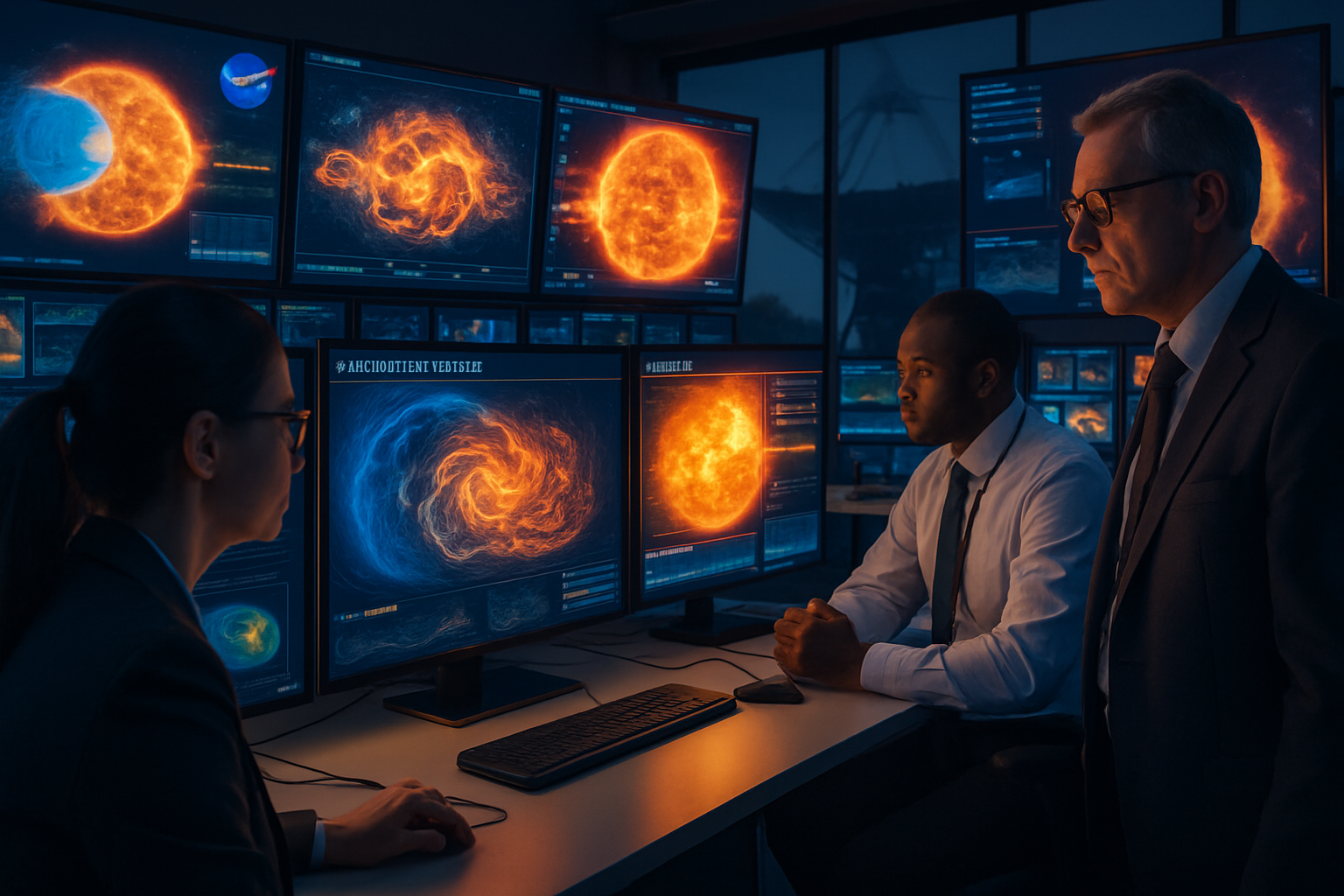
NASA has achieved a revolutionary breakthrough in space weather forecasting with its DAGGER artificial intelligence system, which can now predict dangerous geomagnetic storms with unprecedented 30-minute advance warnings, providing crucial time to protect satellites and electrical grids from solar storm damage.
The Deep Learning Geomagnetic Eruption Retrieval (DAGGER) system represents a quantum leap in space weather prediction capabilities, addressing one of the most persistent threats to modern technological infrastructure. Simultaneously, China has announced ambitious new lunar exploration capabilities with the unveiling of advanced spacecraft technology, highlighting the intensifying global competition in space exploration and technology development.
DAGGER AI: A Game-Changing Defense Against Solar Storms
NASA's DAGGER system utilizes advanced machine learning algorithms to analyze real-time solar wind data and predict the onset of geomagnetic storms that can devastate satellite communications, GPS systems, and power grids. The 30-minute warning window represents a significant improvement over previous prediction models, which often provided insufficient time for protective measures.
According to the latest reports from NASA, the DAGGER AI system can anticipate severe geomagnetic storms with remarkable precision, offering critical infrastructure operators enough time to implement protective protocols. This includes powering down sensitive satellite systems, adjusting power grid operations, and alerting aviation authorities to potential navigation disruptions.
"The DAGGER system provides an unprecedented level of space weather prediction accuracy that directly translates to protecting billions of dollars worth of critical infrastructure."
— NASA Space Weather Operations Center
China's Lunar Ambitions Take Flight
While NASA advances space weather protection, China continues its aggressive space exploration program with the announcement of new lunar mission capabilities. The unveiling of advanced spacecraft technology, including what appears to be next-generation lunar landers and potential reusable rocket systems, demonstrates China's commitment to establishing a sustained presence on the Moon.
This development comes as part of China's broader space strategy, which has seen remarkable progress in recent years. The country has successfully operated the Tiangong space station, conducted Mars rover missions, and maintained an ambitious timeline for lunar sample return missions and eventual crewed lunar landings.
International Space Cooperation at a Crossroads
The dual announcements highlight the complex nature of modern space exploration, where cooperation and competition coexist. While NASA's DAGGER system represents a global benefit—protecting infrastructure worldwide regardless of national boundaries—China's lunar program demonstrates the strategic competition driving much of today's space development.
Recent memory of international space activities shows a pattern of both collaboration and rivalry. The International Space Station continues to operate with international crews, including recent missions featuring French astronaut Sophie Adenot and ongoing cooperation despite geopolitical tensions. Meanwhile, countries like Pakistan are achieving historic milestones with their first astronaut missions to China's Tiangong station, demonstrating the democratization of space access.
Technical Implications and Broader Context
The DAGGER AI breakthrough comes at a critical time when space-based infrastructure has never been more vital to global commerce and communication. With thousands of satellites now orbiting Earth and plans for massive constellation deployments by companies like SpaceX and Amazon, the ability to predict and prepare for space weather events has become essential for maintaining modern civilization's technological backbone.
The system's 30-minute warning capability allows for several critical protective measures:
- Satellite operators can switch sensitive equipment to safe mode
- Power grid operators can adjust loads and prepare for induced currents
- Airlines can reroute flights to avoid polar regions during severe events
- GPS services can implement enhanced accuracy algorithms
China's lunar program developments, meanwhile, signal the country's intention to establish significant off-world capabilities. The combination of reusable rocket technology and advanced lunar spacecraft suggests preparation for sustained lunar operations, potentially including resource extraction and scientific research facilities.
The Future of Space Exploration and Protection
As these developments unfold, the space industry finds itself at a remarkable inflection point. NASA's DAGGER system exemplifies how artificial intelligence can provide practical, immediate benefits for protecting Earth-based infrastructure from space-based threats. The system's success builds on decades of space weather research and represents the kind of AI application that directly serves human safety and economic stability.
China's lunar ambitions, combined with similar programs from other nations and private companies, suggest that the 2020s will be remembered as the decade when sustainable off-world human presence became reality rather than aspiration. The convergence of AI-enhanced space weather protection and expanded lunar capabilities creates a foundation for the next phase of human space exploration.
"We're witnessing the maturation of space technology from experimental to essential infrastructure. Both protecting what we have on Earth and expanding our capabilities beyond Earth are now operational realities."
— International Space Policy Expert
Economic and Strategic Implications
The economic implications of NASA's DAGGER system are substantial. Solar storms have historically caused billions of dollars in damage to satellites, power grids, and communication systems. The 1989 Quebec blackout, caused by a geomagnetic storm, left millions without power for hours and demonstrated the vulnerability of modern infrastructure to space weather events. With better prediction capabilities, such widespread disruptions could potentially be avoided or minimized.
China's advancing lunar capabilities represent a different kind of economic opportunity—the potential for space-based resource extraction and manufacturing. As the country develops more sophisticated lunar mission technologies, it positions itself to potentially access the Moon's mineral resources and establish facilities that could support further deep space exploration.
The international implications extend beyond economics to questions of space governance and cooperation. As more nations develop independent space capabilities, the need for international frameworks governing space activities becomes increasingly urgent. NASA's space weather protection benefits all nations with space-based assets, while competitive lunar programs could potentially create territorial or resource disputes if not properly managed through international agreements.
Looking ahead, these developments suggest that 2026 may be remembered as a pivotal year in space exploration history—the year when AI-enhanced space weather protection became operational and when lunar exploration transitioned from sporadic missions to sustained capability development. The convergence of these trends points toward an era where space-based activities become integral to human civilization's infrastructure and economic systems.