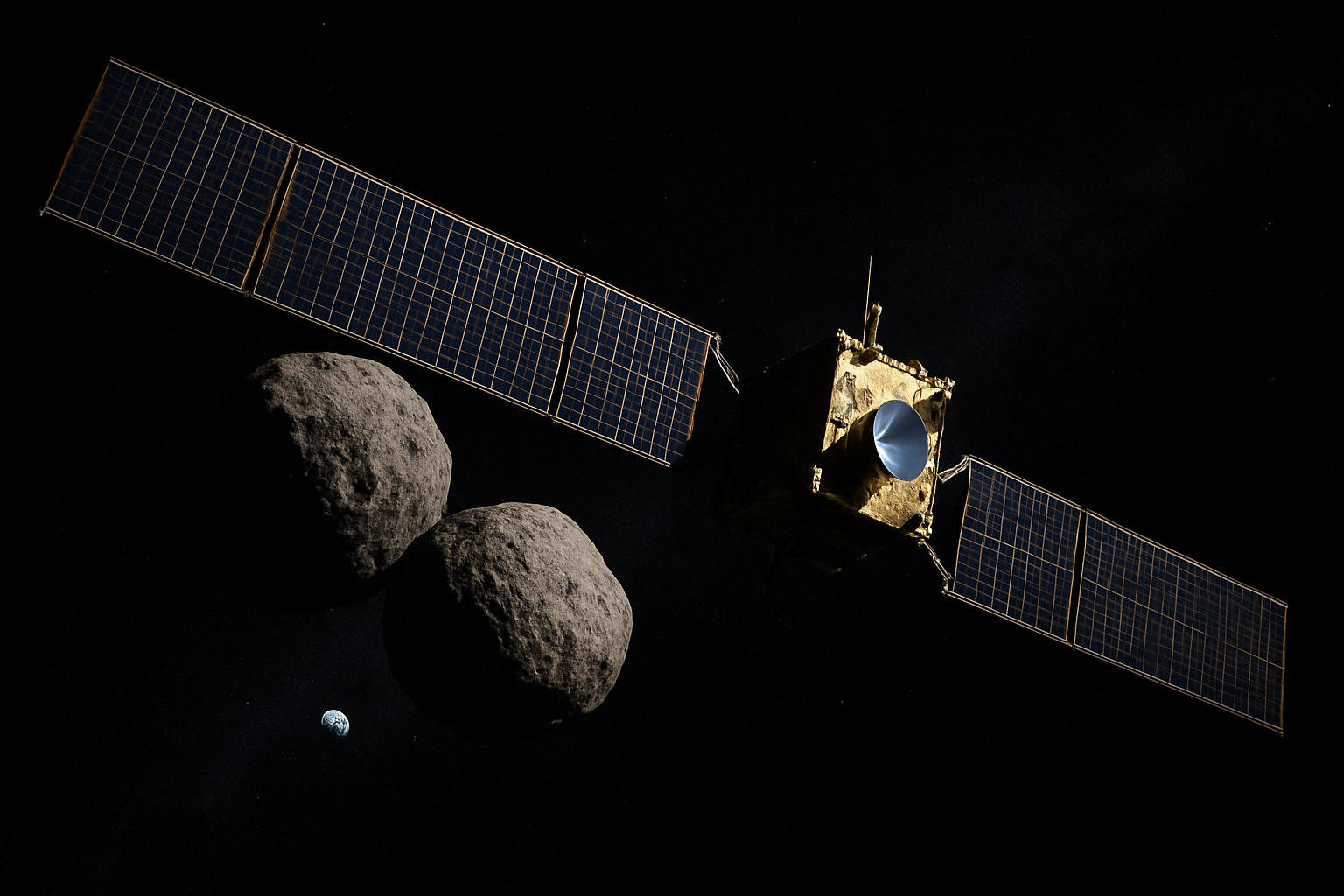
NASA's Double Asteroid Redirection Test (DART) mission has achieved unprecedented success, not only altering the Dimorphos asteroid's orbit but fundamentally changing the path of the entire asteroid system around the Sun—marking humanity's first successful modification of a celestial body's solar trajectory.
The breakthrough, confirmed through extensive analysis published in March 2026, demonstrates that Earth now possesses proven planetary defense capabilities against potentially catastrophic asteroid impacts. The mission's success comes at a critical time when NASA warns that approximately 15,000 undetected "city-killer" asteroids over 140 meters in diameter remain untracked, posing significant threats to human civilization.
Revolutionary Results Exceed All Expectations
When NASA's DART spacecraft deliberately collided with the moonlet Dimorphos in September 2022, scientists initially measured a successful 32-minute reduction in its orbital period around the larger asteroid Didymos. However, new comprehensive analysis reveals the impact achieved far more than anticipated—the binary asteroid system's entire trajectory around the Sun has been measurably altered.
"This represents a quantum leap in our understanding of kinetic impactor technology," explained Dr. Kelly Fast, NASA's Planetary Defense Coordination Officer. "We've demonstrated that relatively small spacecraft can produce changes on a cosmic scale, fundamentally shifting how we approach planetary protection."
The DART mission targeted Dimorphos, roughly the size of one and a half football fields, while the larger Didymos measures approximately one and a half times the height of Toronto's CN Tower. The precision required for this interplanetary collision, executed across millions of kilometers of space, represents one of the most technically challenging achievements in space exploration history.
Addressing the Undetected Asteroid Threat
The mission's success takes on heightened significance given NASA's February 2026 warning about the vast number of potentially hazardous asteroids that remain undetected. Current tracking systems have identified only a fraction of near-Earth objects capable of causing regional devastation, with many asteroids remaining invisible due to their dark surfaces that absorb rather than reflect sunlight.
The 15,000 untracked objects represent a significant portion of the estimated medium-sized asteroid population in Earth's cosmic neighborhood. Each possesses destructive capability to devastate metropolitan areas and cause millions of casualties, highlighting the urgent need for expanded detection and deflection capabilities.
Scientific Renaissance Reshaping Multiple Disciplines
The DART success coincides with remarkable discoveries across multiple scientific disciplines during what researchers are calling the "2026 Scientific Renaissance." These breakthroughs are fundamentally challenging established theories about life, cosmic evolution, and human history.
Astrobiology Breakthroughs
Austrian researchers have made groundbreaking discoveries suggesting that radio signals from potential alien civilizations might be systematically altered by active stellar environments, potentially explaining why humanity has not detected extraterrestrial communications despite extensive search efforts. The research indicates that stellar activity near signal sources could modify transmissions so significantly that they become indistinguishable from cosmic background noise.
Simultaneously, American scientists conducted revolutionary experiments demonstrating that extremophile bacteria can survive conditions equivalent to Mars surface asteroid impacts, providing experimental support for panspermia theory—the hypothesis that life can spread between planets through natural processes. The research showed highly resistant bacterial strains maintaining biological integrity under pressures comparable to cosmic projectiles striking planetary surfaces at over 20 kilometers per second.
Archaeological Revelations Challenge Timeline
Archaeological discoveries are rewriting human history with the unearthing of a 2,100-year-old inscribed sling bullet in the Galilee region. The artifact, bearing the Greek inscription "Learn your lesson," was possibly used by defenders of the ancient city of Hippos against the Hasmonean army of King Alexander Jannaeus in 101 BCE. This discovery provides rare insight into psychological warfare tactics of ancient conflicts and the sophisticated communication methods employed during siege warfare.
The inscription represents one of the few direct messages from ancient combatants to their enemies, offering unprecedented glimpse into the mindset and strategies of ancient military commanders. The artifact was discovered during systematic excavations that have revealed extensive evidence of the prolonged siege that ultimately determined control over this strategically important region.
International Cooperation in the Golden Age of Space
These discoveries occur during what space policy experts term the transition from the "AI revolution" to the "space economy golden age." International cooperation continues through organizations like the International Space Station, while competitive dynamics intensify in lunar exploration, satellite constellations, and space-based infrastructure development.
The success of planetary defense initiatives requires unprecedented international coordination, as asteroid threats transcend national boundaries. Current efforts involve NASA-ESA collaboration with international partners, but technological and funding gaps remain significant obstacles to comprehensive planetary protection.
Pakistan's selection of astronauts for China's Tiangong space station mission, scheduled for October-November 2026, demonstrates the democratization of space capabilities. Thailand's leadership role in UN space governance frameworks reflects growing global recognition that space-related challenges require coordinated international responses.
Technology Integration and AI Revolution
The DART mission's success has been enhanced by artificial intelligence integration throughout space operations. NASA's fully AI-planned Mars rover missions in December 2025 demonstrated autonomous navigation capabilities that enable real-time decision-making across cosmic distances, reducing dependence on Earth-based mission control.
Advanced detection systems under development include next-generation space-based infrared telescopes capable of identifying dark asteroids invisible to optical systems. AI integration in astronomical observation promises accelerated object identification and tracking capabilities essential for comprehensive planetary defense.
Climate and Environmental Context
These scientific breakthroughs occur as Earth faces unprecedented environmental challenges, with January 2026 marking the 18th consecutive month of global temperatures exceeding 1.5°C above pre-industrial levels. The convergence of cosmic threats and terrestrial challenges underscores the importance of scientific innovation for addressing multiple simultaneous risks to human civilization.
Research into extremophile organisms surviving asteroid impact conditions provides insights into life's resilience under extreme environmental stress—knowledge relevant for both space exploration and understanding biological adaptation to climate change on Earth.
Economic and Strategic Implications
The space economy is projected to exceed $1 trillion by 2030, with planetary defense representing a critical component of space infrastructure investment. Countries implementing prevention-focused approaches to cosmic threats demonstrate superior cost-effectiveness compared to reactive disaster response models.
Commercial space companies like SpaceX, preparing for a potential trillion-dollar IPO in June 2026, are integrating planetary defense capabilities into broader space infrastructure development. The convergence of commercial capabilities with government planetary protection requirements creates unprecedented opportunities for innovative solutions.
Future Research Directions
The DART mission's success establishes foundations for expanded asteroid monitoring and deflection programs. Future missions will investigate different deflection techniques, including gravity tractors for more precise trajectory modifications and enhanced early warning systems for smaller but still dangerous objects.
Research into extremophile survival will expand to different microorganisms, impact velocities, and planetary environments, creating comprehensive understanding of conditions enabling interplanetary life transfer. Mars Sample Return missions will search for biological signatures in Martian material while ongoing research investigates impact sites where Earth-Mars material exchange occurred.
A Watershed Moment for Human Civilization
March 2026 represents a watershed moment in human scientific capability, where breakthrough discoveries across space exploration, astrobiology, and archaeology demonstrate coordinated global research achieving transformative insights despite resource constraints and geopolitical tensions.
The successful demonstration of planetary defense capabilities, combined with expanding understanding of life's cosmic distribution and human historical development, positions humanity at a critical juncture. The tools and knowledge exist for effective protection against cosmic threats and continued scientific advancement, but success depends on sustained international cooperation and adequate resource commitment.
As Dr. Fast noted, "We've proven that humanity can defend itself against cosmic threats, but this is just the beginning. The real challenge ahead is scaling these capabilities while maintaining the international cooperation that made this breakthrough possible."
The convergence of successful planetary defense, groundbreaking astrobiology research, and historical archaeological discoveries suggests that 2026 may be remembered as the year humanity truly began its transition to a spacefaring civilization capable of protecting Earth while expanding knowledge of life's place in the cosmos.