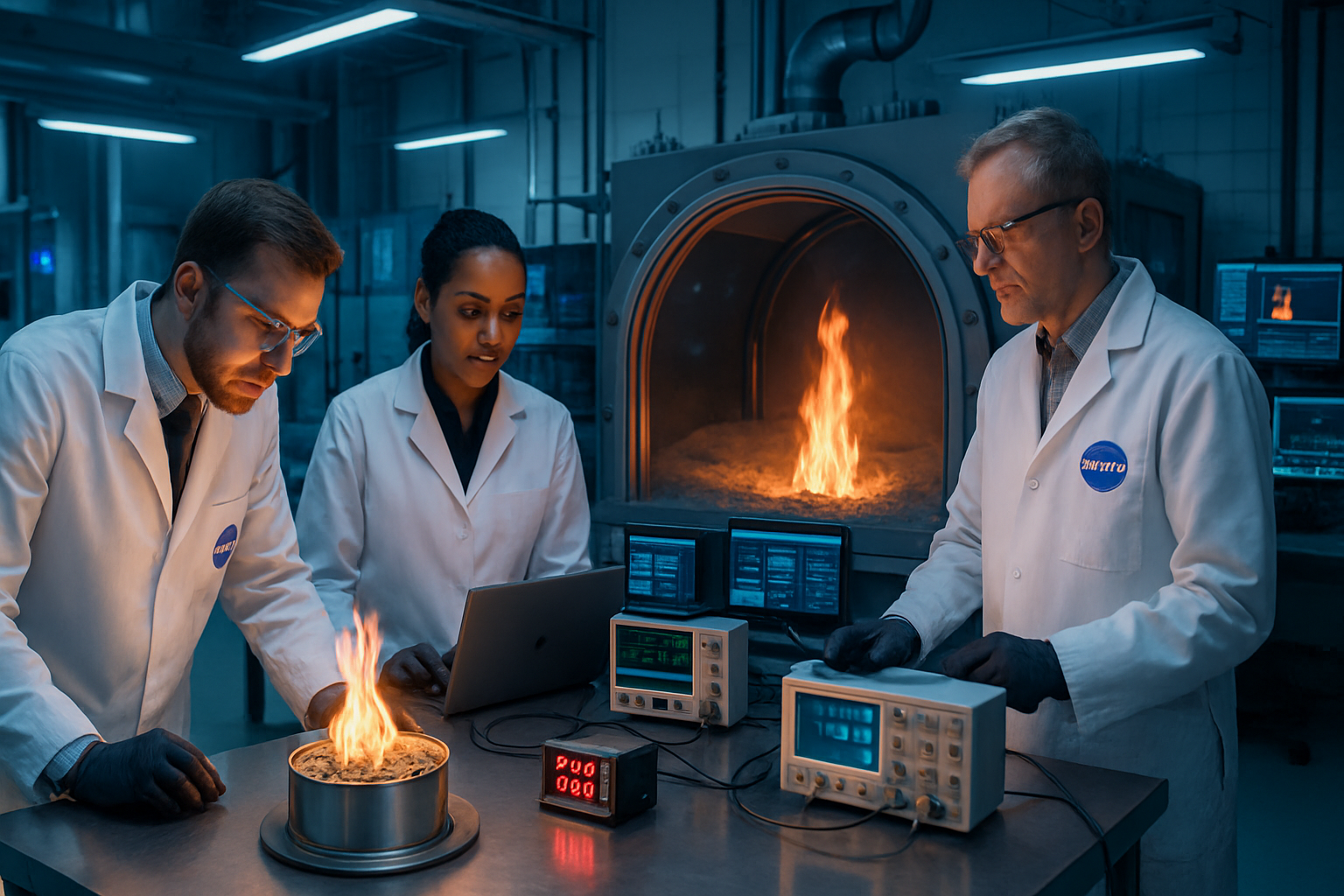
NASA is preparing unprecedented fire testing experiments on the lunar surface, addressing a critical safety concern that has mission planners more worried than almost any other challenge: how fire behaves in the Moon's unique environment where materials that are non-flammable on Earth could burn for extremely long periods.
According to new research from NASA's Glenn Research Center and Johnson Space Center, in collaboration with Case Western Reserve University, fire poses an extraordinary challenge for upcoming crewed lunar missions. The low-gravity, low-pressure environment of the Moon fundamentally alters how fires start, spread, and extinguish, creating unprecedented safety risks for astronauts and equipment.
The Lunar Fire Challenge
The research highlights a paradoxical danger: materials that are considered fire-safe on Earth could become significant hazards on the Moon. In the lunar environment's reduced gravity and unique atmospheric conditions, fires can behave in ways that defy terrestrial experience, potentially burning much longer and spreading in unpredictable patterns.
"Fire represents one of the most significant risks we face in planning sustained lunar presence," explained researchers involved in the study. The concern is so substantial that it ranks among mission planners' top priorities, surpassing many other technical challenges that have dominated space exploration discussions.
Context of Current Space Renaissance
This research comes during what experts are calling a "space economy golden age," marked by unprecedented international cooperation and technological advancement. NASA's recently completed Artemis II mission in April 2026 ended a 54-year gap in human deep space exploration, with Canadian astronaut Jeremy Hansen becoming the first Canadian beyond Earth orbit alongside Commander Reid Wiseman, Christina Koch, and Victor Glover.
The successful Artemis II mission, which achieved a new human distance record of 406,777.8 kilometers from Earth, validated critical deep space systems and paved the way for NASA's ambitious $20 billion lunar base program by 2030. However, the fire research underscores that technical challenges remain for sustained human presence on the lunar surface.

International Competition and Cooperation
The urgency of this research is amplified by intensifying international competition in lunar exploration. China has announced plans for crewed lunar missions by 2030, while recent breakthroughs by Shanghai Institute of Technical Physics achieved the first detailed chemical mapping of the Moon's far side using artificial intelligence analysis of Chang'e-6 samples.
Meanwhile, SpaceX's trillion-dollar IPO preparation and strategic pivot toward lunar colonization within the next decade has further accelerated the pace of lunar exploration planning. President Gwynne Shotwell's declaration that humans could return to the Moon by 2030 reflects the commercial space sector's ambitious timeline.
Building on Space Medicine Research
The fire safety research builds on extensive space medicine advances, including French astronaut Sophie Adenot's record eight-month ISS mission focusing on lung tissue cultivation and Space-Associated Neuro-Ocular Syndrome (SANS) studies. These long-duration spaceflight studies provide crucial data for understanding human physiology during extended missions beyond Earth evacuation possibility.
"Understanding fire behavior in space environments is as critical as understanding human physiology," noted space safety experts. "Both are essential for permanent lunar settlements where traditional Earth-based emergency responses are impossible."
— NASA Safety Research Team
Nuclear Propulsion and Deep Space Operations
The fire research also supports NASA's Space Reactor 1 Freedom nuclear spacecraft program, designed for Mars exploration where solar power is insufficient. Nuclear propulsion systems require stringent fire safety protocols, as they enable faster transit times and continuous power generation for deep space operations extending far beyond the Moon.
European research has revealed additional challenges for permanent space settlements, including reproduction difficulties in microgravity environments that require artificial gravity solutions through rotating habitats. Fire safety becomes even more critical in enclosed, pressurized environments where evacuation options are extremely limited.
Technical Integration with Modern Systems
The lunar fire testing program integrates with advanced AI systems that have revolutionized space operations. NASA's fully AI-planned Mars rover missions demonstrate autonomous navigation capabilities, while Chinese AI breakthroughs in analyzing lunar samples show how artificial intelligence enhances traditional scientific methods.
These technological convergences are crucial as space exploration transitions from experimental ventures to critical infrastructure. The space economy is projected to exceed $1 trillion by 2030, positioning space exploration as essential rather than optional for humanity's future development.
Environmental and Resource Implications
Fire research gains additional significance considering lunar resource utilization plans. Israeli-American scientists have confirmed ice accumulation at lunar poles over at least 1.5 billion years, providing stable water resources for future settlements. Greek researchers have successfully cultivated chickpeas under lunar surface simulation conditions, addressing fundamental challenges of feeding astronauts during extended missions.
These resource developments make fire safety protocols even more critical, as permanent lunar settlements will require comprehensive safety systems protecting both human life and essential resources like water, food production facilities, and oxygen generation equipment.
Safety-First Cultural Evolution
The emphasis on fire research reflects NASA's evolved safety-first institutional culture, demonstrated through the methodical approach that resolved technical challenges preceding the Artemis II launch. Multiple delays throughout 2026 prioritized crew protection over schedule adherence, learning from historical tragedies like Challenger and Columbia.
This comprehensive safety approach extends beyond individual missions to establishing sustainable infrastructure for humanity's expansion into the cosmos. Fire research represents just one element of the systematic preparation required for permanent extraterrestrial settlements.
Future Implications for Spacefaring Civilization
The lunar fire testing program exemplifies the transition from brief space visits to sustained cosmic expansion capabilities. As NASA Administrator Jared Isaacman confirmed during Artemis preparations, success in addressing challenges like fire safety determines the trajectory of human space exploration for generations.
President Donald Trump's recognition of the Artemis II crew as "truly extraordinary" emphasized the political commitment behind these ambitious goals. The convergence of international cooperation, advanced technology, and comprehensive safety research creates unprecedented momentum for establishing humanity's permanent presence among the stars.
The fire research ultimately supports not just lunar missions, but the broader vision of multi-planetary species development through sustained cosmic expansion. As the space economy enters its golden age, understanding fire behavior in extraterrestrial environments becomes fundamental to humanity's future as a spacefaring civilization.