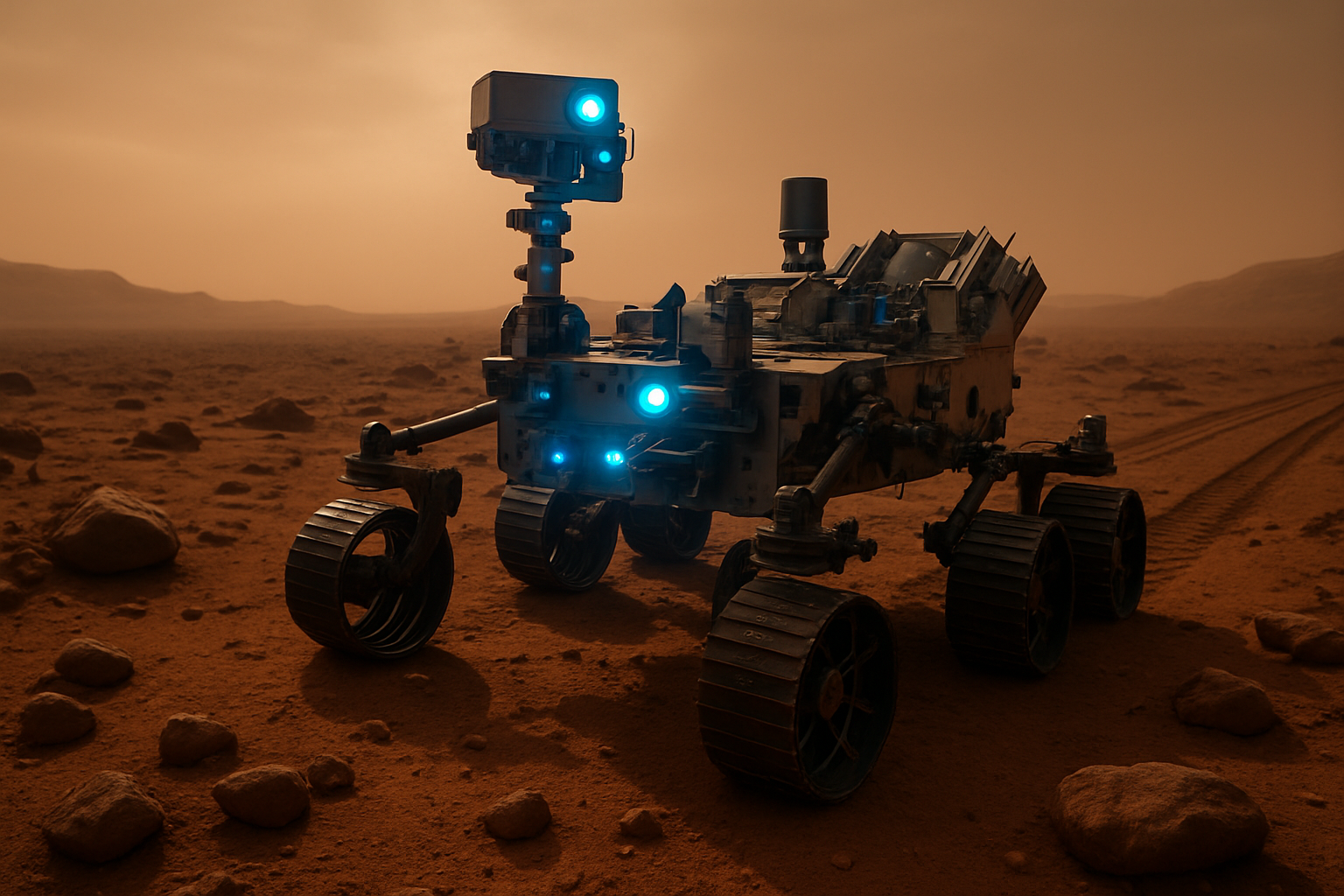
NASA's Mars rover has successfully completed the first mission entirely planned by artificial intelligence, marking a revolutionary milestone in autonomous space exploration that could fundamentally change how humanity explores other worlds.
According to NASA officials, the groundbreaking December experiment definitively proved that generative AI is capable of independently planning safe routes across the Martian surface. This achievement represents a quantum leap forward in robotic autonomy, potentially enabling future Mars missions to operate with unprecedented independence from Earth-based mission control.
Breaking the Communication Barrier
The successful AI-planned mission addresses one of the most significant challenges in Mars exploration: the communication delay between Earth and Mars. Radio signals traveling between the two planets can take anywhere from 4 to 24 minutes each way, depending on their orbital positions. This delay means that traditional rover operations require careful planning and often result in rovers sitting idle while waiting for instructions from mission controllers.
With AI-driven autonomous planning capabilities, Mars rovers can now make real-time decisions about navigation, scientific target selection, and hazard avoidance without human intervention. This capability dramatically increases the efficiency and scientific output potential of Mars missions.
Technical Breakthrough in Generative AI
The December mission utilized advanced generative artificial intelligence algorithms specifically designed for planetary exploration. These systems can analyze terrain data, weather conditions, and mission objectives to create optimal paths and scientific investigation plans autonomously.
The AI system demonstrated its ability to navigate complex Martian terrain while avoiding hazards such as loose sand, steep slopes, and rocky obstacles. More importantly, it showed sophisticated decision-making capabilities in prioritizing scientific targets and adjusting mission parameters based on real-time conditions.
"This represents a fundamental shift in how we approach planetary exploration. The successful demonstration of fully autonomous AI mission planning opens possibilities we've only dreamed of before."
— NASA Mission Operations Team
Implications for Future Space Exploration
The success of this AI-planned mission has profound implications for future space exploration endeavors. NASA's ambitious plans for human Mars missions, scheduled for the late 2020s and early 2030s, will benefit enormously from rovers capable of autonomous scouting and preparation.
Future Mars rovers equipped with this technology could conduct extended scientific investigations, explore dangerous terrain unsuitable for human crews, and prepare landing sites and infrastructure well before human arrival. The technology could also prove invaluable for exploring other celestial bodies, including Jupiter's moon Europa and Saturn's moon Enceladus.
AI Revolution in Space Technology
This achievement comes amid a broader revolution in artificial intelligence applications across the space industry. The successful Mars rover AI mission coincides with ongoing developments in AI-powered space infrastructure, including proposals for space-based data centers and AI-enhanced satellite communications systems.
The timing is particularly significant given the current AI industry challenges, including the ongoing memory crisis that has seen computer memory prices surge sixfold due to generative AI development demands. NASA's success demonstrates that AI applications in space exploration can overcome terrestrial infrastructure limitations.
Building on Perseverance Success
This milestone builds on the remarkable success of NASA's Perseverance rover, which has been operating on Mars since February 2021. The rover has already demonstrated impressive autonomous capabilities, including the ability to select and analyze rock samples independently.
The December AI mission likely utilized Perseverance's advanced suite of instruments and sensors, including its sophisticated cameras, spectrometers, and ground-penetrating radar. The integration of generative AI with these existing systems represents the culmination of years of technological development and testing.
International Space Cooperation
The breakthrough comes at a time when international cooperation in space exploration is more critical than ever. While NASA's Artemis program faces technical challenges, including recent delays to the Artemis II lunar mission due to hydrogen leak issues, the success of AI-powered Mars exploration demonstrates continued American leadership in space technology innovation.
This achievement also positions NASA favorably in the growing competition for space exploration leadership, particularly as private companies and other nations expand their space capabilities.
Looking Toward Mars Sample Return
The successful AI mission planning capability will be crucial for NASA's Mars Sample Return mission, one of the most ambitious robotic missions ever attempted. The ability of rovers to operate autonomously will be essential for the complex coordination required between multiple spacecraft and rovers working together to collect and return Martian samples to Earth.
Future missions may feature multiple AI-enabled rovers working in coordination, sharing data and dividing tasks automatically to maximize scientific output and mission success probability.
What This Means for Space Exploration
The December AI mission success represents more than just a technological achievement; it marks the beginning of a new era in space exploration where artificial intelligence serves as humanity's advance scout across the cosmos. As we prepare for eventual human missions to Mars and beyond, these AI-powered robotic explorers will serve as our pathfinders, mapping safe routes and identifying the most promising locations for scientific investigation and human settlement.
With this breakthrough, NASA has demonstrated that the future of space exploration will be characterized by unprecedented autonomy, efficiency, and scientific capability. The red planet may still be millions of miles away, but artificial intelligence has just brought it significantly closer to human understanding and eventual exploration.