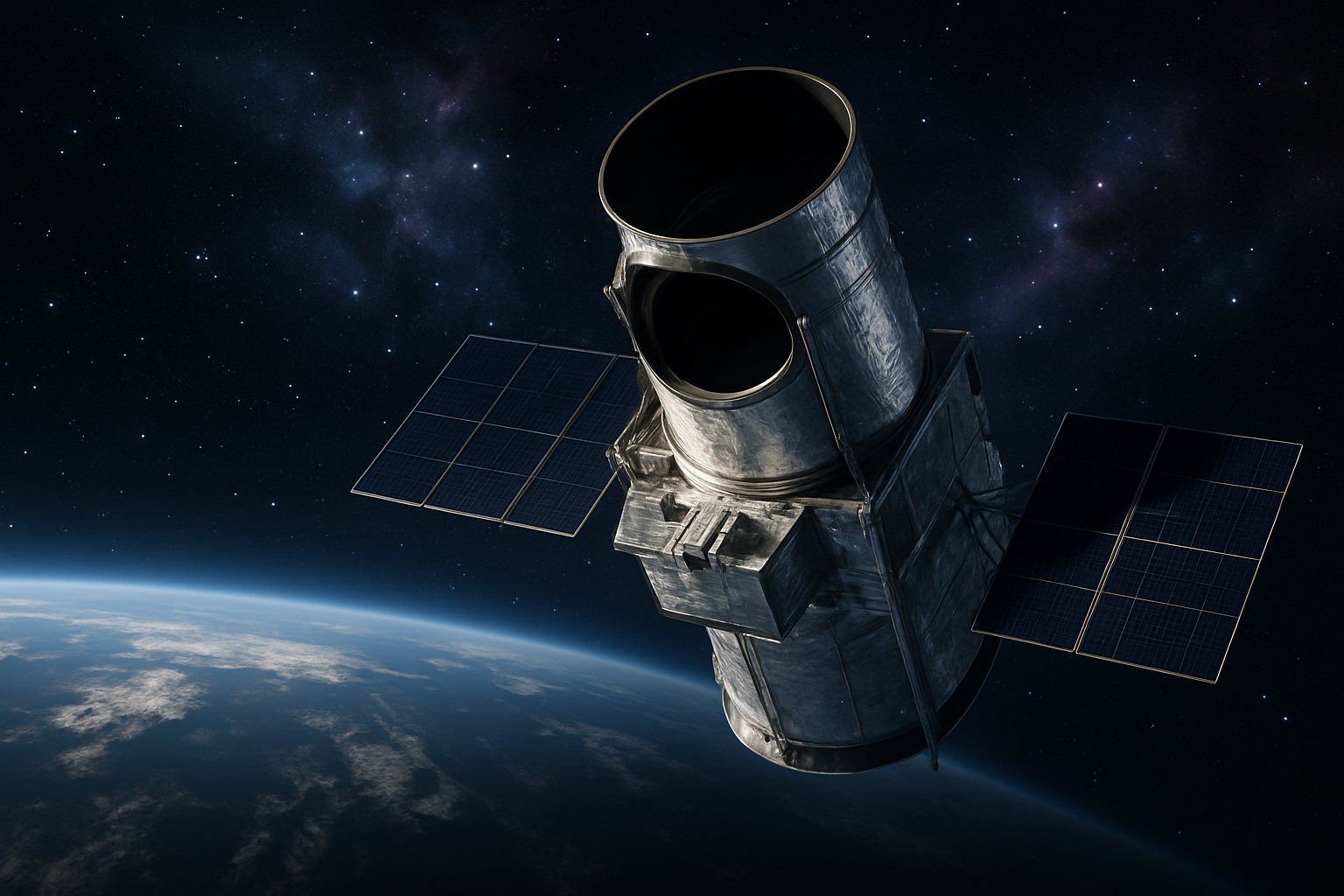
NASA has unveiled its most ambitious cosmic mapping project yet with the Nancy Grace Roman space telescope, a revolutionary observatory designed to create what officials call an "atlas of the universe" while addressing the mysteries of dark matter and dark energy.
The announcement comes as the space agency continues to grapple with unexpected challenges from human space exploration, including post-mission readjustment difficulties faced by astronauts returning from lunar missions.
Revolutionary Telescope Technology
Speaking at a news conference at the Goddard Space Flight Centre in Maryland, NASA Administrator Jared Isaacman declared, "Roman will give the Earth a new atlas of the universe." The 12-meter (39-feet) silvery contraption represents a quantum leap in astronomical observation capabilities, equipped with infrared vision systems that can observe light emitted by celestial bodies billions of years ago.
The Roman telescope is specifically designed to scan vast swathes of the universe, with particular focus on discovering planets outside our solar system and investigating the fundamental mysteries of dark matter and dark energy. Early projections suggest the observatory will discover tens of thousands of exoplanets, potentially offering unprecedented clarity about how many habitable worlds exist beyond our solar system.
"The Roman space telescope is expected to discover tens of thousands of planets, possibly offering clarity about how many could be out there," according to mission specifications released by NASA.
Unexpected Human Challenges in Space Exploration
While NASA celebrates technological advances, recent missions have highlighted unexpected human challenges that even the most sophisticated simulators cannot fully prepare astronauts for. Following the successful completion of the Artemis II mission, crew members faced a task that no ground-based training could perfectly replicate: relearning how to walk.
Even after relatively short missions, the human body resists returning to gravity it once took for granted. Video documentation from astronaut Christina Koch demonstrates how fragile the balance is between space adaptation and Earth readjustment, and how long the recovery process actually takes.
This revelation adds complexity to future long-duration missions, including planned lunar settlements and Mars expeditions where astronauts may spend months or years in reduced gravity environments before attempting to return to Earth.
Building on Historic Space Exploration Renaissance
The Roman telescope announcement comes during what experts are calling a "space economy golden age," building on the momentum of recent historic achievements including the successful completion of NASA's Artemis II mission in April 2026, which ended a 54-year gap in human deep space exploration.
The telescope project represents the convergence of multiple breakthrough technologies developed over decades of space exploration. Advanced infrared detection systems, sophisticated data processing algorithms, and unprecedented international cooperation have made this cosmic mapping project possible.
Technical Specifications and Capabilities
The Roman telescope's infrared vision capabilities represent a significant advancement over previous space-based observatories. Its ability to peer through cosmic dust and observe ancient light sources positions it as a critical tool for understanding the universe's structure and evolution.
The observatory's primary mission includes:
- Systematic scanning of galactic regions for exoplanet detection
- Dark matter and dark energy investigation through gravitational lensing
- Comprehensive stellar formation and evolution studies
- Detailed cosmic structure mapping across billions of light-years
Space Medicine Advances and Challenges
The readjustment challenges faced by returning astronauts highlight the critical importance of space medicine research currently being conducted aboard the International Space Station. Recent eight-month missions have provided invaluable data on lung tissue cultivation in microgravity and Space-Associated Neuro-Ocular Syndrome (SANS) research essential for extended missions beyond Earth evacuation possibilities.
European research has revealed that reproduction challenges in microgravity environments require artificial gravity solutions through rotating habitats for permanent settlements, adding another layer of complexity to humanity's spacefaring ambitions.
International Cooperation Framework
The Roman telescope project exemplifies the international cooperation that has characterized recent space exploration achievements. Following the successful validation of the Artemis Accords peaceful lunar exploration framework through international crew participation, space science continues to benefit from collaborative approaches that pool global expertise and resources.
This cooperation model has proven essential as space exploration transitions from brief experimental missions to sustained infrastructure development supporting humanity's expansion into the cosmos.
Economic and Strategic Implications
The unveiling of the Roman telescope occurs during a period of unprecedented space industry growth, with the global space economy projected to exceed $1 trillion by 2030. NASA's historic $20 billion commitment toward establishing a permanent lunar surface base by 2030 represents the largest space infrastructure investment in agency history.
The telescope's discoveries could influence future mission planning by identifying potentially habitable worlds and advancing our understanding of cosmic phenomena critical for deep space navigation and settlement planning.
Future Implications for Space Exploration
The Roman telescope's comprehensive cosmic mapping capabilities will provide essential data for humanity's continued expansion beyond Earth. As space agencies worldwide prepare for sustained lunar presence and eventual Mars exploration, understanding the broader cosmic environment becomes increasingly critical.
The convergence of advanced astronomical observation capabilities with growing understanding of human adaptation challenges positions 2026 as a watershed moment in space exploration. The Roman telescope will provide the cosmic roadmap while concurrent research addresses the physiological and psychological challenges of becoming a truly spacefaring civilization.
Success in both technological advancement and human adaptation research will determine humanity's trajectory toward establishing permanent extraterrestrial settlements and achieving the long-sought goal of becoming a multi-planetary species through sustained cosmic expansion capabilities.